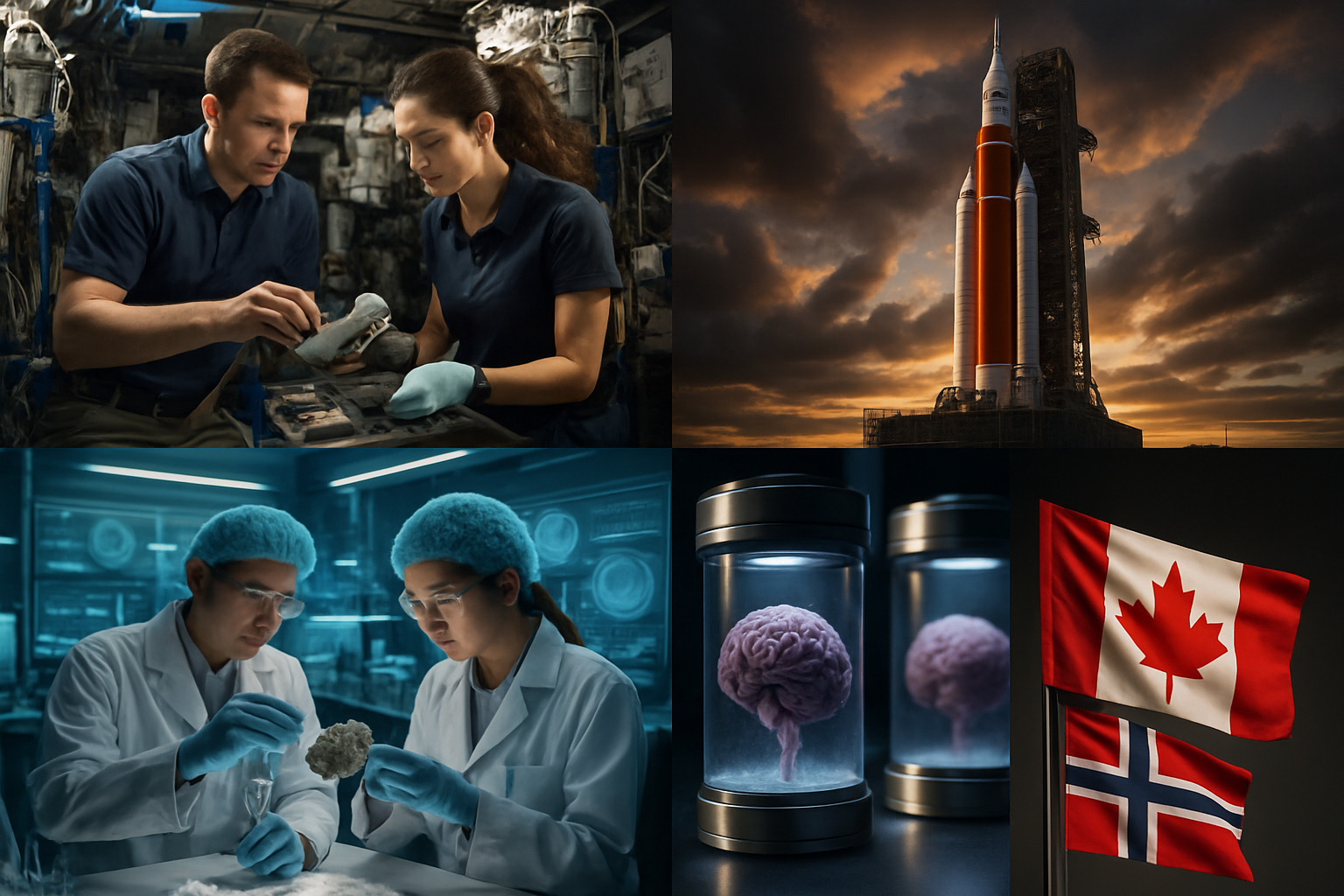
March 2026 has emerged as a watershed moment in space exploration, marked by unprecedented international cooperation, groundbreaking scientific discoveries, and revolutionary technological advances that are reshaping humanity's relationship with the cosmos.
From the launch platforms of NASA's Kennedy Space Center to the laboratories of Europe's most advanced research institutions, scientists and engineers are achieving breakthroughs that were once confined to the realm of science fiction. The convergence of artificial intelligence, space medicine, stellar astronomy, and international partnerships is creating what experts describe as a "golden age of space exploration."
NASA's Artemis II: Humanity's Return to Deep Space
At the forefront of these developments stands NASA's ambitious Artemis II mission, which has overcome significant technical challenges to target an April 1, 2026 launch date. The mission will carry four astronauts—Canadian Jeremy Hansen, NASA's Reid Wiseman, Christina Koch, and Victor Glover—on humanity's first crewed journey beyond Earth orbit since Apollo 17 in December 1972.
The delays that pushed the mission from its original March timeline have actually strengthened confidence in the program's safety protocols. Engineers successfully resolved critical helium system failures affecting the Space Launch System (SLS) rocket's upper stage, along with persistent hydrogen leak issues that plagued wet dress rehearsal testing.
"We will only launch when we believe we are ready," emphasized NASA Administrator Jared Isaacman, reflecting the agency's commitment to safety-first protocols learned from historical tragedies.
— Jared Isaacman, NASA Administrator
The SLS rocket, standing 322 feet tall and weighing 5.75 million pounds when fully fueled with over 700,000 gallons of liquid hydrogen and oxygen, represents the most powerful launch vehicle NASA has ever constructed. The 10-day lunar flyby covering 600,000 miles will serve as a crucial stepping stone toward the Artemis III lunar landing planned for 2028.
Stellar Origins: Tracing the Sun's Cosmic Journey
While NASA prepares for its lunar return, European researchers have made remarkable discoveries about our solar system's origins. Austrian scientists have identified thousands of "sister stars" that formed alongside our Sun near the center of the Milky Way galaxy before migrating billions of years ago to their current positions throughout the galaxy.
This groundbreaking research provides unprecedented insights into the Sun's birthplace and early cosmic environment. The discovery helps explain how stellar formations evolve over billions of years and offers clues about the conditions that led to the development of our solar system.
The implications extend far beyond academic curiosity. Understanding stellar formation patterns and migration helps astronomers identify potentially habitable worlds around other stars and provides crucial data for the search for extraterrestrial life.
Cryogenic Breakthroughs: Science Fiction Becomes Reality
Perhaps the most startling advancement comes from research institutions across Bosnia and Herzegovina, where scientists have achieved what many considered impossible: successfully reviving brain tissue after cryogenic preservation, commonly known as "frozen sleep."
This breakthrough research has successfully demonstrated that complex neural tissue can survive extreme cold preservation and maintain biological function upon thawing. The implications for long-duration space missions are profound, potentially addressing one of the greatest challenges facing interplanetary exploration—keeping astronauts healthy during multi-year journeys to Mars and beyond.
The research builds on decades of cryobiology studies and represents a convergence of advanced preservation techniques, molecular biology, and space medicine. While full human hibernation remains a distant goal, the ability to preserve and revive complex tissues opens new possibilities for medical treatment both on Earth and in space.
"Scientific fiction is becoming scientific possibility. What we've achieved in the laboratory brings us significantly closer to solving the challenges of long-duration space exploration."
— Lead Researcher, Bosnia and Herzegovina Cryogenics Institute
International Cooperation: A New Space Partnership Model
The Norwegian government's recent agreement with Canada represents another significant development in international space cooperation. The partnership focuses on joint space missions, technology sharing, and coordinated research programs that will benefit both nations' space capabilities.
This agreement exemplifies the evolving nature of space exploration, where bilateral partnerships are complementing traditional multilateral frameworks. The Canada-Norway space cooperation agreement includes provisions for shared satellite programs, joint astronaut training, and collaborative research on Arctic monitoring from space.
The timing is particularly significant as both nations prepare for expanded roles in lunar exploration through the Artemis Accords. Canada's contribution of astronaut Jeremy Hansen to the Artemis II mission demonstrates how international partnerships are becoming essential components of major space exploration initiatives.
Space Medicine: Preparing for Deep Space Missions
Concurrent with these exploration advances, the International Space Station continues serving as a crucial testing ground for space medicine research. French astronaut Sophie Adenot's record-setting eight-month mission is providing invaluable data on long-duration spaceflight effects on human biology.
Her research focuses on lung tissue cultivation in microgravity and Space-Associated Neuro-Ocular Syndrome (SANS), a condition affecting astronaut vision during extended missions. These studies are directly informing medical protocols for future lunar bases and Mars expeditions, where astronauts may spend years away from Earth without possibility of medical evacuation.
The convergence of cryogenic research, space medicine studies, and international cooperation is creating a comprehensive framework for sustainable human presence beyond Earth orbit. Each breakthrough builds upon others, creating synergistic advances that accelerate the overall pace of space exploration development.
Economic and Strategic Implications
These developments occur during what industry experts call the transition from the "AI revolution" to the "space economy golden age." SpaceX's preparation for a potential June 2026 IPO with valuations exceeding $1 trillion reflects the maturation of commercial space activities from experimental ventures to essential infrastructure.
The economic implications extend beyond individual companies or nations. Space-based research is driving innovations in materials science, medical technology, artificial intelligence, and international cooperation frameworks that have applications across multiple industries.
Countries investing in space capabilities are positioning themselves for leadership roles in an emerging space economy projected to exceed $1 trillion by 2030. The convergence of government programs, commercial enterprises, and international partnerships is creating unprecedented opportunities for technological advancement and economic growth.
Looking Forward: The Next Phase of Human Space Exploration
The breakthroughs achieved in March 2026 represent more than individual scientific or technological advances—they signal humanity's maturation as a spacefaring species. The successful integration of international cooperation, advanced technology, medical research, and safety-first approaches provides a robust foundation for sustained space exploration.
As NASA prepares for the Artemis II launch, researchers continue advancing cryogenic preservation techniques, and international partnerships expand, the stage is set for an unprecedented era of cosmic discovery. The convergence of these developments suggests that the 2020s may be remembered as the decade when humanity truly began its expansion beyond Earth.
The challenges ahead remain significant—technical hurdles, funding requirements, international coordination complexities, and the inherent dangers of space exploration. However, the remarkable progress achieved in just the first quarter of 2026 demonstrates that with sustained commitment, international cooperation, and technological innovation, humanity's cosmic future appears brighter than ever before.
These achievements represent the collective effort of thousands of scientists, engineers, astronauts, and support personnel across multiple continents. Their dedication to pushing the boundaries of human knowledge and capability is opening pathways to a future where space exploration becomes as routine and essential as aviation is today.