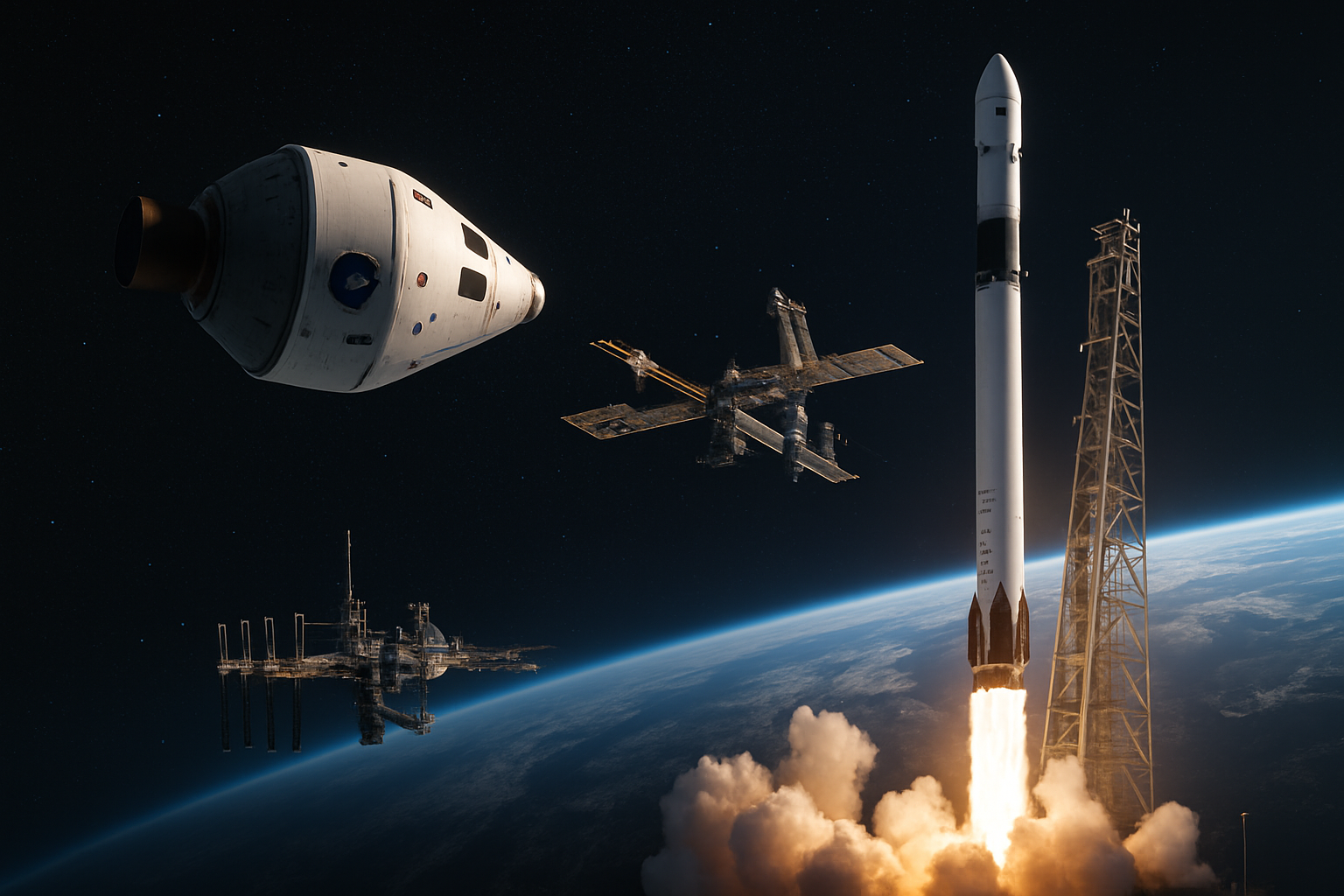
A confluence of historic achievements and significant challenges is reshaping the global space exploration landscape in April 2026, as NASA's Artemis II mission successfully reaches lunar trajectory while facing unprecedented budget pressures and SpaceX encounters new delays with its Starship program.
Artemis II Achieves Historic Lunar Trajectory Success
NASA's Artemis II mission has successfully completed its critical translunar injection burn, marking humanity's first return to deep space exploration since Apollo 17 in December 1972. The four-astronaut international crew—Canadian Jeremy Hansen (the first Canadian beyond Earth orbit), NASA Commander Reid Wiseman, Christina Koch, and Victor Glover—are now heading toward the Moon on their historic 10-day, 685,000-mile lunar flyby mission.
The mission launched on April 1, 2026, at 6:24 PM EDT from Kennedy Space Center after engineers successfully resolved persistent technical challenges including helium system failures and hydrogen leak problems that had caused multiple delays throughout early 2026. NASA Flight Director Jeff Radigan described the 5-minute 49-second translunar injection burn as "perfect," with all crew members performing excellently.
"This represents humanity's renewed commitment to becoming a spacefaring civilization through advanced technology, international cooperation, and space medicine knowledge accumulated over decades of ISS operations."
— NASA Administrator Jared Isaacman
The crew demonstrated remarkable technical proficiency during their first orbital day, successfully resolving multiple in-flight challenges including communication system failures, thermal sensor malfunctions, and spacecraft toilet system repairs—all without affecting the mission timeline. These achievements represent significant advancement over Apollo-era missions and validate improved crew training effectiveness.
SpaceX Starship Faces Monthlong Delay
In a contrasting development, SpaceX has announced a one-month delay to its next Starship test launch, according to CEO Elon Musk. This postponement represents another setback for the ambitious vehicle that NASA has selected as the lunar lander for the Artemis III mission planned for 2028.
The delay comes as SpaceX's Starship program has already accumulated more than two years of development challenges since its selection as the Artemis lunar lander in 2021. The primary technical hurdles involve complex orbital fuel transfer operations requiring multiple Starship tanker vehicles—a process unprecedented at the required scale for lunar missions.
Despite these challenges, SpaceX maintains its proven track record with regular ISS crew rotations and cargo deliveries. The company is also preparing for a potential trillion-dollar IPO in June 2026, reflecting the commercial space sector's maturation during what experts call the "space economy golden age."
White House Proposes $5.6 Billion NASA Budget Cut
Perhaps the most concerning development for America's space ambitions is the White House's proposal to cut NASA's budget by $5.6 billion for fiscal year 2027. This dramatic reduction would represent one of the largest single-year decreases in the agency's modern history and could significantly impact ongoing programs including the Artemis lunar initiative.
The proposed cuts come at a critical juncture as NASA has committed to a historic $20 billion investment toward establishing a permanent lunar surface base by 2030—the largest space infrastructure investment in the agency's history. The timing appears particularly challenging given the success of Artemis II and the momentum building toward sustained lunar exploration.
The budget reduction proposal occurs amid intensifying international competition in space, with China planning crewed lunar missions by 2030 and multiple nations developing independent space capabilities. This financial pressure could potentially affect America's ability to maintain its leadership position in the emerging trillion-dollar space economy.
International Space Cooperation and Competition Intensifies
The current developments unfold against a backdrop of both unprecedented international cooperation and growing competition. Jeremy Hansen's participation in Artemis II validates the Artemis Accords framework for peaceful lunar exploration, representing the most significant Canadian human spaceflight contribution since the Space Shuttle era.
Argentina has contributed the Atenea radiation study device aboard the Artemis II mission, studying deep space radiation effects crucial for future missions. This scientific collaboration demonstrates how space exploration continues to unite nations in pursuit of common goals while individual countries advance their strategic interests.
Meanwhile, China's space program continues its steady advancement with plans for lunar crews by 2030, Pakistan has selected astronaut candidates for China's Tiangong station missions, and European nations are investing heavily in independent space capabilities. Sweden's Isar Aerospace facilities are testing 30 engines monthly, while Germany has committed €10 billion to satellite programs.
Space Medicine and Technology Advances
The Artemis II mission is providing invaluable data for future deep space exploration. The crew is building on research conducted during French astronaut Sophie Adenot's record eight-month ISS mission, which focused on lung tissue cultivation and Space-Associated Neuro-Ocular Syndrome (SANS) research—critical studies for understanding human adaptation to extended space missions.
European research has revealed significant challenges for permanent space settlements, including findings that microgravity disrupts human sperm navigation, making reproduction difficult in space environments. These discoveries underscore the need for artificial gravity solutions through rotating habitats for sustainable lunar settlements and Mars expeditions.
NASA has also announced the Space Reactor 1 Freedom nuclear spacecraft program for Mars exploration, providing the energy density necessary for interplanetary missions where solar power proves insufficient. This nuclear propulsion technology enables faster transit times, continuous power generation, and reduced radiation exposure for deep space operations.
Economic and Strategic Implications
The space economy is projected to exceed $1 trillion by 2030, positioning space exploration as critical infrastructure rather than experimental endeavor. SpaceX's potential trillion-dollar IPO and the establishment of space-based data centers to address the global memory crisis demonstrate how space capabilities are becoming integral to terrestrial systems.
The success of Artemis II validates systems essential for permanent lunar settlements and Mars exploration foundations. However, the proposed NASA budget cuts could undermine America's ability to capitalize on these achievements and maintain leadership in the emerging space economy.
"The 54-year gap since Apollo 17 represents the longest period without human deep space exploration. This mission determines the trajectory of human space exploration for generations to come."
— Space Industry Analyst
Multi-billion dollar space infrastructure investments are positioning nations for leadership in resource access, scientific discovery, and technological development that will define spacefaring capabilities. The convergence of government programs with commercial enterprises is creating integrated Earth-space technological systems that could fundamentally alter human civilization's relationship with the cosmos.
Looking Ahead: The Space Economy Golden Age
April 2026 represents a watershed moment in space exploration history. The successful Artemis II mission ending the 54-year gap in human deep space exploration, combined with growing commercial capabilities and international partnerships, suggests humanity is transitioning toward becoming a truly spacefaring species.
However, significant challenges remain. SpaceX's Starship delays could affect the timeline for returning astronauts to the lunar surface, while proposed NASA budget cuts threaten America's space leadership ambitions. The balance between international cooperation and strategic competition will likely determine which nations lead humanity's expansion into the solar system.
The crew of Artemis II will travel 4,000 miles beyond the Moon's far side—farther from Earth than any humans since the Apollo era. Their mission serves as more than a technological demonstration; it represents humanity's renewed commitment to cosmic exploration and the establishment of permanent human presence beyond Earth.
As the space economy enters its projected golden age, the decisions made in 2026 regarding funding, international cooperation, and technological development will likely determine whether humanity successfully establishes sustainable settlements on the Moon and eventually Mars, or whether budget constraints and technical challenges delay these cosmic ambitions for another generation.