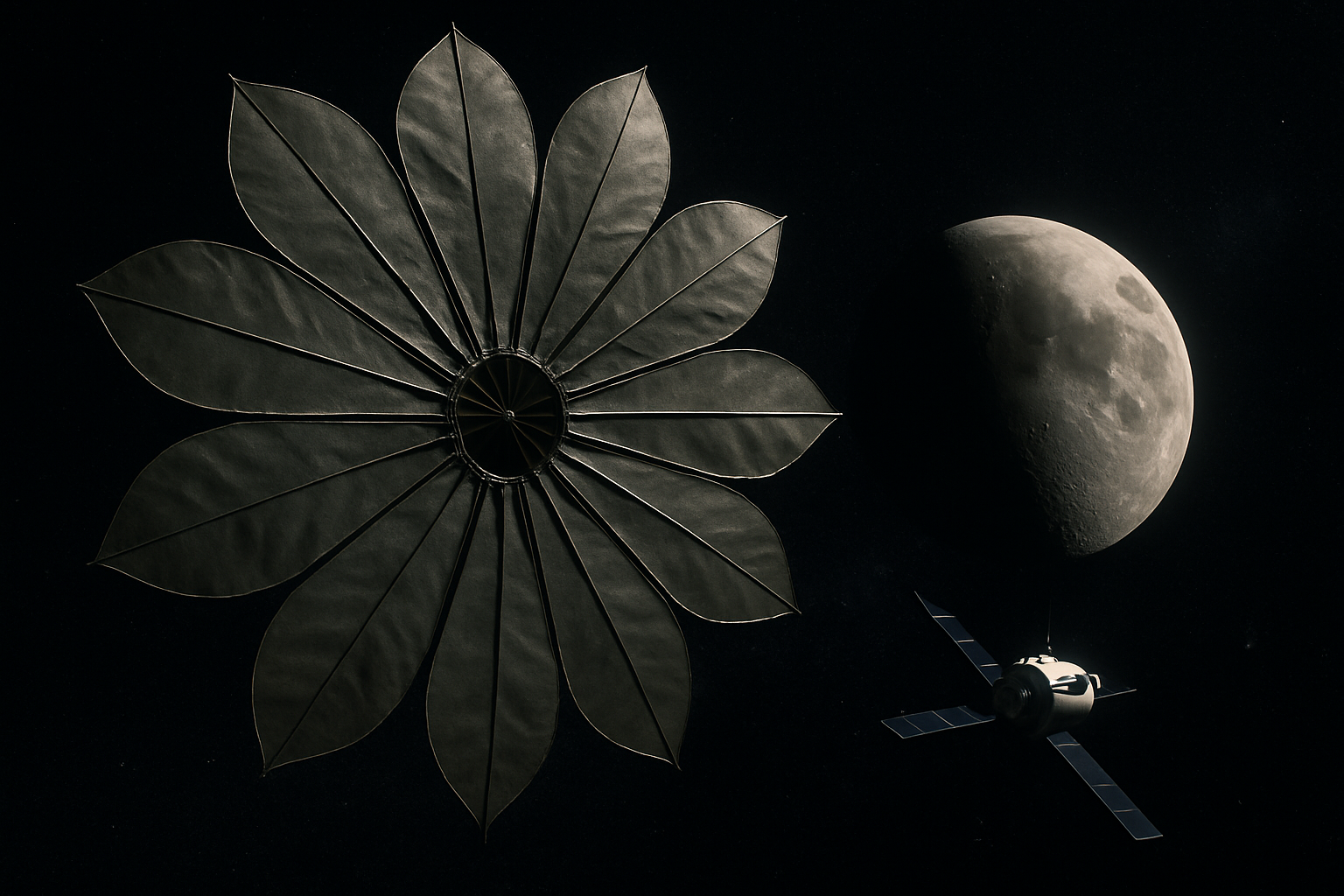
An international team of scientists has unveiled plans for a massive 99-meter flower-shaped structure designed to hunt for Earth-like planets in distant solar systems, as NASA's Artemis II mission faces another series of technical delays that could push humanity's return to lunar orbit beyond March 2026.
The innovative proposal, dubbed a "giant flower in space," represents a revolutionary approach to exoplanet detection that could dramatically enhance our ability to identify potentially habitable worlds. The structure would function as an enormous sunshade, precisely blocking light from distant stars to allow telescopes to analyze the atmospheres of orbiting planets with unprecedented clarity.
Revolutionary Starshade Technology
The flower-shaped starshade addresses one of astronomy's greatest challenges: detecting Earth-like exoplanets that are typically billions of times fainter than their host stars. By deploying the 99-meter structure in space, scientists would essentially create an artificial eclipse, allowing space telescopes to peer directly at previously invisible worlds.
"This technology represents a quantum leap in our ability to search for a second Earth," explains the international research team behind the proposal. The starshade's distinctive petal design isn't merely aesthetic – its precise geometric shape is critical for creating the sharp-edged shadow necessary to block starlight while preserving the faint signals from orbiting planets.
The ambitious project builds on recent astronomical breakthroughs that have revolutionized our understanding of planetary systems. In February 2026, astronomers discovered "impossible" planetary systems 116 light-years away that challenged existing formation theories, while the James Webb Space Telescope continues revealing complex organic molecules in interstellar space.
Artemis Program Faces Fresh Setbacks
Meanwhile, NASA's flagship Artemis II mission has encountered new technical challenges that threaten to delay humanity's first crewed lunar flyby since Apollo 17 in 1972. The mission, carrying four astronauts including Canadian Jeremy Hansen on a 10-day journey around the Moon, faces persistent hydrogen leak issues and critical helium system failures affecting the Space Launch System (SLS) rocket.
"We will only launch when we believe we are ready," emphasized NASA Administrator Jared Isaacman, reflecting the agency's safety-first approach following institutional lessons learned from historical tragedies.
— Jared Isaacman, NASA Administrator
The 322-foot SLS rocket, weighing 5.75 million pounds when fully fueled with over 700,000 gallons of liquid hydrogen and oxygen, represents the most powerful rocket NASA has ever built. However, technical problems consistently emerge at T-minus 5 minutes during countdown simulations, forcing mission planners to extend timelines indefinitely.
Space Economy Golden Age Transformation
These developments unfold during what experts term the transition from the "AI revolution" to the "space economy golden age." SpaceX is preparing for a potentially trillion-dollar IPO in June 2026, while simultaneously shifting strategic focus from Mars colonization to lunar city development within 10 years.
The convergence of innovative starshade technology and lunar exploration delays reflects the dual nature of modern space exploration – breakthrough scientific concepts advancing rapidly while complex engineering challenges continue testing human spaceflight capabilities.
International cooperation remains strong despite competitive dynamics. Pakistan has selected astronaut candidates for China's Tiangong station mission in October-November 2026, while European nations expand rocket manufacturing capabilities through facilities like Germany's Isar Aerospace Swedish operations testing 30 engines monthly.
Scientific Research Continues Aboard ISS
Critical space medicine research proceeds aboard the International Space Station, where French astronaut Sophie Adenot conducts an eight-month mission – a record for European astronauts – focusing on lung tissue cultivation and Space-Associated Neuro-Ocular Syndrome (SANS) studies essential for future lunar settlements and Mars exploration.
This research directly addresses medical challenges astronauts face during extended missions, particularly vision problems that could affect deep space exploration. The data will prove crucial for implementing the starshade project, which would require precise astronomical observations over extended periods.
Technological Integration and Future Prospects
The space flower concept leverages artificial intelligence breakthroughs demonstrated by NASA's fully AI-planned Mars rover missions in December 2025, which proved autonomous navigation capabilities essential for complex space operations. Similarly advanced AI systems would coordinate the starshade's positioning and telescope observations across vast cosmic distances.
The project represents a methodical approach to space exploration that parallels NASA's careful Artemis program development. While government agencies prioritize crew safety and systematic testing, commercial entities and international scientific collaborations push forward with innovative concepts that could revolutionize our understanding of cosmic environments.
Implications for Planetary Defense and Discovery
The starshade initiative gains urgency from recent NASA warnings about Earth's vulnerability to approximately 15,000 undetected "city-killer" asteroids. Enhanced detection capabilities developed for exoplanet hunting could simultaneously improve our ability to identify and track potentially hazardous near-Earth objects.
Dr. Kelly Fast, NASA's Planetary Defense Coordination Officer, has emphasized that current detection systems track only a fraction of potentially dangerous asteroids. The same advanced optical systems designed for the starshade could contribute to comprehensive asteroid cataloging efforts.
Global Context and Competition
The ambitious starshade proposal emerges amid intensifying international space competition. China's Shenlong reusable spacecraft program continues advancing, while emerging nations gain unprecedented access to space capabilities through international partnerships and democratized technology.
Thailand now chairs UN space governance initiatives, reflecting how space policy influence spreads beyond traditional space powers. The global memory crisis, with semiconductor prices increasing sixfold, drives interest in space-based data centers and orbital infrastructure development.
Success of the flower-shaped starshade project would position the international scientific community at the forefront of exoplanet research, potentially identifying Earth-like worlds within our cosmic neighborhood and answering fundamental questions about life's prevalence in the universe.
As NASA works through Artemis technical challenges with methodical precision, breakthrough scientific concepts like the space flower demonstrate that human space exploration continues advancing through diverse approaches – from careful human spaceflight development to innovative robotic exploration technologies that could reshape our understanding of cosmic possibilities.