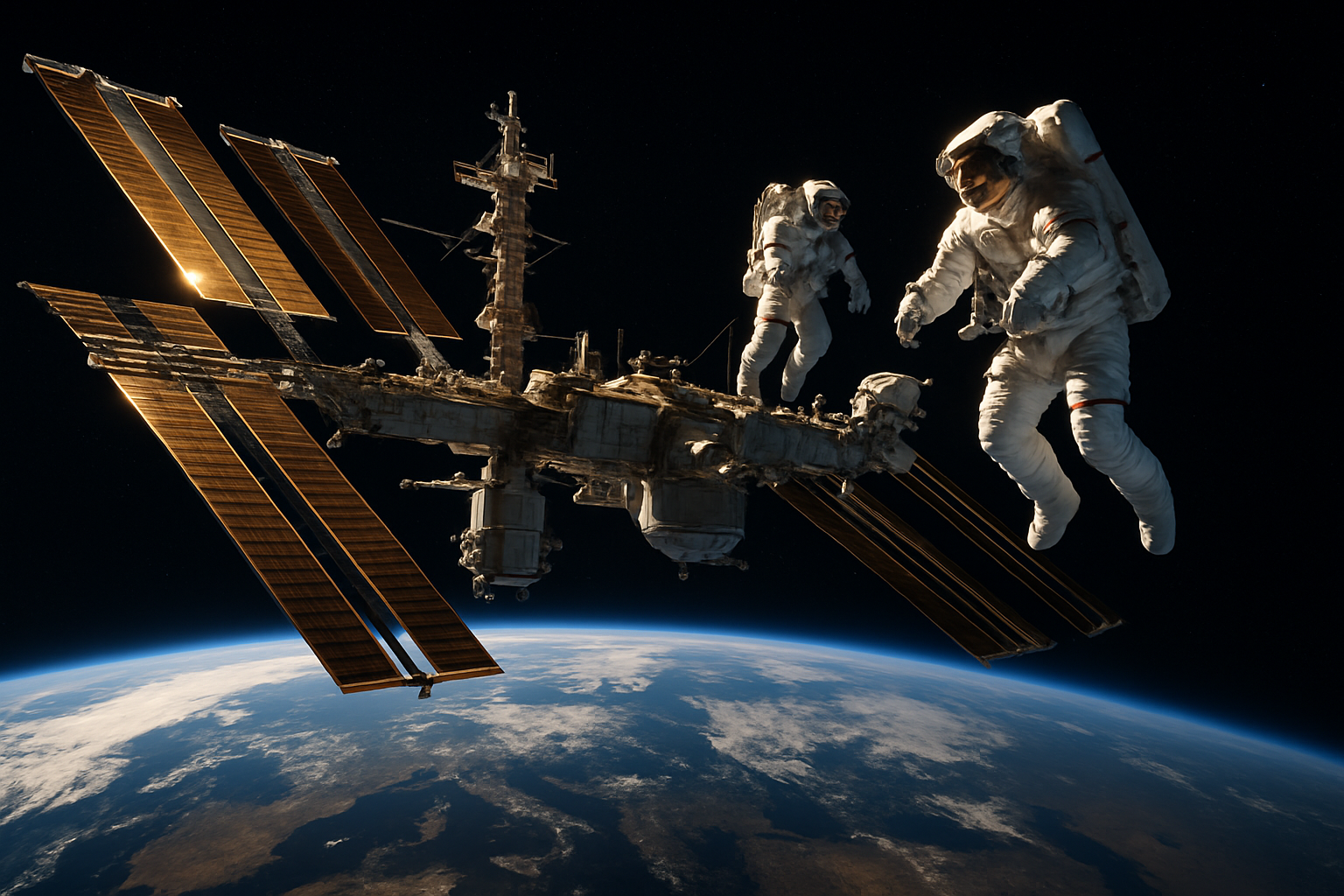
The International Space Station faces its final descent in 2030 as Russian space officials confirm deorbiting plans, while remarkable findings from a decades-old NASA jellyfish experiment continue reshaping our understanding of life in space.
Dmitry Bakanov, head of Roscosmos, officially confirmed the ISS deorbiting schedule during recent statements to international media. "In 2028, we will begin the gradual deorbiting of the station," Bakanov announced, solidifying plans for the controlled descent of humanity's most ambitious space laboratory into Earth's oceans by 2030.
Historic Jellyfish Experiment Reveals Profound Space Biology Insights
Meanwhile, a fascinating chapter from space exploration history continues providing valuable scientific data. In 1990, NASA conducted an extraordinary biological experiment by sending approximately 2,500 juvenile jellyfish to space aboard a space mission. The results proved far more dramatic than scientists anticipated.
The jellyfish returned to Earth having multiplied to an astounding 60,000 individuals during their time in microgravity. However, the space-born jellyfish faced severe adaptation challenges upon returning to Earth's gravitational environment. Scientists documented significant anomalies in their cardiac rhythms and severe vertigo symptoms that persisted long after their return.
This groundbreaking experiment aimed to understand how microgravity might affect humans born in space - a critical question as humanity prepares for permanent settlements on the Moon and Mars. The jellyfish, chosen for their simple nervous systems and gravity-sensing organs similar to those found in humans, provided unprecedented insights into biological adaptation to space environments.
ISS Legacy and Future Space Exploration
The International Space Station has served as humanity's primary orbital laboratory for over two decades, hosting continuous human presence since November 2000. The station has facilitated groundbreaking research in microgravity science, materials research, and biological studies that continue informing preparation for deep space missions.
Recent ISS operations have maintained the station's seven-person operational capacity through international cooperation between NASA, ESA, and Roscosmos. The Crew-12 mission successfully restored full complement following the first medical evacuation in ISS history, demonstrating the robustness of emergency protocols developed for space operations.
Current research aboard the ISS includes critical studies on Space-Associated Neuro-Ocular Syndrome (SANS), which affects astronaut vision during extended missions, and lung tissue cultivation research essential for understanding human biological changes in microgravity. These investigations directly support NASA's Artemis program goals and future Mars exploration missions.
Space Medicine Challenges for Future Missions
The jellyfish experiment's findings remain highly relevant as space agencies prepare for extended lunar missions and eventual Mars colonization. The cardiac abnormalities and vestibular system disruptions observed in space-born jellyfish highlight potential challenges humans might face during long-duration space missions or permanent space settlements.
Portuguese scientists have made significant breakthroughs in SANS research, addressing vision problems that affect astronauts during extended missions. These studies build upon decades of space medicine research, including the landmark jellyfish experiments that first demonstrated how fundamental biological processes adapt to microgravity environments.
Space medicine research has become increasingly critical as mission durations extend beyond Earth orbit. The ISS serves as an essential platform for understanding human physiological changes during long-term space exposure, informing medical protocols for future lunar bases and Mars missions where Earth evacuation would be impossible.
International Cooperation Amid Growing Competition
The planned ISS deorbiting occurs during a period of intensifying international space competition. While cooperation continues through ISS operations, emerging space powers are developing independent capabilities. Pakistan has selected astronaut candidates for China's Tiangong space station mission scheduled for October-November 2026, demonstrating the democratization of space access.
China's space program continues advancing with the Shenlong reusable spacecraft program, while European nations pursue launch independence through expanded manufacturing capabilities. Germany's investment in Swedish rocket facilities and Thailand's leadership role in UN space governance reflect the growing global participation in space activities.
Despite competitive dynamics, the ISS represents the pinnacle of international space cooperation, with crew members from multiple nations working together on shared scientific objectives. This collaborative model provides valuable experience for future deep space missions requiring sustained international coordination.
Legacy of Space Biology Research
The 1990 jellyfish experiment established important precedents for space biology research that continue informing current investigations. Understanding how living organisms adapt to microgravity environments remains crucial for developing life support systems, medical protocols, and habitat designs for permanent space settlements.
Modern space research builds upon these foundational experiments, utilizing advanced technologies and AI-assisted analysis unavailable in the 1990s. Current ISS research programs examine cellular behavior, tissue development, and physiological changes with unprecedented precision, providing comprehensive data for future human space exploration.
The jellyfish findings also contributed to understanding Earth-based medical conditions. Research into balance disorders, cardiac arrhythmias, and vestibular system dysfunction has benefited from insights gained through space biology experiments, demonstrating how space research advances terrestrial medicine.
Preparing for the Post-ISS Era
As the ISS approaches its planned 2030 deorbiting, space agencies are developing next-generation orbital laboratories. Commercial space stations, lunar gateways, and specialized research platforms will continue the scientific work begun aboard the ISS, building upon decades of accumulated knowledge and operational experience.
The transition period will be critical for maintaining continuous human presence in space while establishing new research capabilities. Plans for lunar-based laboratories and Mars-bound missions will rely heavily on lessons learned from ISS operations and the countless experiments conducted in its laboratories.
The jellyfish experiment's enduring relevance demonstrates how fundamental space biology research continues providing valuable insights across decades. As humanity prepares for expansion beyond Earth orbit, understanding biological adaptation to space environments remains essential for ensuring the health and survival of future space explorers.
The convergence of ISS deorbiting plans with renewed focus on space biology research marks a pivotal moment in human space exploration. While the station prepares for its controlled ocean descent, the scientific knowledge gained during its operational lifetime - including insights from pioneering experiments like the jellyfish study - will guide humanity's next steps toward becoming a truly spacefaring civilization.