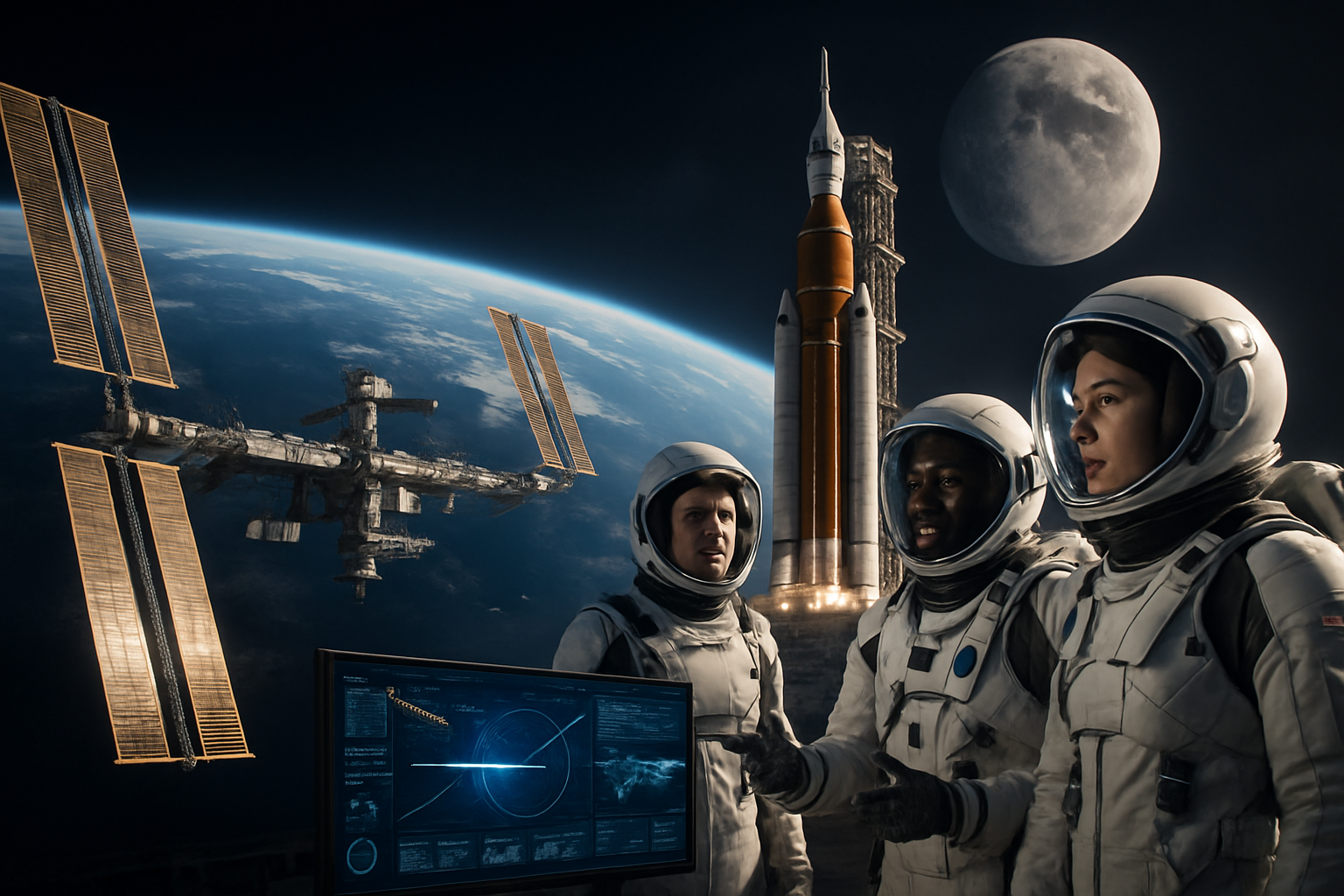
March 2026 represents a defining moment in humanity's relationship with space exploration and advanced technology, as international cooperation in lunar missions intersects with cutting-edge defense innovations and deep-sea exploration breakthroughs.
Canadian Astronaut Inspires Next Generation
At Ingersoll District Collegiate Institute in Ontario, a remarkable story of inspiration continues to unfold. Canadian astronaut Jeremy Hansen's parents, Nancy and Gary Hansen, recently visited their son's former high school to witness firsthand how his upcoming Artemis II moon mission has galvanized an entire generation of students.
The visit highlighted the profound impact of Hansen's selection as the first Canadian astronaut to venture beyond Earth orbit in over five decades. Students at the school have formed the Artemis II Explorers Club, transforming what began as a simple lunchtime Lego project into a comprehensive mission to follow Hansen's historic lunar journey.
"What started as students building with Lego blocks has evolved into a mission that connects young minds directly to space exploration,"
— School Administrator, Ingersoll District Collegiate Institute
Hansen's inclusion in the four-astronaut Artemis II crew alongside NASA's Reid Wiseman (commander), Christina Koch, and Victor Glover represents more than individual achievement—it symbolizes Canada's renewed commitment to human spaceflight and international cooperation in deep space exploration.
Artemis Program Faces Technical Challenges
While inspiration continues to build around the Artemis II mission, NASA faces ongoing technical challenges that have repeatedly delayed the lunar flyby. The mission, originally scheduled for early 2026, has been pushed to April 1, 2026, following a series of critical system failures.
The Space Launch System (SLS) rocket has experienced persistent helium system failures affecting the upper stage, essential for engine purging and fuel tank pressurization. These issues emerged during wet dress rehearsal testing, joining previous hydrogen leak problems that have plagued the 322-foot, 5.75-million-pound rocket requiring over 700,000 gallons of liquid hydrogen and oxygen.
NASA Administrator Jared Isaacman has maintained the agency's safety-first approach, emphasizing, "We will only launch when we believe we are ready." This methodology reflects institutional learning from historical tragedies and demonstrates NASA's commitment to crew protection over schedule adherence.
Deep Sea Innovation Parallels Space Exploration
The convergence of exploration technologies extends beyond space into Earth's most challenging environments. Australian engineer Ron Allum, the mastermind behind James Cameron's Deepsea Challenger submersible, represents the intersection of extreme environment engineering that informs both deep-sea and space exploration.
Allum's submersible, which reached the deepest point in the world's oceans, demonstrates engineering principles directly applicable to space exploration: pressure vessel design, life support systems, and remote operation capabilities. These technological crossovers highlight how advances in one extreme environment often benefit exploration in another.
The engineering challenges of maintaining human life in the crushing depths of ocean trenches share remarkable similarities with the vacuum of space: both require hermetically sealed environments, sophisticated life support systems, and fail-safe engineering protocols.
Japan's Strategic Defense Innovation
Japan's consideration of mass drone deployment for coastal defense represents a significant evolution in military technology and strategic thinking. The proposed SHIELD defense system would integrate more than 10 types of drones, including units designed for attacking enemy ships, intelligence gathering, and protecting radar installations.
This development reflects the increasing role of unmanned systems in national defense, paralleling the automation trends visible in space exploration. Just as NASA has successfully implemented fully AI-planned Mars rover missions, military applications are embracing autonomous systems for complex operational scenarios.
The technological convergence between civilian space exploration and military applications continues to drive innovation in both sectors, with advances in autonomous navigation, satellite communications, and precision positioning benefiting multiple applications.
International Cooperation Amid Competition
The current space environment exemplifies the complex dynamics of international cooperation existing alongside strategic competition. While Hansen prepares for his lunar mission as part of the collaborative Artemis program, other nations are developing independent capabilities.
China continues advancing its space program with successful Shenlong spacecraft missions and plans for lunar crews by 2030. Pakistan has selected astronaut candidates for China's Tiangong space station, scheduled for missions in October-November 2026. Meanwhile, European nations are investing billions in independent launch capabilities and satellite systems.
This dual nature of cooperation and competition drives innovation while raising important questions about space governance, resource access, and the peaceful use of space technologies. Thailand's leadership of UN space governance initiatives reflects the growing importance of international frameworks for managing these relationships.
Technology Integration and Future Implications
The convergence of AI technology, autonomous systems, and human space exploration represents a fundamental shift in how humanity approaches extreme environments and exploration. NASA's successful implementation of AI-planned Mars rover missions demonstrates the potential for autonomous systems to operate across cosmic distances with minimal Earth-based control.
These technological advances have immediate applications in space medicine research, including studies of Space-Associated Neuro-Ocular Syndrome (SANS) affecting astronaut vision during extended missions. Such research, conducted on the International Space Station, directly informs protocols for future lunar settlements and Mars exploration.
The commercial space economy, projected to exceed $1 trillion by 2030, reflects the transformation from experimental space activities to essential infrastructure. SpaceX's planned IPO, potentially valuing the company over $1 trillion, exemplifies this transition from government-dominated space programs to commercial innovation.
Looking Toward the Future
March 2026 marks a pivotal moment where space exploration strategy has matured toward pragmatic objectives while maintaining ambitious long-term goals. The methodical approach to solving Artemis II's technical challenges, combined with international cooperation frameworks and commercial space expansion, establishes foundations for sustained human presence beyond Earth.
The integration of deep-sea exploration capabilities, defensive autonomous systems, and space exploration technologies demonstrates humanity's expanding capability to operate in extreme environments. These converging technologies position civilization for unprecedented achievements in space exploration, ocean research, and planetary defense.
As Jeremy Hansen's story continues to inspire students in Ontario, and as engineers worldwide solve complex challenges in submarines, spacecraft, and defense systems, March 2026 stands as a testament to human ingenuity and international cooperation in pushing the boundaries of what's possible.