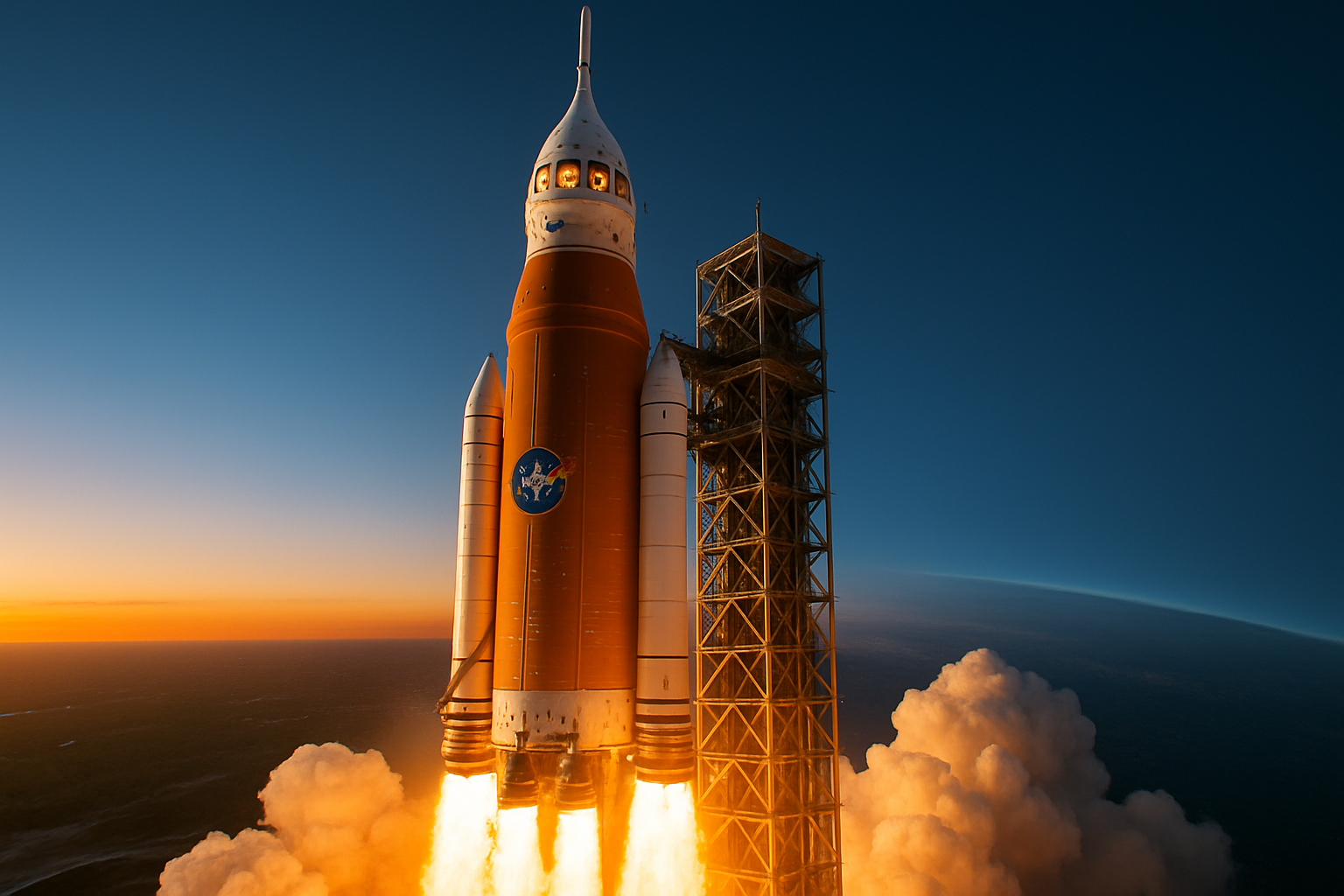
The year 2026 has emerged as a defining moment in human space exploration, with NASA's historic Artemis II mission successfully completing humanity's first journey beyond Earth orbit since Apollo 17 in 1972, while unprecedented international cooperation and technological breakthroughs establish the foundation for a permanent human presence among the stars.
Artemis II: Breaking the 54-Year Barrier
On April 8, 2026, NASA's Artemis II crew achieved a new human distance record, reaching 406,777.8 kilometers from Earth and breaking Apollo 13's 1970 record by 6,606.8 kilometers. The four-astronaut international crew—Canadian Jeremy Hansen (the first Canadian beyond Earth orbit), NASA Commander Reid Wiseman, Christina Koch, and Victor Glover—completed a historic 10-day, 685,000-mile lunar flyby that ended the longest gap in human deep space exploration.
The mission's technical success validated critical systems for future lunar settlements and Mars exploration. After resolving persistent helium system failures and hydrogen leak problems that caused multiple delays throughout early 2026, the most powerful NASA rocket ever built—the 322-foot SLS weighing 5.75 million pounds fully fueled—successfully demonstrated deep space transportation capabilities essential for sustained cosmic expansion.
"We are on our way to the Moon. Humanity has demonstrated once again what it is capable of."
— Jeremy Hansen, Artemis II Astronaut
International Cooperation Reaches New Heights
The mission exemplified unprecedented international cooperation in space exploration. Jeremy Hansen's participation validated the Artemis Accords framework for peaceful lunar exploration, representing the most significant Canadian human spaceflight contribution since the Space Shuttle era. Argentina's Atenea radiation device collected crucial deep space effects data, while Czech ADVACAM chips monitored astronaut safety throughout the journey.
This collaborative spirit extends beyond the Artemis program. Pakistan has selected astronaut candidates for China's Tiangong station missions planned for October-November 2026, while European nations are advancing space independence through Germany's €10 billion satellite investments and Sweden's Isar Aerospace facilities testing 30 engines monthly.
The Space Economy Golden Age
NASA's historic $20 billion commitment to establishing a permanent lunar surface base by 2030—the largest space infrastructure investment in agency history—signals the transition from experimental space ventures to critical infrastructure. The cancellation of the Lunar Gateway orbiting station project redirects funds toward surface operations, positioning America for leadership in what experts project will become a trillion-dollar space economy by 2030.
SpaceX's preparation for a trillion-dollar IPO in June 2026, along with strategic pivots from Mars to lunar colonization focusing on self-sustaining settlements within 10 years, demonstrates how commercial space capabilities are advancing alongside government programs to create integrated Earth-space technological systems.
Revolutionary Space Technologies
The introduction of NASA's Space Reactor 1 Freedom nuclear spacecraft program represents a paradigm shift for interplanetary exploration. This nuclear propulsion system enables faster transit times, continuous power generation, and reduced radiation exposure for missions where solar power proves insufficient, particularly for Mars exploration and asteroid mining operations.
Artificial Intelligence has revolutionized space operations, with NASA implementing fully AI-planned Mars rover missions that enable autonomous navigation and real-time decision-making, reducing dependence on Earth-based control. Chinese scientists achieved breakthroughs using AI to determine the Moon's far side chemical composition through Chang'e-6 samples, providing the first detailed mapping of permanently hidden lunar regions.
Space Medicine and Human Adaptation
Critical advances in space medicine have emerged from ongoing International Space Station research, including French astronaut Sophie Adenot's record eight-month mission focusing on lung tissue cultivation and Space-Associated Neuro-Ocular Syndrome (SANS) studies. This research directly informs medical protocols essential for lunar bases and Mars expeditions where astronauts may spend years without possibility of Earth evacuation.
European research has revealed reproduction challenges in microgravity environments, necessitating artificial gravity solutions through rotating habitats for permanent space settlements. These findings highlight the complex biological adaptations required for humanity's transition to a truly spacefaring species.
Addressing Space Sustainability
As space activity intensifies, sustainability challenges have emerged. Over 30,000 tracked orbital objects threaten cascade collision effects that could potentially trap humanity on Earth through chain reaction debris fields. Romanian research has documented atmospheric pollution from rocket debris, including tenfold lithium elevation, emphasizing the need for sustainable space development practices.
China's Hukeda-2 orbital servicing mission features innovative "octopus tentacle" robotic arms for satellite servicing and debris disposal, demonstrating technologies that extend satellite lifespans while preventing cascade effects that threaten long-term space access.
Lunar Resources and Scientific Discovery
Israeli-American scientists confirmed that ice has been accumulating at the Moon's poles for a minimum of 1.5 billion years, with "cold traps" in permanently shadowed craters gradually collecting water ice over geological epochs. This represents a stable, accessible resource for future lunar settlements, providing drinking water, oxygen, and hydrogen rocket fuel that transforms the Moon into a viable staging ground for Mars missions.
Greek researchers achieved breakthroughs in lunar agriculture, successfully cultivating chickpeas under simulated lunar surface conditions using regolith-like materials. This research addresses fundamental space exploration challenges of feeding astronauts during extended missions without complete Earth supply dependence.
Planetary Defense Achievements
NASA's Double Asteroid Redirection Test (DART) mission achieved unprecedented success, not only altering Dimorphos asteroid's orbit but fundamentally changing the entire binary asteroid system's trajectory around the Sun—humanity's first successful modification of a celestial body's solar trajectory. This demonstrates that kinetic impactor technology can produce cosmic-scale changes through relatively small spacecraft interventions.
With approximately 15,000 undetected "city-killer" asteroids over 140 meters in diameter remaining untracked, the DART mission's success provides confidence for expanded asteroid monitoring and deflection capabilities essential for planetary protection.
Looking to the Cosmic Future
The convergence of achievements in 2026—from the successful Artemis II mission to international cooperation breakthroughs and revolutionary space technologies—represents humanity's maturation as a spacefaring species. The Space Reactor 1 Freedom nuclear spacecraft scheduled for Mars launch in late 2028 will enable faster interplanetary transit and continuous power generation for missions where solar power proves insufficient.
These developments establish the foundation for permanent lunar settlements, regular interplanetary transport, space-based manufacturing using asteroid resources, and backup human settlements ensuring species survival through sustained expansion beyond Earth. The year 2026 will likely be remembered as the moment humanity truly began its transition from brief cosmic visits to sustained presence among the stars, marking the beginning of a new era in human civilization's cosmic journey.