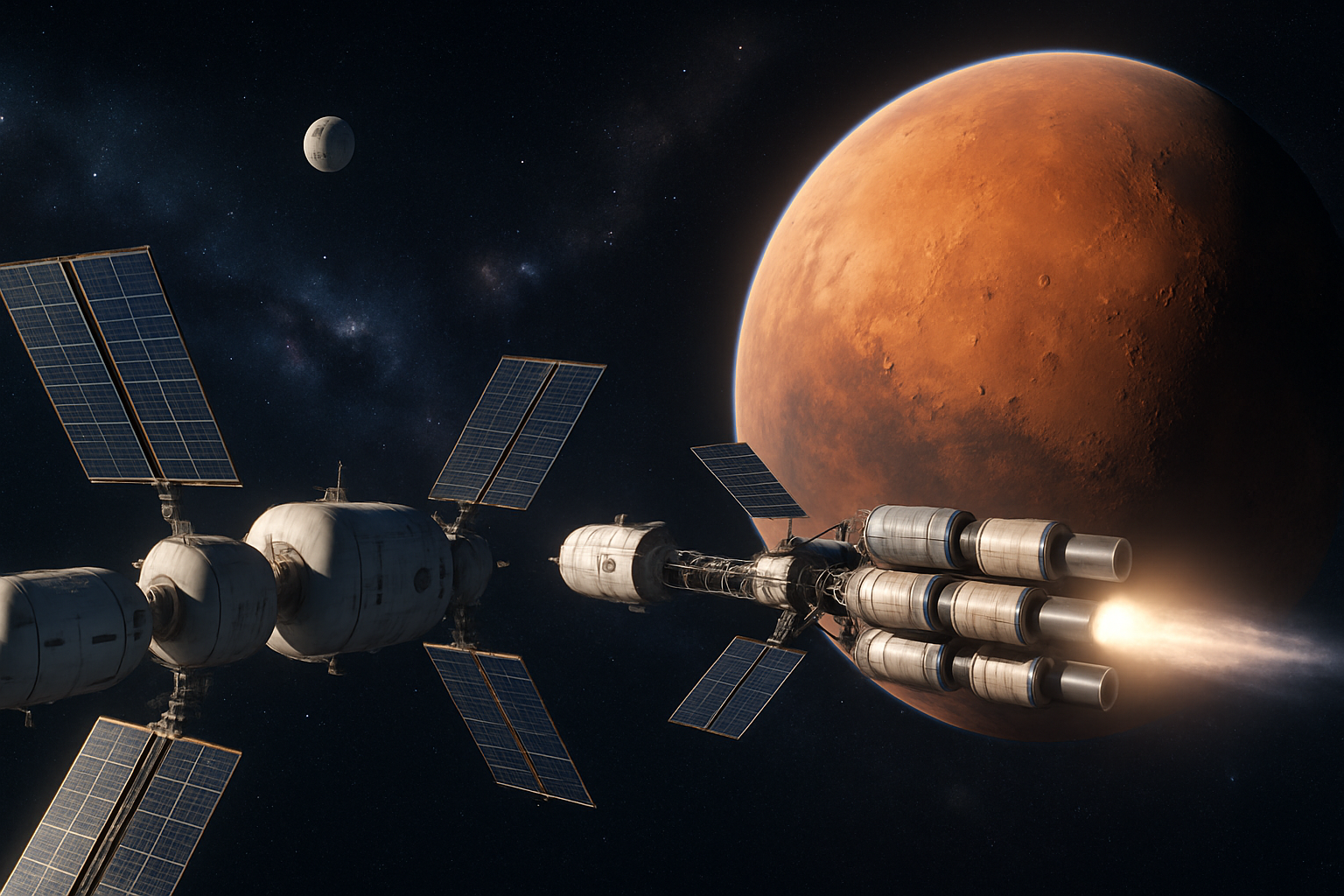
Revolutionary developments in space exploration are converging to establish humanity as a truly spacefaring civilization, with NASA's nuclear-powered Mars mission and groundbreaking lunar ice research positioning 2026 as a watershed year for cosmic expansion.
Nuclear Propulsion: The Mars Game-Changer
NASA's ambitious Space Reactor 1 Freedom (SR-1 Freedom) nuclear spacecraft represents a paradigm shift in interplanetary exploration, scheduled to launch toward Mars by late 2028. This groundbreaking nuclear propulsion system addresses the fundamental limitation of solar power for deep space missions, providing the energy density necessary for sustained operations beyond Earth's vicinity.
The nuclear spacecraft will enable faster transit times to Mars, continuous power generation regardless of distance from the Sun, and significantly reduced radiation exposure for future crews. Unlike conventional chemical propulsion systems that require massive fuel reserves, nuclear technology offers the efficiency needed for routine interplanetary travel.
"Nuclear propulsion represents the key to unlocking the solar system for human exploration. Where solar power becomes insufficient, nuclear energy provides the foundation for sustained deep space operations."
— NASA Technical Assessment Team
Lunar Ice: Billions of Years in the Making
Israeli and American scientists have made a revolutionary discovery that fundamentally changes our understanding of lunar resources. Using data from NASA's Lunar Reconnaissance Orbiter, researchers have confirmed that ice has been gradually accumulating at the Moon's poles for at least 1.5 billion years, published in the prestigious journal Nature Astronomy.
The research reveals that "cold traps" - deep, permanently shadowed craters near the lunar poles where temperatures plummet to minus 160 degrees Celsius - have been slowly collecting water ice through a process spanning geological epochs. This gradual accumulation rather than catastrophic deposition suggests a stable, accessible resource for future lunar settlements.
The implications are staggering. These ancient ice reserves could provide drinking water, oxygen for breathing, and hydrogen for rocket fuel, making the Moon a viable staging ground for Mars missions and deep space exploration. The discovery transforms lunar colonization from a theoretical possibility into a practical engineering challenge.
Environmental Monitoring Expands Global Research
Ukrainian scientists are contributing to this space exploration renaissance through expanded environmental monitoring programs. Researchers have installed advanced air quality monitoring instruments at the Akademik Vernadsky Station in Antarctica and aboard the research icebreaker Noosfera, creating a comprehensive network for atmospheric and oceanic research.
This expansion of monitoring capabilities reflects the interconnected nature of Earth and space science. Understanding our planet's atmospheric systems provides crucial insights for developing life support systems for lunar bases and Mars colonies, where environmental control becomes a matter of survival.
The Russian Biological Discovery
Adding to the space medicine revolution, Russian scientists have developed innovative compounds based on spruce extracts that effectively slow blood clotting in laboratory tests. Published in the open-access journal Polysaccharides, this research demonstrates how natural plant materials can be modified for medical applications - research that has direct implications for space medicine.
The modified spruce polysaccharides, enhanced with sulfates for improved water solubility, represent the type of biocompatible medical solutions essential for long-duration space missions where traditional Earth-based medical support is unavailable. These natural compounds could prove invaluable for treating medical emergencies during multi-year Mars expeditions.
Strategic Context: The Space Economy Golden Age
These developments occur during what experts term the "space economy golden age," with the global space economy projected to exceed $1 trillion by 2030. NASA's historic $20 billion commitment to establishing a permanent lunar surface base by 2030 represents the largest space infrastructure investment in the agency's history.
The strategic shift reflects lessons learned from the successful Artemis II mission, which ended a 54-year gap in human deep space exploration when Canadian astronaut Jeremy Hansen became the first Canadian beyond Earth orbit alongside his international crew. The mission's success validated critical technologies for sustained lunar presence and Mars exploration.
International Competition and Cooperation
China's parallel lunar program, planning crewed lunar missions by 2030, intensifies international competition while demonstrating the global recognition of space resources' strategic importance. Pakistan's selection of astronaut candidates for China's Tiangong station exemplifies the democratization of space capabilities.
European nations are advancing independent space capabilities through programs like Germany's €10 billion satellite investment and Sweden's Isar Aerospace facilities, reflecting a multipolar space environment where traditional partnerships coexist with emerging competition.
Technology Integration and AI Revolution
The convergence of artificial intelligence with space exploration is revolutionizing mission capabilities. NASA's fully AI-planned Mars rover missions enable autonomous navigation and real-time decision-making, reducing dependence on Earth-based control systems during the 20-minute communication delays inherent in Mars operations.
Chinese scientists achieved a breakthrough using AI to determine the Moon's far side chemical composition through Chang'e-6 samples, providing the first detailed mapping of permanently hidden lunar regions. This represents nearly half the Moon's surface, previously inaccessible to human observation.
Space Medicine: Preparing for Permanent Settlement
Critical space medicine research continues advancing through programs like Sophie Adenot's record eight-month ISS mission, focusing on lung tissue cultivation and Space-Associated Neuro-Ocular Syndrome (SANS) research. These studies are essential for understanding how human physiology adapts to extended weightlessness - knowledge crucial for permanent lunar settlements and Mars expeditions.
European research has revealed significant challenges for human reproduction in microgravity environments, necessitating artificial gravity solutions through rotating habitats for permanent space settlements. This research directly influences the design requirements for lunar bases and Mars colonies where natural human reproduction determines the success of permanent human presence beyond Earth.
Nuclear Technology: Enabling Deep Space Operations
The SR-1 Freedom nuclear spacecraft represents more than technological advancement; it embodies humanity's transition from terrestrial civilization to spacefaring species. Nuclear propulsion enables missions impossible with chemical rockets, providing the sustained power necessary for:
- Continuous life support systems during multi-year missions
- High-powered scientific instruments for deep space research
- Advanced communication systems for real-time Earth contact
- Mining and manufacturing operations on asteroids and planetary surfaces
Environmental Implications and Sustainability
The expansion of space-based research through programs like Ukraine's atmospheric monitoring reflects growing recognition that space exploration and environmental stewardship are interconnected. Space-based observations provide unprecedented data about Earth's climate systems while developing technologies essential for creating sustainable human habitats beyond our planet.
Romanian research documenting space debris pollution emphasizes the need for sustainable space development practices. With over 30,000 tracked orbital objects threatening cascade collision effects, responsible space exploration requires international cooperation to prevent scenarios that could trap humanity on Earth.
Future Implications: A Spacefaring Civilization
The convergence of nuclear propulsion, lunar resource utilization, advanced space medicine, and AI-powered operations represents humanity's evolution into a truly spacefaring civilization. These developments establish the foundation for:
- Permanent lunar settlements serving as staging grounds for Mars missions
- Regular cargo and crew transport between Earth, Moon, and Mars
- Space-based manufacturing utilizing asteroid resources
- Backup human settlements ensuring species survival
The 1.5-billion-year accumulation of lunar ice provides the resources necessary for sustained human presence, while nuclear propulsion offers the transportation capability for routine interplanetary travel. Combined with advancing space medicine and AI systems, these technologies create the infrastructure for humanity's permanent expansion beyond Earth.
Economic and Strategic Transformation
The space economy's projected growth to over $1 trillion by 2030 reflects not experimental ventures but essential infrastructure development. Space-based data centers address Earth's memory crisis, providing unlimited expansion potential with continuous solar power and no cooling requirements.
Countries implementing comprehensive space strategies demonstrate superior long-term positioning for resource access, technological development, and strategic influence. The window for establishing space capabilities narrows as early movers secure advantageous positions in lunar resource extraction and asteroid mining.
Conclusion: Humanity Among the Stars
The convergence of nuclear Mars missions, billion-year lunar ice reserves, expanding environmental monitoring, and revolutionary space medicine marks 2026 as the year humanity began its transformation into a spacefaring species. These are not isolated achievements but interconnected developments establishing the foundation for permanent human presence throughout the solar system.
The success of these programs determines whether humanity remains confined to Earth or begins its expansion among the stars. With nuclear propulsion providing the energy, lunar ice offering the resources, and advancing technology enabling sustained operations, the infrastructure for cosmic civilization is emerging. The choices made in the coming years will determine humanity's trajectory for generations, establishing whether we become a truly spacefaring species capable of thriving throughout the cosmos.