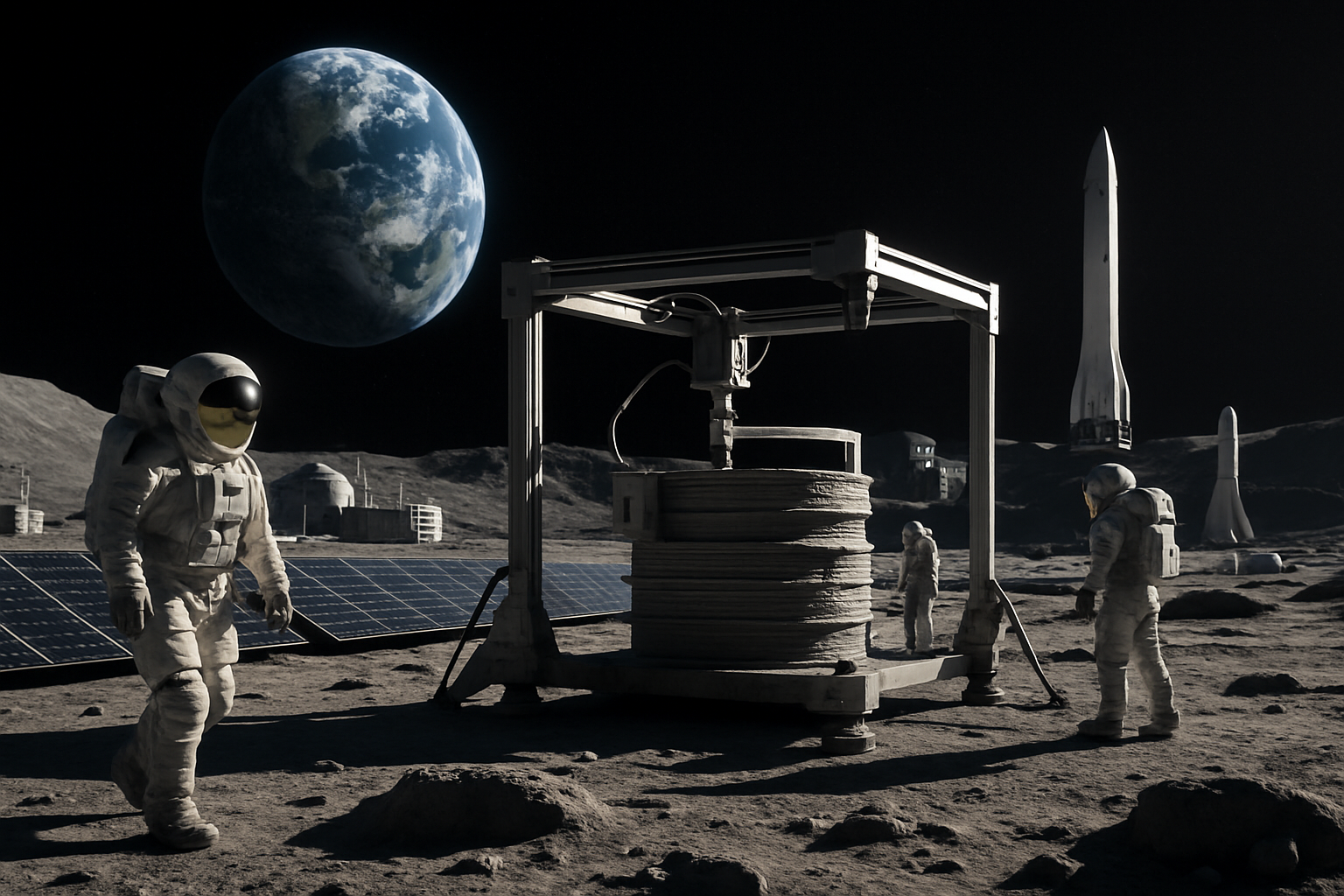
The landscape of space exploration and technology innovation underwent dramatic shifts in February 2026, as industry leaders pivoted from distant Mars ambitions to pragmatic lunar colonization while revolutionary bioprinting technologies promised to transform medical care on Earth and beyond.
SpaceX's Strategic Lunar Pivot
In a surprising reversal of long-held ambitions, Elon Musk announced SpaceX is fundamentally shifting focus from Mars colonization to establishing a self-sustaining lunar city. The Slovak technology publication Startitup.sk first reported this strategic redirection, which marks a significant departure from SpaceX's decade-long Mars-focused mission.
This pivot aligns with broader industry trends toward lunar development, building on historical context from recent missions. Memory records show SpaceX had previously announced unmanned Moon landing plans for March 2027, representing a more measured approach following years of ambitious Mars timeline predictions that consistently proved unrealistic.
The lunar focus offers compelling logistical advantages over Mars exploration. While Mars missions face 26-month alignment cycles between Earth and the red planet, lunar missions benefit from frequent launch windows and three-day travel times enabling rapid resupply and emergency response capabilities. Real-time communication with Earth remains possible, crucial for coordinating complex construction and scientific operations.
"The Moon is only the beginning," NASA astronaut Stephen Bowen emphasized during recent Vienna presentations supporting the Artemis program goals.
— Stephen Bowen, NASA Astronaut
International Space Missions Face Weather Delays
The shift toward lunar ambitions occurs amid ongoing operational challenges for current space missions. NASA announced another delay for the Crew-12 mission to the International Space Station due to adverse weather conditions, with the launch now targeted for February 13. The mission includes French astronaut Sophie Adenot, highlighting continued international cooperation in space exploration.
These delays reflect broader technical challenges facing the space industry. Historical memory shows the Artemis II lunar flyby mission has been repeatedly postponed due to hydrogen leak issues, now scheduled for March 2026. Despite setbacks, the mission represents the first crewed mission beyond Earth orbit since Apollo 17 in 1972, carrying four astronauts including Canadian Jeremy Hansen on a 10-day lunar journey.
Breakthrough in 3D Bioprinting Technology
While space exploration advances, revolutionary developments in medical technology promise to transform healthcare delivery. Uzbekistan has emerged as an unexpected leader in 3D organ printing technology, according to the country's Ministry of Higher Education, Science, and Innovations.
The bioprinting breakthrough opens possibilities for manufacturing human organs using specialized 3D printers, potentially addressing critical organ shortage challenges facing healthcare systems globally. This technology represents a convergence of materials science, cellular biology, and advanced manufacturing that could fundamentally reshape medical treatment approaches.

The implications extend beyond terrestrial medicine. For future lunar colonies and Mars missions, 3D bioprinting could provide critical medical capabilities for treating injuries and replacing damaged organs during extended space missions. The technology addresses one of the most challenging aspects of deep space exploration: providing comprehensive medical care far from Earth-based facilities.
Environmental Innovation in Space Technology Context
Complementing space and medical advances, Uzbek scientists unveiled fully biodegradable alternatives to plastic film, addressing environmental challenges that affect both Earth and space exploration. Plastic pollution has accumulated in soils and water bodies for decades, creating global ecological and public health issues that could contaminate future lunar and planetary settlements.
The biodegradable film technology demonstrates how environmental sustainability intersects with space exploration planning. Future lunar cities will require comprehensive waste management systems, and biodegradable materials could prevent the accumulation of persistent pollutants that might compromise enclosed habitats.
Historical Context and Industry Evolution
These developments occur within a broader transformation of the space industry from government-dominated programs to commercial innovation. Memory records indicate China's consistent advancement in reusable spacecraft technology, including the recent fourth launch of the Shenlong spacecraft, positioning it as a potential rival to U.S. space capabilities.
The period represents what analysts describe as a transition from the "AI revolution to space economy golden age," with SpaceX preparing for a potential June IPO that could value the company over $1 trillion. The convergence of artificial intelligence, advanced manufacturing, and space technology creates unprecedented opportunities for technological development.
Recent achievements include NASA's historic success with fully AI-planned Mars rover missions, demonstrating autonomous navigation capabilities crucial for future lunar and planetary operations. The rover completed its mission in December 2025 without Earth-based mission control, proving generative artificial intelligence can independently plan safe routes and conduct scientific investigations.
Challenges and Future Prospects
Despite remarkable progress, significant challenges persist. The global memory crisis, with semiconductor prices surging sixfold, affects both space technology development and AI systems crucial for autonomous operations. Companies like Samsung, SK Hynix, and Micron operate at full capacity but cannot meet demand, with shortages expected to continue until 2027.
Technical challenges for lunar colonization include radiation protection, life support systems, and in-situ resource utilization. Space-Associated Neuro-Ocular Syndrome affecting long-duration missions remains a critical medical concern for extended lunar operations.
The bioprinting revolution faces its own hurdles, including regulatory approval processes, technical complexity of organ vascularization, and ensuring bio-compatibility. However, success could address organ shortage crises affecting millions of patients worldwide while providing essential medical capabilities for space exploration.
International Cooperation and Competition
The space exploration landscape reflects both cooperation and competition among nations. Pakistan achieved a historic milestone with its first astronaut mission to China's Tiangong space station scheduled for October-November 2026, demonstrating how space capabilities are democratizing beyond traditional space powers.
International cooperation continues through the International Space Station operations, shared research initiatives, and technology development partnerships. However, competitive dynamics intensify in areas like reusable spacecraft development, lunar exploration capabilities, and space-based infrastructure deployment.
Memory records show Thailand's appointment as chair of UN space governance activities, reflecting emerging nations' growing influence in space policy and international coordination efforts. This distributed leadership model may become increasingly important as space activities expand beyond government programs to include commercial entities and smaller nations.
Economic and Strategic Implications
The convergence of space exploration advancement and bioprinting technology breakthrough represents profound economic opportunities. The space economy could generate trillions in economic value through satellite infrastructure, space-based data centers, and eventual resource extraction from lunar and asteroid sources.
Bioprinting technology promises to transform healthcare economics by addressing organ shortage costs, reducing transplant waiting times, and enabling personalized medical treatments. The technology could create new industries while reducing healthcare system burdens from organ failure treatments.
Strategic implications include national competitiveness in advanced technology sectors, medical tourism potential for countries developing bioprinting capabilities, and space exploration leadership determining future resource access and technological development opportunities.
Looking Ahead
February 2026 may be remembered as a pivotal moment when space exploration strategy matured from ambitious long-term visions to pragmatic near-term objectives, while breakthrough medical technologies promised immediate humanitarian benefits. The shift from Mars dreams to lunar realities reflects industry evolution toward achievable goals that build foundations for eventual interplanetary expansion.
Success in lunar colonization could provide the technological development, operational experience, and economic foundation necessary for eventual Mars exploration. Meanwhile, 3D bioprinting advances promise to enhance human capabilities both on Earth and in the challenging environments of space exploration.
The integration of these technologies suggests a future where space exploration and advanced medicine support each other, creating resilient human capabilities for both terrestrial challenges and cosmic expansion. As industry leaders pivot toward achievable lunar objectives while revolutionary medical technologies mature, 2026 represents a transition from speculative ambitions to practical implementation of transformative human capabilities.