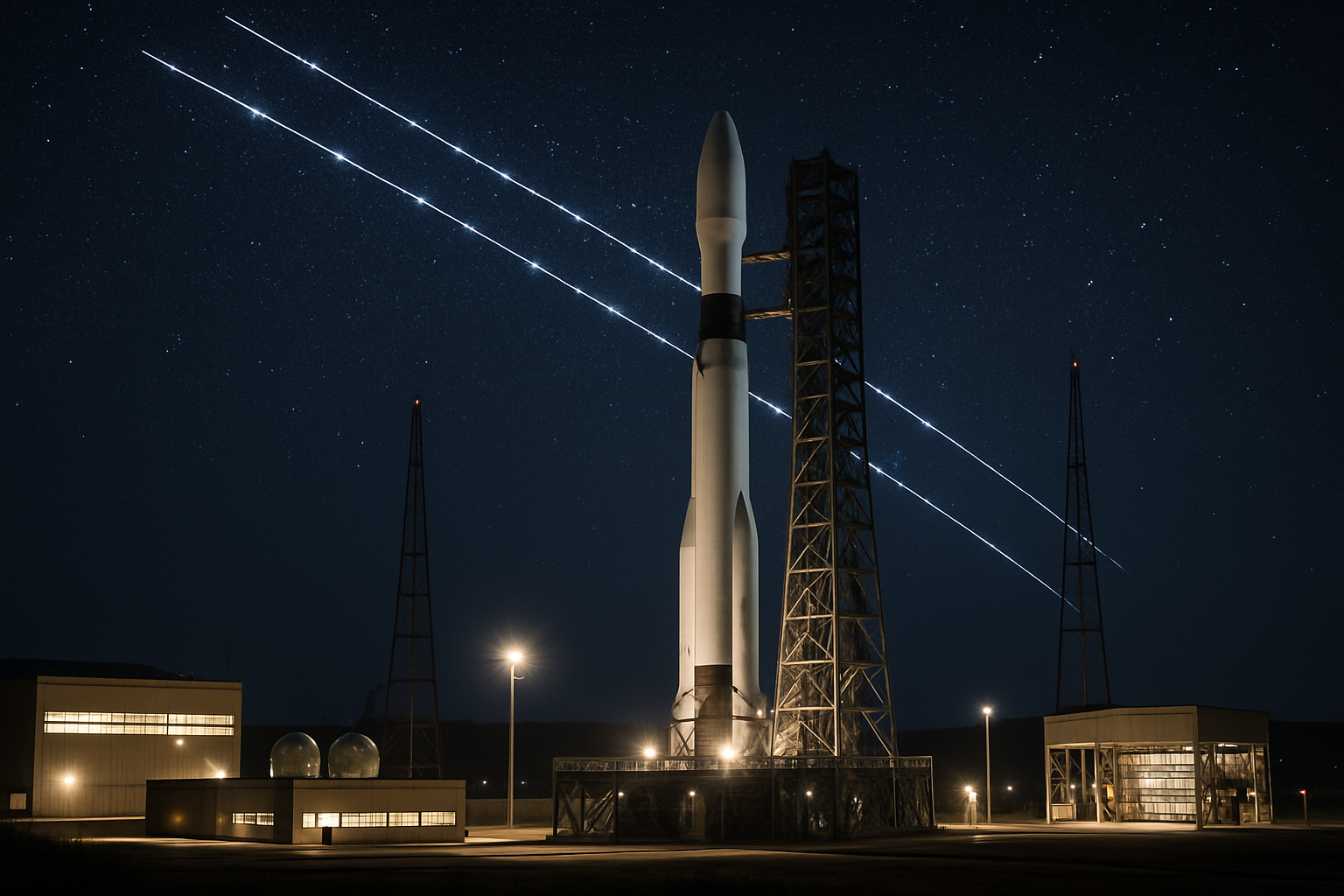
The global space industry is experiencing unprecedented growth in February 2026, with major satellite network expansions and new international launch facilities coming online across multiple continents, demonstrating the sector's rapid evolution from national programs to truly global commercial enterprises.
Two significant developments this week highlight the industry's momentum: SpaceX's Starlink satellite constellation becoming increasingly visible across Argentina for the third consecutive time, while German rocket manufacturer Isar Aerospace advances construction of a major new testing facility at Sweden's Esrange Space Center near Kiruna.
Starlink Constellation Expands Global Coverage
Argentine observers will witness another spectacular display of Starlink satellites crossing the night sky, marking the third consecutive occurrence of this phenomenon. The satellite train, appearing as a distinctive line of lights moving across the firmament, represents the continued expansion of SpaceX's global internet constellation that now serves millions of users worldwide.
This development occurs against the backdrop of recent strategic advances by SpaceX, including the company's historic $1.25 trillion merger with xAI announced in February 2026. The combined entity represents the world's most valuable private company, with ambitious plans to build space-based data centers powered by solar energy to address the AI industry's growing computational demands.
"The integration of SpaceX's rocket technology and Starlink satellites with advanced AI platforms represents the most ambitious, vertically-integrated innovation engine on and off Earth."
— Elon Musk, SpaceX CEO
The Starlink network has recently demonstrated its strategic importance beyond commercial internet services. In February 2026, SpaceX successfully implemented countermeasures to prevent unauthorized Russian use of Starlink terminals for controlling attack drones in Ukraine, showcasing the dual-use nature of modern satellite technology.
European Space Industry Accelerates
Meanwhile in northern Sweden, Isar Aerospace is constructing a significant new rocket engine testing facility at the Esrange Space Center outside Kiruna. The German company's new installation will have the capacity to test 30 rocket engines per month, representing a substantial expansion of European space industry capabilities.
Esrange has emerged as a critical hub for European space operations, offering advantages including its high latitude location ideal for polar and sun-synchronous orbits, minimal air traffic, and established infrastructure supporting both sounding rocket and satellite launches.
The facility expansion reflects broader European ambitions to reduce dependence on foreign launch services and establish autonomous space capabilities. This aligns with the European Space Agency's strategy to develop competitive launch systems and maintain strategic independence in space access.
International Cooperation and Competition
These developments unfold within a complex landscape of international space cooperation and competition. Thailand's recent appointment as chair of the UN Scientific and Technical Subcommittee under the UN Committee on the Peaceful Uses of Outer Space (COPUOS) demonstrates how emerging space nations are taking leadership roles in global space governance.
NASA's recent achievements further illustrate the sector's rapid advancement. In December 2025, NASA's Mars rover completed the first fully AI-planned mission, proving that generative artificial intelligence can independently navigate Martian terrain and select scientific targets without Earth-based mission control delays.
However, the industry also faces challenges, as evidenced by NASA's continued delays of the Artemis II mission. Originally scheduled for February 8, 2026, the crewed lunar flyby mission has been postponed to March due to persistent hydrogen leak issues during testing, highlighting the technical complexities of human spaceflight.
Commercial Space Revolution
The current space industry boom extends far beyond traditional government programs. Private companies are increasingly driving innovation, with SpaceX's planned initial public offering potentially becoming the largest in history at $527 per share for the combined SpaceX-xAI entity.
Astronomical discoveries are also accelerating, with the University of Washington's recent record-breaking asteroid discovery using early images from the new Vera C. Rubin Observatory in Chile demonstrating how advanced ground-based facilities complement space-based assets.
The integration of artificial intelligence into space operations represents a paradigm shift. From autonomous Mars rover navigation to AI-enabled Olympic broadcasting using Qwen technology at the Milano-Cortina 2026 Winter Olympics, space-derived technologies are finding applications across multiple sectors.
Strategic Implications
These developments occur within a broader context of shifting geopolitical dynamics. The Ukraine conflict has highlighted both the strategic value of satellite communications and the vulnerabilities of space-based systems to military interference. SpaceX's ability to selectively deny service to prevent weapons use demonstrates the growing importance of private companies in national security considerations.
The space industry's expansion also reflects growing recognition of space assets' economic value. From satellite internet services generating billions in revenue to space-based manufacturing possibilities, the commercial space sector is transitioning from experimental ventures to essential infrastructure.
Future Outlook
Looking ahead, the space industry appears poised for continued rapid growth. The combination of established companies like SpaceX expanding their capabilities, new entrants like Isar Aerospace building infrastructure, and international cooperation frameworks evolving suggests a dynamic period ahead.
The successful demonstration of AI-powered space operations opens possibilities for more autonomous exploration missions, potentially enabling complex operations on distant worlds without the communication delays that currently limit real-time control from Earth.
As satellite constellations become more visible to ground observers worldwide and new launch facilities come online across multiple continents, the space age appears to be entering a new phase characterized by international cooperation, commercial innovation, and technological convergence that promises to reshape both terrestrial and extraterrestrial human activities in the coming decade.