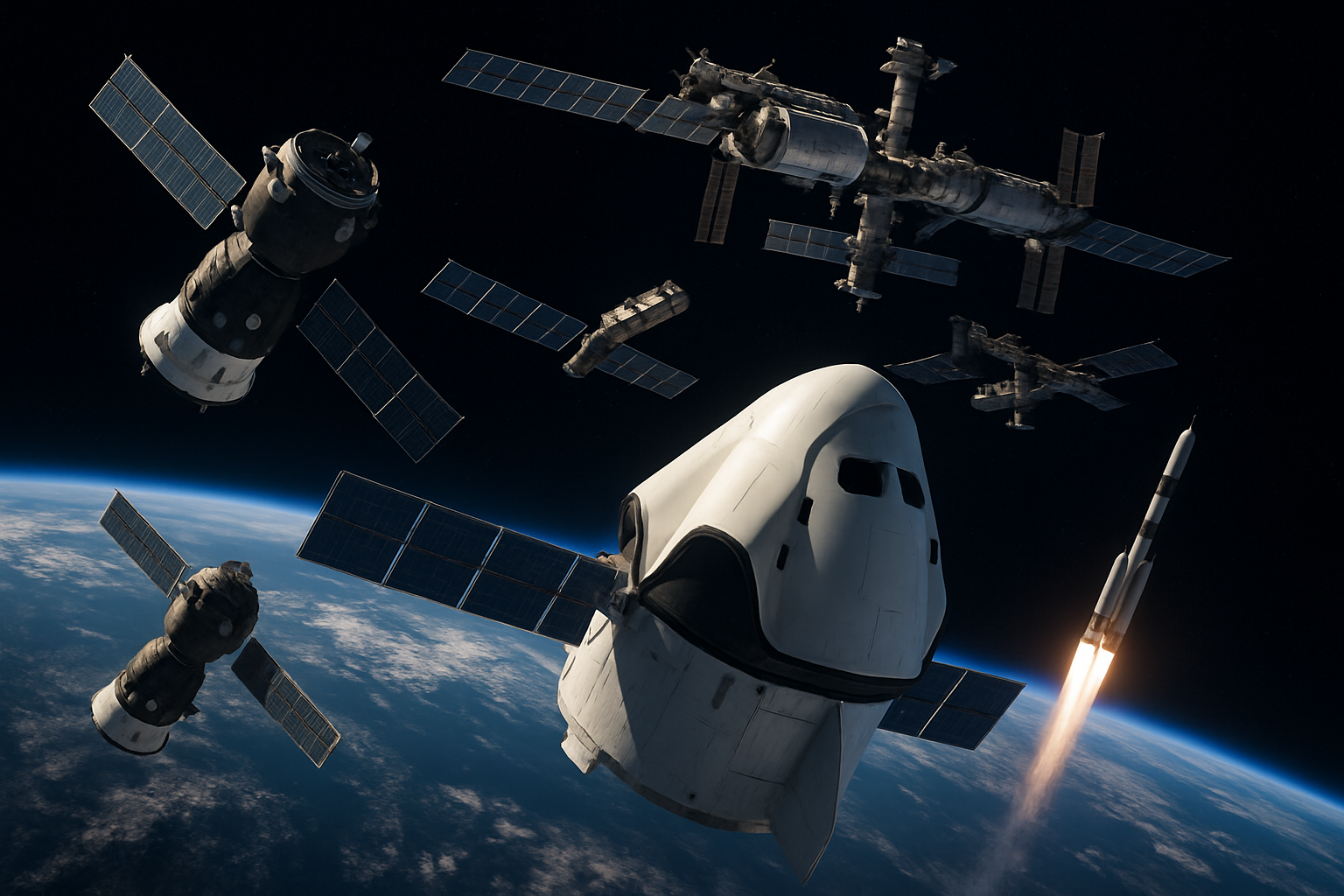
The global space industry reached a pivotal milestone in March 2026 as Roscosmos announced the completion of critical repairs to the damaged Baikonur Cosmodrome launchpad, while space agencies and technology companies worldwide advance revolutionary space-based infrastructure projects that promise to transform both space exploration and terrestrial computing.
The restoration of Baikonur's operational capacity comes after a November 27, 2025 incident during a crewed Soyuz launch to the International Space Station that damaged the service cabin of the historic launchpad. The successful repair marks a crucial milestone for maintaining international space station operations and demonstrates the resilience of critical space infrastructure during what industry experts are calling the "space economy golden age."
From Mars Dreams to Lunar Reality
Parallel to these operational developments, visionary entrepreneur Elon Musk continues to reshape humanity's space ambitions through his revolutionary proposal for space-based data centers. As detailed in recent Mexican financial analysis, Musk's vision extends far beyond traditional rocket launches to encompass a fundamental transformation of how we approach computing infrastructure.
"There are entrepreneurs who build better products. There are entrepreneurs who create industries. Perhaps once in a generation, someone manages to push entire civilization forward," noted the comprehensive assessment of Musk's impact. His companies have systematically addressed seemingly impossible challenges: rockets that return to Earth autonomously, solar cells that transform energy economics, and now technology infrastructure that operates beyond our planet's constraints.
"We reached the Moon thanks to a speech and haven't returned in 5 decades. Today we're witnessing the practical implementation of space infrastructure that could make such missions routine rather than exceptional."
— Space Industry Analysis, March 2026
The strategic pivot toward space-based data centers addresses multiple critical challenges simultaneously. Global semiconductor prices have surged sixfold since early 2025, creating what industry analysts describe as a "memory crisis" affecting major manufacturers including Samsung, SK Hynix, and Micron. Traditional data centers consume enormous amounts of energy and water for cooling, with the World Bank projecting AI systems alone will require 4.2-6.6 billion cubic meters of water annually by 2027.
International Cooperation and Competition
The space industry's evolution reflects a complex interplay of international cooperation and strategic competition. While Roscosmos restored Baikonur's capabilities, the International Space Station continues operating through unprecedented multinational collaboration. NASA's Crew-12 mission, featuring French astronaut Sophie Adenot's historic eight-month stay, has demonstrated the continued value of shared space infrastructure for advancing scientific knowledge crucial to future deep space missions.
Current ISS research programs focus on addressing critical challenges for extended space travel, including Space-Associated Neuro-Ocular Syndrome (SANS) that affects astronaut vision during long-duration missions, and lung tissue cultivation studies that provide essential data for establishing permanent lunar settlements and eventual Mars exploration.

Meanwhile, competitive dynamics are intensifying across multiple fronts. China's Shenlong reusable spacecraft program continues advancing, Pakistan has selected astronaut candidates for China's Tiangong station missions scheduled for October-November 2026, and European nations are investing heavily in independent launch capabilities. Germany's Isar Aerospace has constructed rocket testing facilities in Sweden capable of testing 30 engines monthly, reflecting Europe's drive for technological sovereignty in space access.
Technical Infrastructure Revolution
The technological underpinnings of this space renaissance extend far beyond launch vehicles. NASA's DAGGER AI system achieved a revolutionary breakthrough in space weather forecasting, providing 30-minute advance warning of geomagnetic storms that threaten satellite infrastructure worth billions of dollars. This capability becomes increasingly critical as thousands of additional satellites deploy across multiple constellations.
Space-based computing infrastructure offers compelling advantages over terrestrial alternatives: unlimited expansion potential without geographical constraints, continuous solar power availability, elimination of cooling requirements that consume massive amounts of energy and water, and absence of atmospheric interference affecting operations. Industry projections suggest space-based data centers could achieve cost-effectiveness within 36 months, fundamentally altering the economics of large-scale computing.
Artemis Program Developments
NASA's Artemis program continues facing technical challenges that underscore the complexity of human deep space exploration. Persistent hydrogen leak issues and helium system failures have delayed the Artemis II lunar flyby mission beyond March 2026, despite the mission representing the first crewed venture beyond Earth orbit since Apollo 17 in December 1972.
The four-astronaut international crew—Canadian Jeremy Hansen, NASA's Reid Wiseman, Christina Koch, and Victor Glover—awaits clearance for their planned 10-day journey covering 600,000 miles around the Moon. The mission serves as a critical stepping stone toward the Artemis III lunar landing targeted for 2027, which will establish sustainable human presence on the lunar surface for the first time in over five decades.
Commercial Space Economy Maturation
The commercial space sector's transformation from experimental ventures to essential infrastructure represents one of the most significant economic shifts of the 21st century. SpaceX's preparation for a potential June 2026 IPO, with valuations potentially exceeding $1 trillion, reflects investor confidence in space-based business models that extend far beyond traditional satellite services.
This economic maturation encompasses multiple sectors: satellite internet constellation expansion, space-based manufacturing research, asteroid resource extraction planning, and now orbital computing infrastructure. The convergence of these capabilities creates opportunities for sustained revenue generation that supports continued technological advancement and space exploration objectives.
"The space industry has reached an inflection point where commercial capabilities enable governmental objectives while government research supports commercial innovation. This symbiotic relationship accelerates progress beyond what either sector could achieve independently."
— Industry Economic Analysis, March 2026
Global Space Governance Evolution
As space activities expand exponentially, international governance frameworks struggle to keep pace with technological advancement. Thailand's leadership of UN space governance initiatives demonstrates how emerging nations are gaining influence in determining the regulatory environment for commercial space activities that extend far beyond traditional government-controlled space programs.
Critical governance challenges include space debris management, with over 34,000 tracked objects larger than 10 centimeters currently orbiting Earth, plus millions of smaller debris pieces capable of catastrophic damage at orbital speeds. ESA's Space Safety Programme has warned that space is becoming dangerously overcrowded, requiring immediate international cooperation to prevent a cascade effect that could make certain orbital regions unusable for decades.
Medical and Scientific Breakthroughs
Space medicine research has achieved critical breakthroughs that benefit both space exploration and terrestrial healthcare. Portuguese scientists leading SANS research have made significant progress understanding how extended microgravity exposure affects human vision, knowledge essential for missions to Mars where crew members could spend 18 months or more in space.
The successful medical evacuation of astronaut Mike Fincke from the ISS—the first such emergency in NASA's 65-year human spaceflight history—provided invaluable data about emergency medical protocols for situations where Earth evacuation becomes impossible during deep space missions. This real-world experience informs development of medical systems for lunar bases and Mars settlements where autonomous medical capability becomes essential for crew survival.
Environmental Considerations and Sustainability
The rapid expansion of space activity has prompted increased attention to environmental implications both on Earth and in space. Austrian scientists achieved the first direct measurements of atmospheric pollution from rocket debris, documenting lithium concentrations elevated tenfold above normal levels following Falcon-9 stage reentry.
These findings highlight the need for sustainable space development practices as launch frequency increases exponentially. Space-based data centers could paradoxically reduce environmental impact by relocating energy-intensive computing operations beyond Earth's atmosphere while utilizing unlimited solar energy and eliminating cooling requirements that consume billions of gallons of water annually.
Looking Toward the Future
The convergence of restored launch capabilities at Baikonur, advancing space-based computing infrastructure, and accelerating international space activities signals a fundamental transformation in humanity's relationship with space. The current period represents a transition from space exploration as primarily scientific endeavor to space utilization as essential infrastructure supporting modern civilization.
Success in establishing sustainable space-based infrastructure will determine whether humanity can address critical challenges including the global semiconductor shortage, energy consumption by AI systems, and the need for resilient computing infrastructure that transcends terrestrial limitations. The next 24 months will prove critical in demonstrating whether space-based solutions can achieve the scale and reliability necessary to support both continued technological advancement and expanded human presence throughout the solar system.
As space agencies complete essential infrastructure repairs and technology companies develop revolutionary orbital capabilities, March 2026 stands as a watershed moment when space activities evolved from experimental to essential, establishing the foundation for humanity's next phase of cosmic exploration and development.