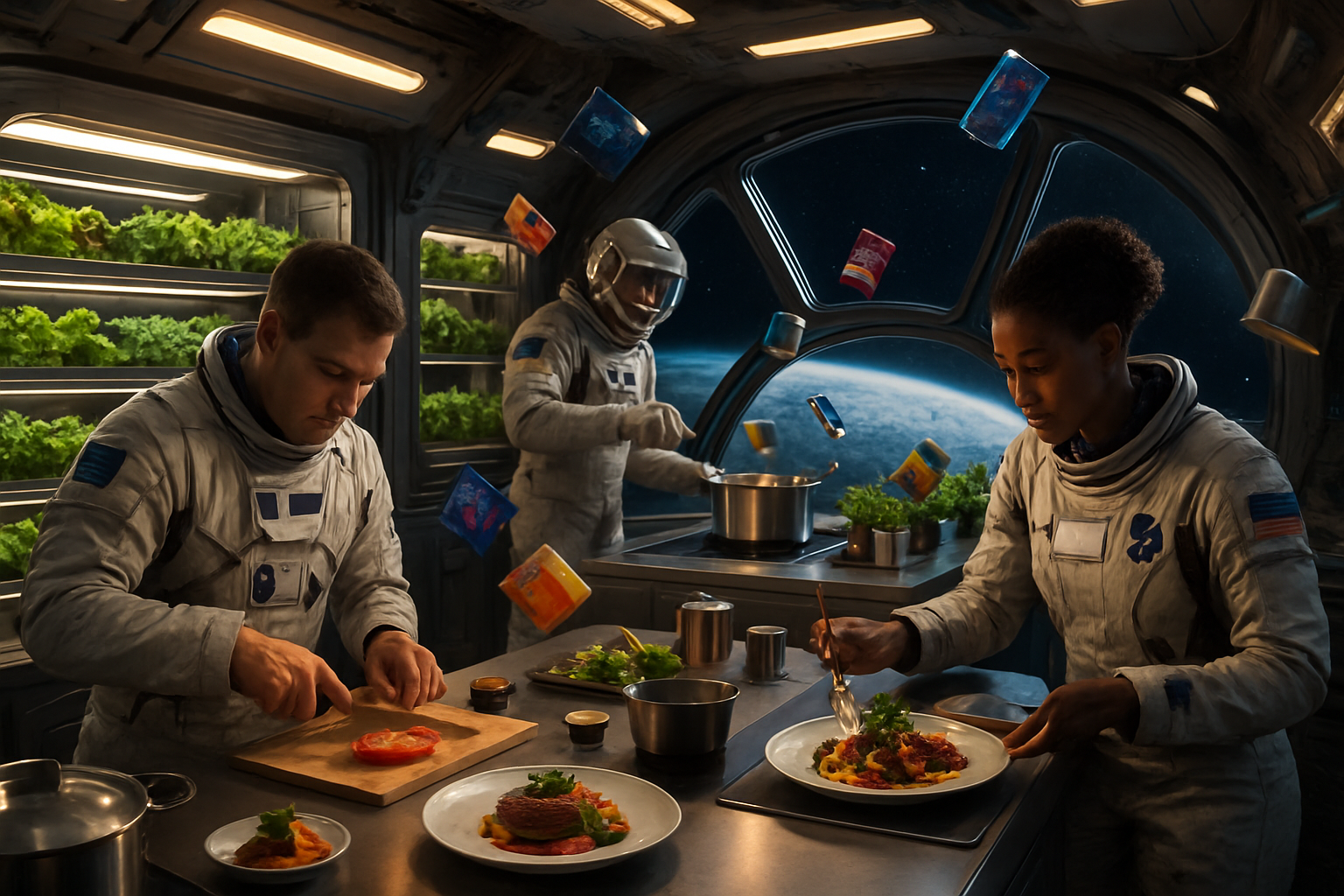
As NASA's Artemis II crew prepares for humanity's return to deep space after a 54-year gap, the evolution of space nutrition represents one of the most remarkable transformations in astronaut technology – from the famous Tang powder of the Apollo era to today's sophisticated gourmet meals that rival fine dining establishments.
The viral moment during April 2026's Artemis II mission – when a floating Nutella jar became an unexpected internet sensation – highlights how space food has evolved far beyond mere survival provisions. While astronaut Christina Koch led repairs on the spacecraft's malfunctioning toilet system, the sight of premium food products floating freely in zero gravity captured global attention, symbolizing the dramatic transformation in space nutrition over the past five decades.
The Great Space Food Evolution
The contrast between Apollo-era nutrition and today's space cuisine is staggering. Early astronauts endured freeze-dried cubes, nutrient pastes, and Tang orange drink as their primary sustenance during brief missions. Today's International Space Station crews enjoy bacon, fresh fruits, and what food scientists describe as "almost fine dining" preparations during missions lasting eight months or more.
Sophie Adenot's record-breaking eight-month ISS mission provided crucial insights into long-duration nutrition requirements. Her research on lung tissue cultivation and Space-Associated Neuro-Ocular Syndrome (SANS) revealed how extended microgravity affects human biology, making advanced nutrition systems essential for future lunar settlements and Mars expeditions.
"The food has changed dramatically. We're not just maintaining astronauts anymore – we're optimizing human performance for missions that could last years beyond Earth evacuation possibility."
— NASA Nutrition Specialist, Artemis Program
Breakthrough Lunar Agriculture Systems
Revolutionary developments in space agriculture are transforming how future missions will feed their crews. Greek researchers achieved a groundbreaking milestone by successfully cultivating chickpeas under lunar surface simulation conditions, using regolith-like materials mimicking Moon soil composition. This breakthrough addresses the fundamental challenge of feeding astronauts during extended missions without complete Earth-supply dependence.
At Texas A&M University, scientists developed even more sophisticated techniques, growing chickpeas in simulated lunar soil composed of 75% lunar simulant mixed with vermicompost from earthworm-processed waste. The chickpeas variety "Myles" was specifically selected for nitrogen-fixing capabilities, high nutritional value, and compact growth suitable for space environments.
The economic implications are staggering. Current food shipping costs to space reach hundreds of thousands of dollars per kilogram. Lunar self-sufficiency would dramatically reduce costs while improving operational independence for permanent settlements.
Zero-Gravity Culinary Innovation
Modern space nutrition extends far beyond basic sustenance. The integration of advanced food preservation, preparation, and presentation techniques has created what experts call the "space economy golden age" of nutrition. Astronauts now enjoy meals that maintain both nutritional density and cultural authenticity.
Recent innovations include:
- Pressurized growing environments with temperature and humidity control
- LED lighting systems optimized for plant growth
- Automated irrigation and radiation shielding using regolith-based materials
- Closed-loop life support systems processing human waste through vermiculture composting
The Norwegian breakthrough in beer-to-meat conversion biotechnology, while still experimental, demonstrates how space nutrition pioneers are exploring unconventional protein sources for long-duration missions where traditional supply chains become impossible.
Addressing Space-Specific Health Challenges
Extended space missions present unique nutritional challenges that Earth-based food systems never encounter. European research has revealed that microgravity seriously disrupts human sperm navigation, making reproduction extremely difficult in space environments. This discovery has critical implications for permanent space settlements, requiring artificial gravity solutions through rotating habitats.
Additionally, Space-Associated Neuro-Ocular Syndrome affects astronaut vision during extended missions, requiring specific nutritional interventions. Research on lung tissue cultivation in microgravity provides essential data for medical protocols where Earth evacuation becomes impossible.
Cultural and Psychological Dimensions
The viral toilet malfunction during Artemis II – which Christina Koch skillfully repaired while crew members joked about the situation – highlighted how food and basic human needs create powerful psychological connections in space. The floating Nutella jar became a symbol not just of technological advancement, but of maintaining human dignity and cultural connections during humanity's most challenging journeys.
Food serves multiple functions beyond nutrition in space environments: maintaining morale, preserving cultural identity, and creating shared experiences that bond international crews during months of isolation. The evolution from survival rations to gourmet meals reflects humanity's commitment to preserving essential aspects of civilization even in the most extreme environments.
International Cooperation and Innovation
Space nutrition advancement represents unprecedented international collaboration. ESA life support development, Chinese lunar program experiments, and private sector investments create a global ecosystem of innovation. The Pakistan astronaut candidates selected for China's Tiangong station missions in October-November 2026 will contribute to this growing knowledge base about nutrition requirements for diverse populations in space.
Argentina's contribution of the Atenea radiation device to Artemis II, combined with Czech ADVACAM radiation chips monitoring astronaut safety, demonstrates how international partnerships enhance our understanding of how cosmic radiation affects both human biology and food safety during deep space missions.
Environmental Applications Beyond Space
Space nutrition technologies increasingly benefit Earth-based applications. Controlled environment agriculture techniques developed for space missions now support farming in deserts, polar regions, and climate change adaptation areas. The precision nutrient delivery systems and closed-loop life support technologies pioneered for space exploration provide templates for sustainable agriculture in extreme Earth environments.
Vertical farming systems originally designed for space stations now help urban agriculture address food security challenges in climate-affected regions. These technologies represent a remarkable reversal where space exploration innovations return to solve terrestrial challenges.
The Economic Revolution
The transformation of space nutrition coincides with the "space economy golden age," with SpaceX preparing a trillion-dollar IPO in June 2026. The space economy is projected to exceed $1 trillion by 2030, positioning space exploration as critical infrastructure rather than experimental endeavor.
Commercial capabilities advancing alongside government programs create integrated Earth-space technological systems. Space-based data centers addressing the global memory crisis, combined with advanced nutrition systems, position space exploration as essential for human civilization's future development.
Looking to the Future
As humanity prepares for permanent lunar settlements and Mars expeditions, the evolution of space nutrition from Tang to gourmet meals represents more than technological advancement – it demonstrates our commitment to maintaining human dignity, health, and cultural identity throughout the cosmos.
The success of future space colonization efforts may ultimately depend not on rockets or life support systems alone, but on our ability to recreate the essential human experience of sharing meals, maintaining cultural traditions, and finding joy in simple pleasures like a perfectly prepared dish floating weightlessly in the vast darkness of space.
"We're not just feeding astronauts anymore. We're creating the foundation for a spacefaring civilization that maintains the best of human culture while adapting to cosmic realities."
— Dr. Andrea Longobardo, INAF Space Nutrition Research
The journey from Tang to gourmet space cuisine mirrors humanity's evolution from brief visitors to permanent residents of the cosmos. As Artemis II's successful mission demonstrates, the future of space exploration depends as much on excellent nutrition as it does on advanced rockets – ensuring that human civilization among the stars maintains both its biological health and its cultural soul.