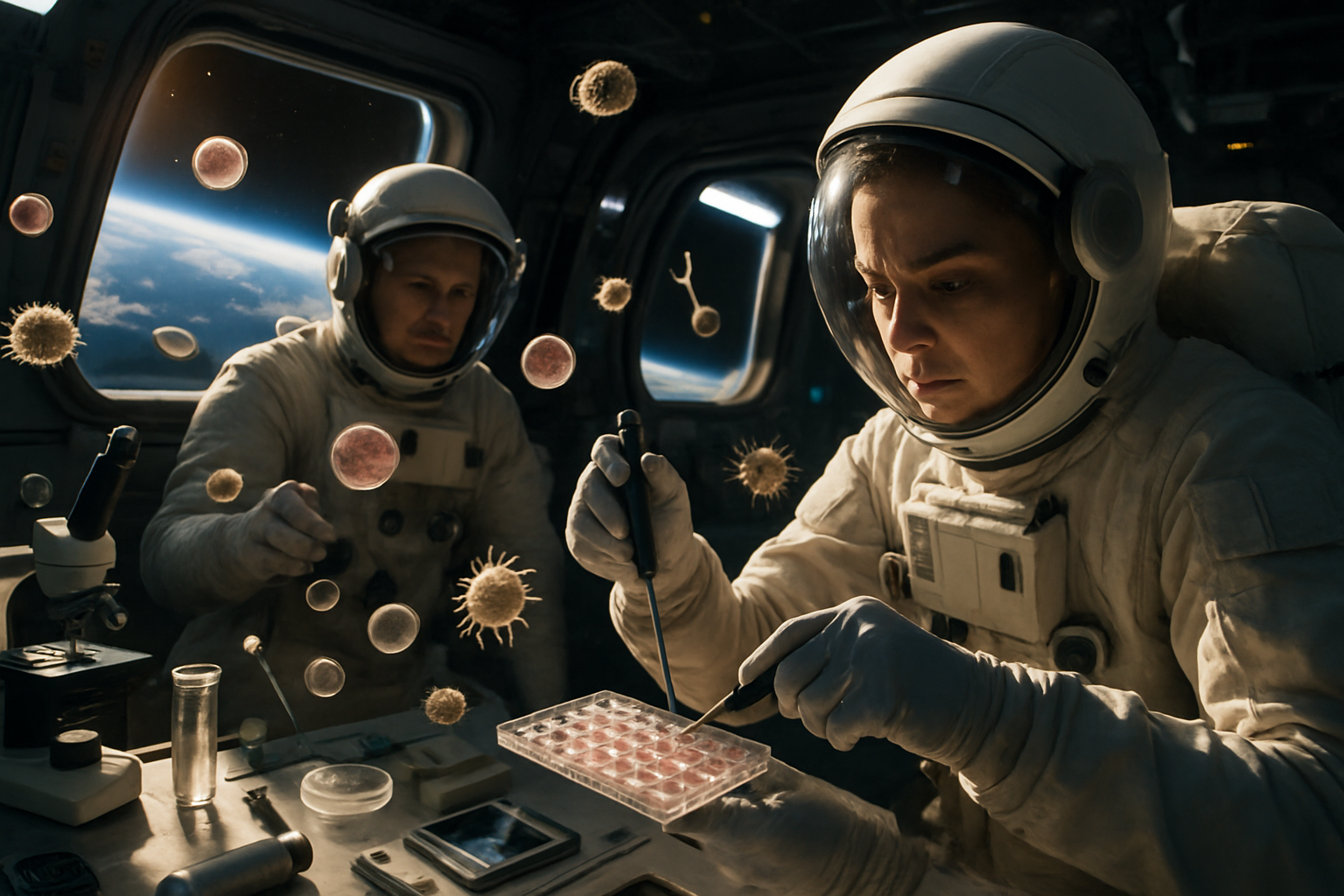
Groundbreaking research has revealed that microgravity severely disrupts human sperm navigation, potentially making reproduction extremely difficult in space environments as NASA prepares for its historic return to the Moon with Artemis II in April 2026.
The troubling findings emerge just as four astronauts—Canadian Jeremy Hansen, NASA's Reid Wiseman, Christina Koch, and Victor Glover—prepare for humanity's first crewed mission beyond Earth orbit since Apollo 17 in December 1972. Their 10-day lunar flyby, covering 600,000 miles, will mark a critical step toward establishing permanent lunar settlements where human reproduction would be essential for long-term survival.
The Sperm Navigation Crisis
According to multiple European research sources, studies published in Communications Biology have documented how microgravity fundamentally disorients sperm cells, preventing them from successfully navigating toward their target. The research, conducted by scientists analyzing reproductive biology in weightless conditions, reveals that the absence of gravity disrupts the normal swimming patterns and directional capabilities that sperm require for successful fertilization.
"Space colonization appears to be at an impasse," Romanian researchers noted in their analysis of the breakthrough study. "Scientists have discovered that microgravity disorients sperm, making reproduction very difficult."
The implications extend far beyond laboratory curiosity. As space agencies worldwide accelerate plans for lunar bases and Mars missions, the fundamental question of human reproduction in space has become critical for the sustainability of any permanent extraterrestrial settlement.
Artemis Missions Under Pressure
The reproductive challenges coincide with mounting technical pressures on NASA's Artemis program. The Space Launch System (SLS) rocket—standing 322 feet tall and weighing 5.75 million pounds when fully fueled—has faced persistent technical setbacks including hydrogen leak issues and helium system failures that have pushed the mission launch date multiple times throughout early 2026.
Administrator Jared Isaacman has maintained NASA's safety-first approach, emphasizing "we will only launch when we believe we are ready." This methodical philosophy reflects institutional learning from historical tragedies and reinforces the agency's commitment to crew protection over schedule adherence.
"We are going to the Moon," exclaimed Reid Wiseman, the mission commander, upon the crew's arrival at Kennedy Space Center for final preparations.
— Reid Wiseman, Artemis II Mission Commander
The mission represents more than a symbolic return to lunar exploration. It serves as a stepping stone toward Artemis III's planned lunar landing in 2028 and the establishment of permanent lunar settlements—objectives now complicated by the reproductive biology challenges revealed in recent research.
Historical Context and Previous Research
The reproductive challenges are not entirely unprecedented. Historical records reveal that NASA conducted significant space biology experiments as early as 1990, including sending 2,500 juvenile jellyfish to space. The organisms returned as 60,000 individuals but suffered severe cardiac abnormalities and persistent vertigo—early evidence that space environments fundamentally affect biological development.
More recent research has built upon these foundations. Australian scientists achieved a historic milestone testing human sperm behavior in zero gravity using miniaturized plastic "obstacle courses." While the resilient sperm cells successfully navigated experimental mazes, suggesting conception remains biologically feasible in weightless conditions, the research uncovered concerning implications for embryonic development post-fertilization, where lack of gravity appeared to harm normal development processes.
Current Space Medicine Research
The International Space Station continues to serve as humanity's primary laboratory for understanding biological adaptation to space environments. French astronaut Sophie Adenot's record-breaking eight-month mission has provided invaluable data on long-duration spaceflight effects, including lung tissue cultivation research and studies of Space-Associated Neuro-Ocular Syndrome (SANS), which affects astronaut vision during extended missions.
This research directly informs medical protocols for future lunar bases and Mars expeditions, where astronauts may spend years without the possibility of Earth medical evacuation. The convergence of reproductive research with ongoing space medicine studies creates a comprehensive framework for understanding the biological requirements of sustainable human presence beyond Earth orbit.
International Competition and Collaboration
The reproductive challenges emerge during intensifying international space competition. China has announced plans for crewed lunar missions by 2030, while SpaceX president Gwynne Shotwell recently declared that human landing on the Moon will occur before 2030, with robotic systems participating in creating production infrastructure on Earth's satellite.
Meanwhile, Pakistan has selected astronaut candidates for China's Tiangong space station missions scheduled for October-November 2026, demonstrating the democratization of space capabilities beyond traditional spacefaring nations.
European nations are also advancing their space independence, with Germany's Isar Aerospace constructing Swedish rocket testing facilities capable of producing 30 engines monthly, reflecting the broader "space economy golden age" transition valued at over $1 trillion by 2030.
Potential Solutions and Future Research
Scientists are actively seeking solutions to ensure human reproductive capability during space colonization. The research suggests that reproductive challenges in weightless conditions may necessitate artificial gravity systems for permanent space settlements through rotating habitats or other engineering solutions.
These considerations directly influence lunar base design requirements and Mars mission planning, where natural reproduction would determine the success of permanent human presence beyond Earth. Space medicine advances are addressing physiological adaptation requirements for spacefaring civilization development through comprehensive adaptation protocols and innovative engineering solutions.
Economic and Strategic Implications
The developments occur during what experts term the transition from the "AI revolution to the space economy golden age," characterized by unprecedented international cooperation and commercial space expansion. SpaceX is preparing for a potential June 2026 IPO with valuations exceeding $1 trillion, while space-based data centers are being developed to address global memory capacity constraints.
The convergence of reproductive research, nuclear propulsion development, and conservation applications establishes critical foundations for sustainable human space presence. The research addresses fundamental biological questions essential for humanity's successful transition to becoming a spacefaring species through comprehensive adaptation protocols and innovative engineering solutions.
Looking Toward the Future
As the Artemis II crew prepares for their historic lunar journey, the reproductive challenges uncovered by recent research add a new dimension to humanity's cosmic ambitions. The mission will validate deep space life support systems, radiation protection beyond Earth's magnetic field, and navigation capabilities essential for sustained lunar presence.
The success of addressing both the technical challenges of space transportation and the biological challenges of space reproduction will determine humanity's ability to establish permanent settlements beyond Earth. The coming months will be crucial for resolving these interconnected challenges and maintaining momentum toward a sustainable spacefaring civilization.
The research emphasizes that space exploration is not merely about reaching new destinations, but about fundamentally adapting human biology and technology to thrive in cosmic environments. As nations invest billions in space infrastructure and prepare for an unprecedented expansion of human presence beyond Earth, the questions of reproduction and biological adaptation have become as critical as rocket technology and life support systems.