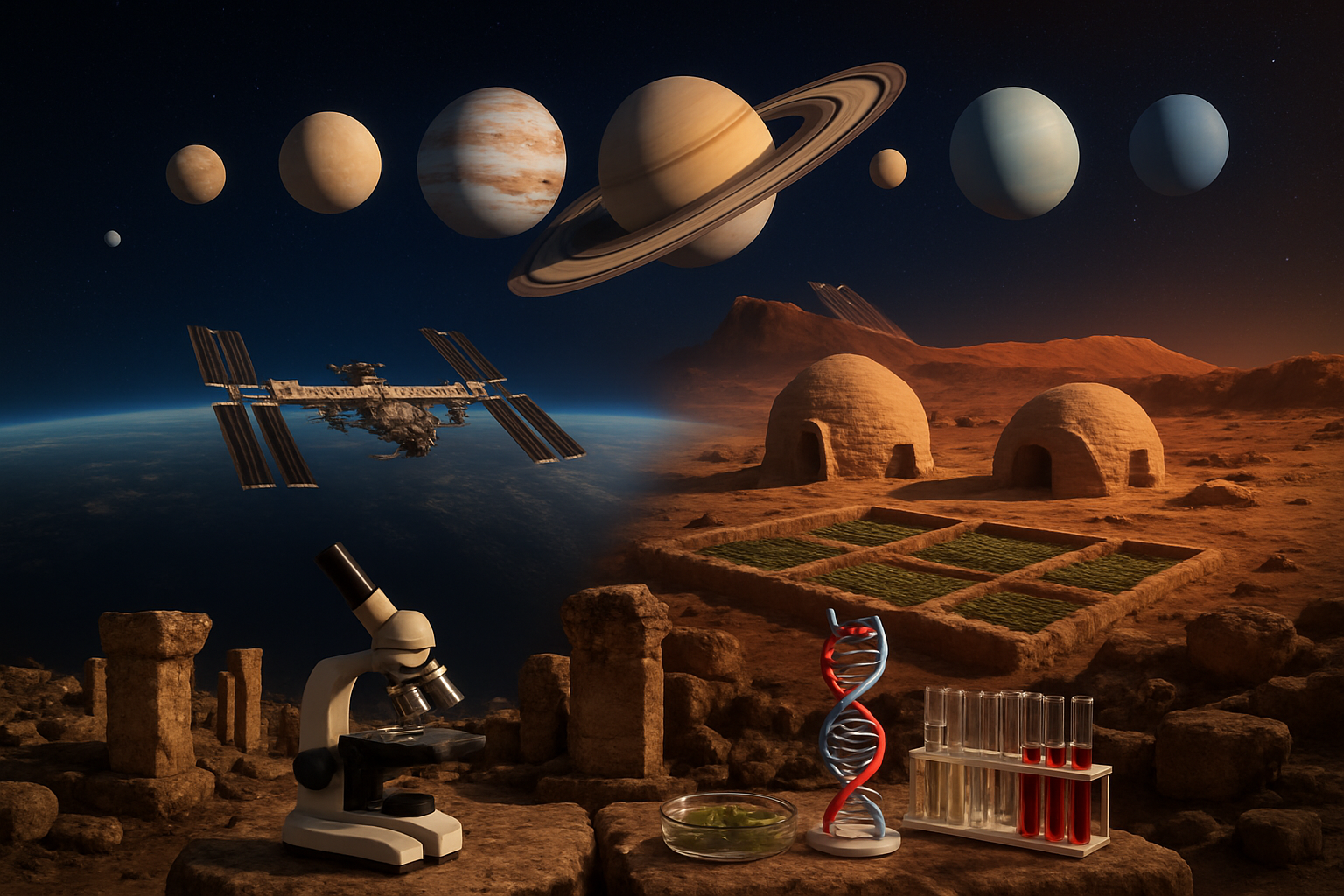
February 2026 has emerged as a defining period for space exploration and scientific research, with extraordinary developments spanning from celestial spectacles to groundbreaking agricultural innovations that could sustain future Mars colonies.
Rare Celestial Alignment Captivates Global Audiences
Tonight, February 28, 2026, six planets will align in a spectacular cosmic dance that has captured the attention of astronomers and the public worldwide. Mercury, Venus, Jupiter, Saturn, Neptune, and Uranus will appear in formation across the night sky in what NASA scientists describe as a rare "parade of planets."
According to Heidi Haviland, planetary scientist at NASA's Marshall Space Flight Center in Huntsville, Alabama, this alignment occurs due to orbital mechanics around the sun. While Mercury, Venus, Saturn, and Jupiter will be visible to the naked eye, Uranus and Neptune will require binoculars or telescopes to observe.
"Early risers should observe before sunrise, while night owls will get the best visibility right after sunset. Venus appears as the brightest 'morning star,' Jupiter shows as a steady golden-white point, and Saturn appears dimmer but still visible,"
— Heidi Haviland, NASA Planetary Scientist
This celestial event represents more than just astronomical spectacle—it demonstrates the predictable nature of cosmic mechanics during an era when space exploration has reached unprecedented sophistication. The alignment coincides with what industry experts are calling the transition from the "AI revolution" to the "space economy golden age."
Revolutionary Mars Agriculture Breakthrough
While Earth observers marvel at planetary alignments, scientists in the Netherlands have achieved a breakthrough that could revolutionize human survival on Mars. Researchers from Wageningen University have successfully developed new crop varieties capable of growing in Mars-like soil conditions.
The research team has been experimenting with growing potatoes in regolith—material similar to Martian soil—using innovative recycling techniques that release nutrients from waste materials. This development represents a crucial step toward sustainable food production for future Mars colonies.
The breakthrough addresses one of the most significant challenges facing long-term Mars exploration: creating a sustainable food system independent of Earth-based supplies. Previous Mars mission planning assumed all food would need to be transported from Earth, making extended missions prohibitively expensive and logistically complex.
3D Construction Revolution Takes Shape
Innovation in construction technology has reached new heights with Luxembourg's completion of its first 3D printed house, demonstrating how advanced manufacturing could transform both Earth-based construction and future space habitats.
The structure, built on a narrow plot measuring just 47 square meters, was completed in only four weeks using sustainable materials and ecological principles. This achievement showcases the potential for 3D printing technology to address housing shortages while reducing environmental impact.

The implications extend far beyond terrestrial construction. NASA and other space agencies are investigating similar 3D printing technologies for building lunar bases and Mars habitats using local materials. This approach would dramatically reduce the cost and complexity of establishing permanent human settlements beyond Earth.
Ancient Pandemic Reveals Historical Mysteries
Archaeological research has unveiled fascinating insights into humanity's ancient encounters with disease, providing valuable perspective on pandemic preparedness and medical history. New analysis of the first historically recorded pandemic, which struck the walled city of Jerash in modern-day Jordan during the 7th century, offers detailed information about those who died during this devastating event.
The research utilizes advanced analytical techniques unavailable to previous generations of archaeologists, including DNA analysis, isotope studies, and sophisticated imaging technologies. These methods allow scientists to reconstruct not only the biological impact of ancient diseases but also their social and cultural consequences.
Understanding historical pandemics provides crucial context for modern epidemiological research and pandemic preparedness strategies. The 7th-century pandemic in Jerash represents one of humanity's earliest documented encounters with large-scale infectious disease, offering lessons that remain relevant for contemporary public health planning.
International Space Cooperation Continues
Despite terrestrial tensions, international cooperation in space exploration has remained robust throughout February 2026. The successful ISS Crew-12 mission, featuring astronauts from the United States, Europe, and Russia, demonstrates the enduring power of scientific collaboration.
French astronaut Sophie Adenot's historic mission—making her the first French woman to reach the International Space Station in 25 years—exemplifies this international partnership. Her eight-month mission includes crucial research on lung tissue cultivation and Space-Associated Neuro-Ocular Syndrome (SANS), both essential for future deep space exploration.
"This research provides essential data for understanding how the human body adapts to extended space missions, directly supporting our preparation for lunar bases and eventual Mars exploration."
— NASA Mission Scientist
The ISS continues to serve as humanity's primary laboratory for understanding long-duration spaceflight effects, with research directly informing plans for sustained lunar presence and Mars exploration missions scheduled for the late 2020s and early 2030s.
Technological Convergence Drives Innovation
February 2026 has demonstrated the powerful convergence of multiple technological domains. Artificial intelligence continues to revolutionize space operations through autonomous navigation systems, while advanced materials science enables new construction techniques applicable both on Earth and in space.
The integration of AI with space exploration has reached new milestones, with NASA's successful implementation of fully autonomous Mars rover missions in late 2025 proving that AI systems can make real-time navigation decisions across cosmic distances. This capability is essential for future missions to Mars and beyond, where communication delays make Earth-based control impractical.
Similarly, the development of 3D printing technology for construction applications represents a convergence of materials science, robotics, and architectural design that promises to transform how humans build both terrestrial and extraterrestrial habitats.
Economic Implications of Space Innovation
The developments of February 2026 carry significant economic implications. SpaceX's preparation for a potential June 2026 IPO, with valuations potentially exceeding $1 trillion, reflects the maturation of commercial space industry from experimental venture to essential infrastructure.
The space economy encompasses far more than rocket launches and satellite deployment. Mars agricultural research promises new approaches to sustainable farming on Earth, while 3D construction technology could revolutionize both affordable housing and disaster relief efforts.
These innovations collectively represent a fundamental shift in how humanity approaches technological development—with space exploration driving terrestrial innovation and Earth-based research supporting space exploration goals.
Looking Toward a Spacefaring Future
As February 2026 draws to a close, the convergence of astronomical phenomena, technological breakthroughs, and international cooperation has established a foundation for humanity's next phase of cosmic exploration. The rare planetary alignment serves as a fitting metaphor for the alignment of scientific capabilities, economic resources, and international partnerships necessary for sustained space exploration.
From Mars agriculture to 3D construction, from ancient pandemic research to modern space medicine, the developments of this remarkable month demonstrate that scientific progress occurs across multiple domains simultaneously. Each breakthrough informs and supports others, creating a momentum that promises to accelerate humanity's expansion beyond Earth.
The success of these diverse endeavors—whether growing crops in Martian soil, building houses with 3D printers, or maintaining international cooperation aboard the ISS—proves that the most significant challenges facing human civilization require interdisciplinary approaches and sustained international collaboration.
As we witness tonight's planetary alignment, we can appreciate both the cosmic clockwork that governs our solar system and the human ingenuity that enables us to understand, predict, and eventually explore these celestial worlds. February 2026 will be remembered as a month when humanity's spacefaring capabilities reached new heights while remaining grounded in rigorous scientific research and international cooperation.