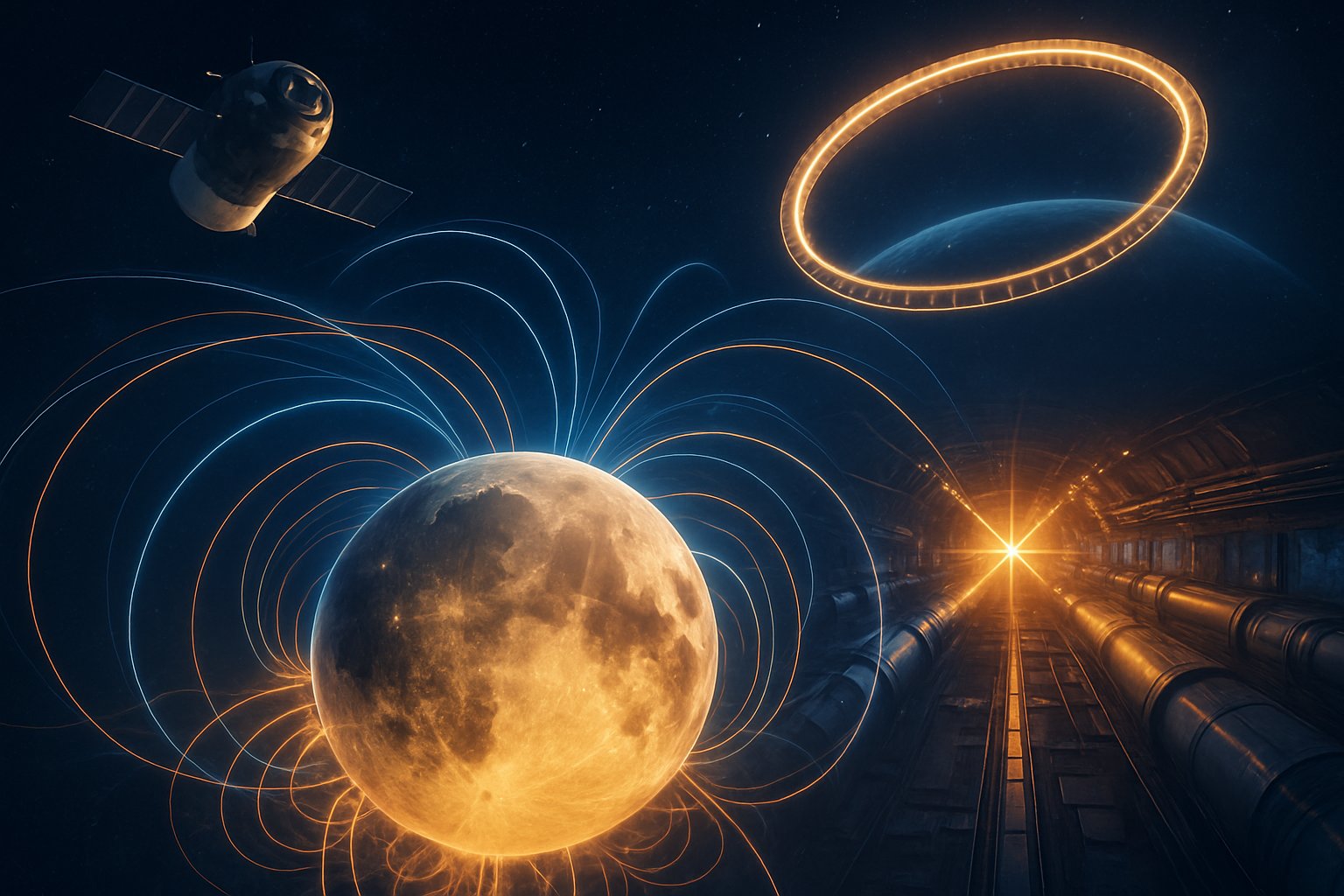
March 2026 has emerged as a defining moment for human scientific achievement, with researchers simultaneously solving one of the Moon's greatest mysteries while advancing our understanding of the universe's most fundamental particles through unprecedented international collaboration.
An international team of scientists has finally explained the long-standing puzzle of strong magnetization found in Apollo lunar samples collected over 50 years ago. Despite the Moon currently lacking the ability to generate magnetic fields, rock samples brought back by Apollo missions between 1969 and 1972 contained evidence of ancient magnetic activity that had confounded scientists for decades.
The breakthrough research, published in Nature Geoscience, reveals that the Moon experienced powerful but temporary magnetic fields during its early formation approximately 4.5 billion years ago. These fields were created through intense bombardment and heating from meteorite and asteroid impacts, which generated shock magnetization under extreme pressures and temperatures, leaving permanent magnetic signatures in the lunar rocks.
Revolutionary Particle Physics Discovery
Simultaneously, the Large Hadron Collider achieved another milestone by discovering its 80th particle, dubbed "Xi-cc-plus." This marks a significant advancement in our understanding of the fundamental building blocks of matter, as the world's most powerful particle accelerator continues to probe the mysteries of the universe at the European CERN physics laboratory.
The new particle was detected in the debris shower from proton collisions occurring at near-light speeds, recreating conditions similar to those immediately following the Big Bang. Scientists hope this discovery will provide new insights into the strong nuclear force that binds atomic nuclei together, contributing to our fundamental understanding of matter itself.
The Large Hadron Collider, a 27-kilometer-long proton-smashing ring running approximately 100 meters below the France-Switzerland border, represents humanity's most ambitious attempt to understand the universe's basic structure. The latest discovery comes as CERN plans to build an even more powerful successor, the Future Circular Collider, to continue pushing the boundaries of particle physics.
Space Operations Continue Despite Challenges
While these scientific breakthroughs captivated the research community, routine but critical space operations continued. Russia's cargo spacecraft Progress MS-31 successfully completed its eight-month mission at the International Space Station before being safely deorbited into a non-navigational area of the Pacific Ocean.
The spacecraft, which had been operating as part of the Russian segment of the ISS since July 2025, undocked at 4:24 p.m. Moscow time and fired its braking engine at 7:42 p.m., allowing it to leave orbit and disintegrate in Earth's dense atmospheric layers. This controlled deorbiting represents the careful management of space debris that has become increasingly important as humanity's presence in orbit expands.
"Today the Progress MS-31 cargo spacecraft, which had been operating as part of the Russian segment of the ISS since July 2025, was deorbited, entered dense layers of the atmosphere and disintegrated."
— Roscosmos Statement
Implications for Future Exploration
The lunar magnetic field discovery has immediate practical applications for NASA's Artemis program and other upcoming lunar missions. Understanding these ancient magnetic signatures provides crucial data for habitat placement, navigation systems, and electronic equipment functionality on the lunar surface. The magnetic anomalies serve as a geological roadmap, helping identify areas of scientific interest and potential resource deposits.
This research demonstrates the enduring value of preserving scientific samples for analysis with advancing technology. The Apollo specimens, carefully curated for over five decades, have yielded new insights through modern spectroscopic techniques that were unavailable to scientists in the 1970s.
The methodology developed for analyzing lunar magnetic properties will prove applicable to understanding Mars, asteroids, and other planetary bodies, contributing to humanity's expanding cosmic presence. As space agencies prepare for sustained lunar exploration, this fundamental geological knowledge becomes essential for establishing permanent human settlements beyond Earth.
International Scientific Renaissance
These discoveries occur during what researchers are calling a "space economy golden age," marked by unprecedented international cooperation in scientific research. The convergence of multiple breakthrough discoveries in March 2026 reflects the maturation of global scientific collaboration networks that transcend political boundaries.
The success of these investigations demonstrates the value of sustained investment in basic scientific research and the importance of preserving samples and data for future analysis. From the Apollo moon rocks analyzed with modern techniques to the high-energy particle collisions at CERN, March 2026 showcases how patient, methodical scientific inquiry yields transformative insights.
Looking ahead, these breakthroughs establish foundations for continued scientific advancement. The lunar magnetic research informs future planetary exploration missions, while particle physics discoveries at the LHC contribute to our understanding of the universe's fundamental nature. Together, they represent humanity's relentless pursuit of knowledge about our place in the cosmos and the basic principles governing reality itself.
Building Toward a Spacefaring Future
As humanity prepares for expanded space exploration through programs like Artemis and commercial space initiatives, the scientific discoveries of March 2026 provide essential knowledge for this cosmic expansion. The Moon's magnetic history helps us understand not just our satellite's evolution, but the processes that shaped all rocky planets in our solar system.
Meanwhile, advances in fundamental particle physics continue to reveal the universe's underlying architecture, potentially informing future technologies that could revolutionize space travel and energy generation. The synergy between space science and particle physics research demonstrates the interconnected nature of scientific discovery, where breakthroughs in one field often illuminate mysteries in another.
March 2026 will be remembered as a month when human scientific achievement reached new heights through international collaboration, patient research, and the application of cutting-edge analytical techniques to both ancient samples and contemporary experiments. These discoveries not only answer long-standing questions but open new avenues of inquiry that will drive scientific progress for generations to come.