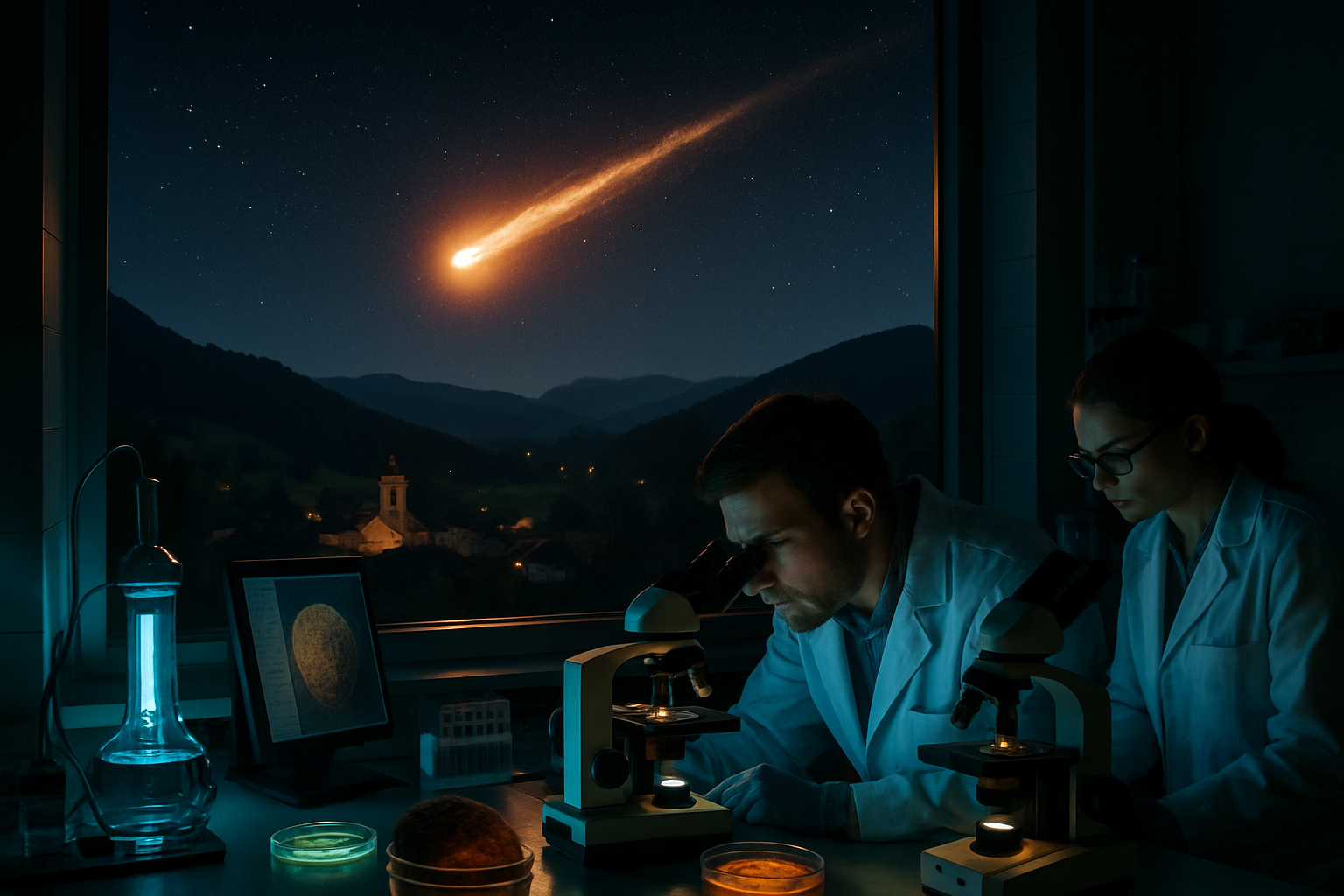
A convergence of spectacular celestial phenomena and groundbreaking laboratory research has delivered unprecedented insights into humanity's cosmic origins, as American scientists demonstrate that extremophile bacteria can survive conditions equivalent to asteroid impacts on Mars, while European observers witness dramatic meteorite displays that underscore our solar system's dynamic nature.
The revolutionary experiment, conducted by American researchers and reported by Czech sources, represents a paradigm shift in our understanding of panspermia – the scientific hypothesis that life can spread between planets through natural processes. The research team subjected highly resistant bacterial strains to pressures and conditions that would occur when asteroids strike the Martian surface, simulating the violent ejection of material that could carry microbial life across interplanetary space.
Bacterial Survival Under Extreme Conditions
The experiment's results have profound implications for astrobiology and our understanding of life's potential distribution throughout the solar system. The extremophile bacteria not only survived the simulated asteroid impact conditions but maintained their biological integrity under pressures comparable to those generated when cosmic projectiles strike planetary surfaces at velocities exceeding 20 kilometers per second.
These findings build upon decades of research into extremophile organisms – life forms that thrive in conditions previously thought unsurvivable. From deep-sea hydrothermal vents to the highly radioactive zones of Chernobyl, these remarkable organisms have consistently challenged our assumptions about the limits of biological resilience.
"The possibility that life on Earth could have originated elsewhere in the universe has long been the domain of speculation. This new experiment gives it more realistic contours."
— Czech Scientific Community Assessment
Swiss Meteorite Spectacle Provides Cosmic Context
As laboratory researchers explore the theoretical foundations of interplanetary life transfer, European sky watchers have been treated to a vivid demonstration of the ongoing cosmic bombardment that makes such transfers possible. Sunday evening witnessed a spectacular meteorite event over the Basel-Landschaft region of Switzerland, with the celestial visitor creating a brilliant streak across the darkening sky before impacting in southern Germany with sufficient force to damage buildings.
The Swiss meteorite event, while destructive on a local scale, represents the everyday cosmic processes that have shaped planetary evolution for billions of years. These impacts, ranging from microscopic particles to kilometer-sized asteroids, provide the mechanism through which material – potentially including life itself – can travel between worlds.
What humans rarely witness directly is, in astronomical terms, routine occurrence. Earth experiences constant bombardment from space debris, with most objects burning up harmlessly in our atmosphere. However, larger meteorites like the one observed over Switzerland demonstrate the ongoing exchange of material between celestial bodies that may have facilitated life's spread throughout the solar system.
Historical Context and Scientific Precedent
The current research builds upon a rich tradition of space-based discoveries that have revolutionized our understanding of life's potential cosmic origins. Recent memory holds numerous breakthroughs that have expanded our conception of life's resilience and distribution. The "Black Beauty" meteorite from Mars revealed significantly more water content than previously assumed, strengthening theories that Mars was much wetter in ancient times and potentially capable of supporting life.
International space exploration efforts have consistently yielded discoveries that challenge conventional wisdom about planetary formation and the conditions necessary for life. From Jupiter size recalculations that have forced textbook revisions to the discovery of organic molecules in interstellar space, the pattern of surprising findings continues to expand our cosmic perspective.
Implications for Mars Exploration
The bacterial survival experiments carry immediate relevance for ongoing Mars exploration programs. As NASA's Artemis program faces technical delays and international space agencies prepare for eventual human missions to Mars, understanding the potential for life transfer between planets becomes crucial for both planetary protection protocols and the search for indigenous Martian life.
The research suggests that if life ever existed on Mars – and growing evidence indicates it may have – that life could potentially have survived the violent process of being ejected from the planet during massive impact events. This mechanism could explain not only how life might have traveled from Mars to Earth billions of years ago, but also how Earth-based contamination might threaten any remaining Martian ecosystems.
Space Economy and Scientific Investment
These discoveries emerge during what analysts describe as the transition from the "AI revolution" to the "space economy golden age." With SpaceX preparing for a potentially trillion-dollar IPO and international cooperation expanding through programs like the ISS, the confluence of commercial space development and fundamental scientific research is accelerating the pace of discovery.
The economic implications of understanding life's potential cosmic distribution extend far beyond academic interest. Space-based biotechnology, the search for extraterrestrial resources, and the development of life support systems for long-duration space missions all depend on comprehensive knowledge of how life functions under extreme conditions.
International Collaboration in Space Science
The current research exemplifies the international nature of modern space science, with American experimental work being reported through Czech sources and contextualized by Swiss observational data. This collaborative approach reflects broader trends in space exploration, where shared facilities like the James Webb Space Telescope and the International Space Station enable discoveries that transcend national boundaries.
Recent developments in international space cooperation include Pakistan's selection of astronaut candidates for China's Tiangong station and Thailand's leadership role in UN space governance. These partnerships demonstrate how space science is becoming increasingly democratized, with emerging nations contributing to humanity's cosmic understanding.
Climate Change and Urgency of Discovery
The research occurs against the backdrop of accelerating environmental change on Earth, with recent months marking consecutive records for global temperature increases. This context adds urgency to understanding life's adaptive mechanisms and potential for survival under extreme conditions – knowledge that may prove crucial for Earth's biological future as well as our expansion into space.
Climate change also affects space research infrastructure, with some ground-based telescopes and research facilities facing challenges from extreme weather events. This reality emphasizes the importance of space-based research platforms and the need for redundant observational capabilities.
Future Research Directions
The bacterial survival experiments open numerous avenues for future investigation. Researchers will likely expand their studies to include different types of microorganisms, various impact velocities, and different planetary environments. The goal is to create a comprehensive understanding of the conditions under which life can survive interplanetary transfer.
Simultaneously, ongoing Mars missions will search for evidence of past or present life on the Red Planet, with particular attention to impact sites where material might have been exchanged with Earth. The Mars Sample Return mission, currently in development, will bring Martian material to Earth laboratories where more detailed analysis of potential biological signatures can be conducted.
Technological Applications
Beyond their scientific significance, these discoveries have practical applications for space technology development. Understanding how life survives extreme conditions informs the design of life support systems for long-duration missions, biological experiments in space, and potential terraforming technologies.
The research also contributes to planetary protection protocols – the international guidelines designed to prevent contamination between Earth and other worlds during space missions. As human presence in space expands, these protocols become increasingly important for preserving both scientific integrity and potential extraterrestrial ecosystems.
The convergence of laboratory breakthroughs and celestial observations represents a watershed moment in space science, where theoretical possibilities gain experimental support while dramatic sky events remind us of the cosmic processes that shape our existence. As we stand on the threshold of becoming a truly spacefaring civilization, these discoveries provide both the scientific foundation and the inspirational vision necessary for humanity's next great leap into the cosmos.
The implications extend far beyond academic curiosity, touching on fundamental questions about our place in the universe, the resilience of life itself, and the potential for biological diversity throughout the solar system and beyond. Whether life began on Earth or arrived from Mars, these findings illuminate the remarkable adaptability of life and the dynamic processes that continue to shape planetary evolution across the cosmos.