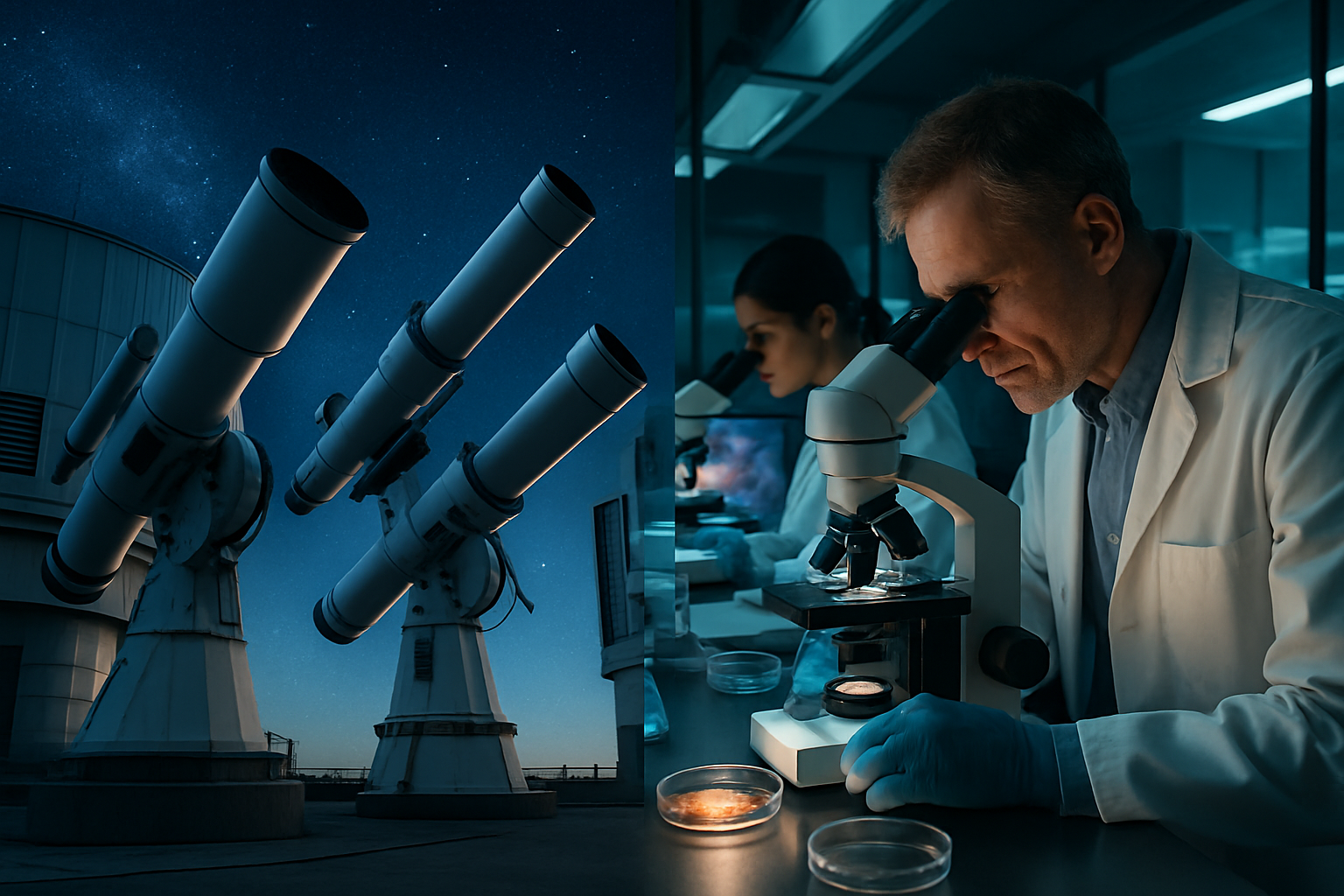
March 2026 marks an extraordinary culmination of what scientists are calling the "2026 Scientific Renaissance" – a year of unprecedented breakthroughs spanning space exploration, archaeological discoveries, and cutting-edge research that is fundamentally reshaping our understanding of the universe and human history.
Space Exploration Enters Golden Age
The year 2026 has witnessed humanity's transition from what experts describe as the "AI revolution to space economy golden age," with remarkable achievements demonstrating both international cooperation and technological sophistication unprecedented in space exploration history.
Perhaps most significantly, Chinese scientists achieved a historic first in March 2026, using artificial intelligence to determine the chemical composition of the Moon's far side through analysis of Chang'e-6 mission samples. Led by Shanghai Institute of Technical Physics (SITP), this breakthrough represents the first detailed chemical mapping of lunar regions that have remained permanently hidden from Earth, unlocking fundamental secrets about nearly half of the Moon's surface.
"This AI-powered analysis processed complex molecular patterns that would have required decades using traditional methods. We're witnessing the convergence of space exploration with cutting-edge artificial intelligence capabilities."
— Dr. Li Chen, Shanghai Institute of Technical Physics
The achievement comes amid a broader pattern of space discoveries that challenge established scientific understanding. Recent findings include NASA's detection of massive stellar formations through advanced X-ray imaging technology, revealing young Sun-like stars creating unprecedented bubble structures that provide crucial insights into early solar system behavior.
International Cooperation Despite Competition
While commercial space competition intensifies – with SpaceX preparing a potential trillion-dollar IPO for June 2026 – international scientific cooperation continues to drive breakthrough discoveries. The International Space Station maintains full operational capacity through the historic Crew-12 mission, featuring Sophie Adenot as the first French woman aboard the ISS in 25 years, conducting critical lung tissue cultivation and space medicine research.
Pakistan's selection of astronaut candidates for China's Tiangong space station mission scheduled for October-November 2026 exemplifies the democratization of space capabilities, allowing emerging nations to participate in human spaceflight through strategic partnerships.
Archaeological Renaissance Transforms Historical Understanding
Parallel to space achievements, 2026 has delivered groundbreaking archaeological discoveries that fundamentally challenge conventional understanding of human development and ancient civilizations.
Austrian researchers made headlines in March with their confirmation of lonsdaleite – the first material proven harder than diamond. This rare mineral, formed during meteor impacts under extreme conditions, represents a materials science revolution with potential applications spanning precision manufacturing to aerospace engineering.
Archaeological teams have uncovered evidence suggesting sophisticated human capabilities emerged far earlier than previously believed. Recent discoveries include 14,000-year-old mammoth ivory tools in Alaska that predate established American settlement theories, and fire control evidence from eastern England indicating early humans mastered combustion techniques 350,000 years earlier than scientific timelines previously established.
Methodological Revolution Through Technology Integration
The 2026 scientific breakthroughs share a common foundation: the integration of advanced analytical techniques with traditional scholarly methods. DNA analysis, isotope studies, sophisticated imaging, and AI-powered data processing are revealing previously invisible aspects of both cosmic and human history.
Romanian scientists extracted 5,000-year-old bacterial strains from ice caves, discovering microorganisms with unique survival mechanisms that predate human civilization while possessing natural antibiotic resistance. This research provides crucial insights for addressing contemporary medical challenges while revealing the complex history of microbial life on Earth.
Similarly, space-based observations using the James Webb Space Telescope have detected organic molecules in interstellar space and identified "impossible" planetary systems 116 light-years away that challenge fundamental formation theories, forcing astronomers to reconsider basic assumptions about cosmic architecture.
Climate Change Urgency Drives Preservation Efforts
The scientific renaissance occurs against a backdrop of climate urgency, with January 2026 marking the 18th consecutive month of temperatures exceeding 1.5°C above pre-industrial levels. This environmental reality adds urgency to archaeological preservation efforts, as many sites containing ancient treasures face threats from climate change, development, and deterioration.
Research teams are racing to document and preserve historical evidence before potential environmental damage occurs, while space-based climate monitoring provides unprecedented data for understanding atmospheric changes and developing adaptation strategies.
Economic and Strategic Implications
The convergence of scientific discoveries carries substantial economic implications across multiple sectors. Space agriculture research is driving sustainable farming innovations on Earth, while archaeological findings boost cultural tourism and enhance international cultural diplomacy. Countries implementing prevention-focused scientific approaches report superior cost-effectiveness compared to reactive models.
The space economy, projected to exceed $1 trillion by 2030, benefits from discoveries that inform resource utilization, habitat design, and life support systems for permanent space settlements. Meanwhile, materials science breakthroughs like lonsdaleite confirmation could revolutionize manufacturing and precision engineering across terrestrial industries.
Looking Forward: Templates for Continued Advancement
The 2026 Scientific Renaissance demonstrates that coordinated global research can achieve transformative breakthroughs even amid resource constraints and geopolitical tensions. The success stems from several key factors: sustained international cooperation, integration of cutting-edge technology with traditional methods, interdisciplinary collaboration, and recognition that scientific advancement serves both peaceful exploration and practical human needs.
As we move through March 2026, the pattern of discoveries suggests this watershed year will be remembered as a turning point when humanity significantly expanded its cosmic understanding while recovering lost chapters of its own history. The convergence of space exploration capabilities, archaeological techniques, and international cooperation has created unprecedented opportunities for advancing human knowledge.
"We're witnessing a scientific renaissance that rivals any period in human history. The integration of space exploration, advanced archaeology, and international cooperation is unlocking secrets of both the cosmos and our own past simultaneously."
— Dr. Sarah Johnson, International Science Cooperation Institute
The discoveries of 2026 establish foundations for continued breakthroughs that could determine humanity's capacity to address 21st-century challenges while expanding our presence beyond Earth. This scientific renaissance demonstrates that through coordinated international cooperation and technological innovation, humanity can achieve remarkable advances in understanding both our place in the universe and our remarkable journey through time.