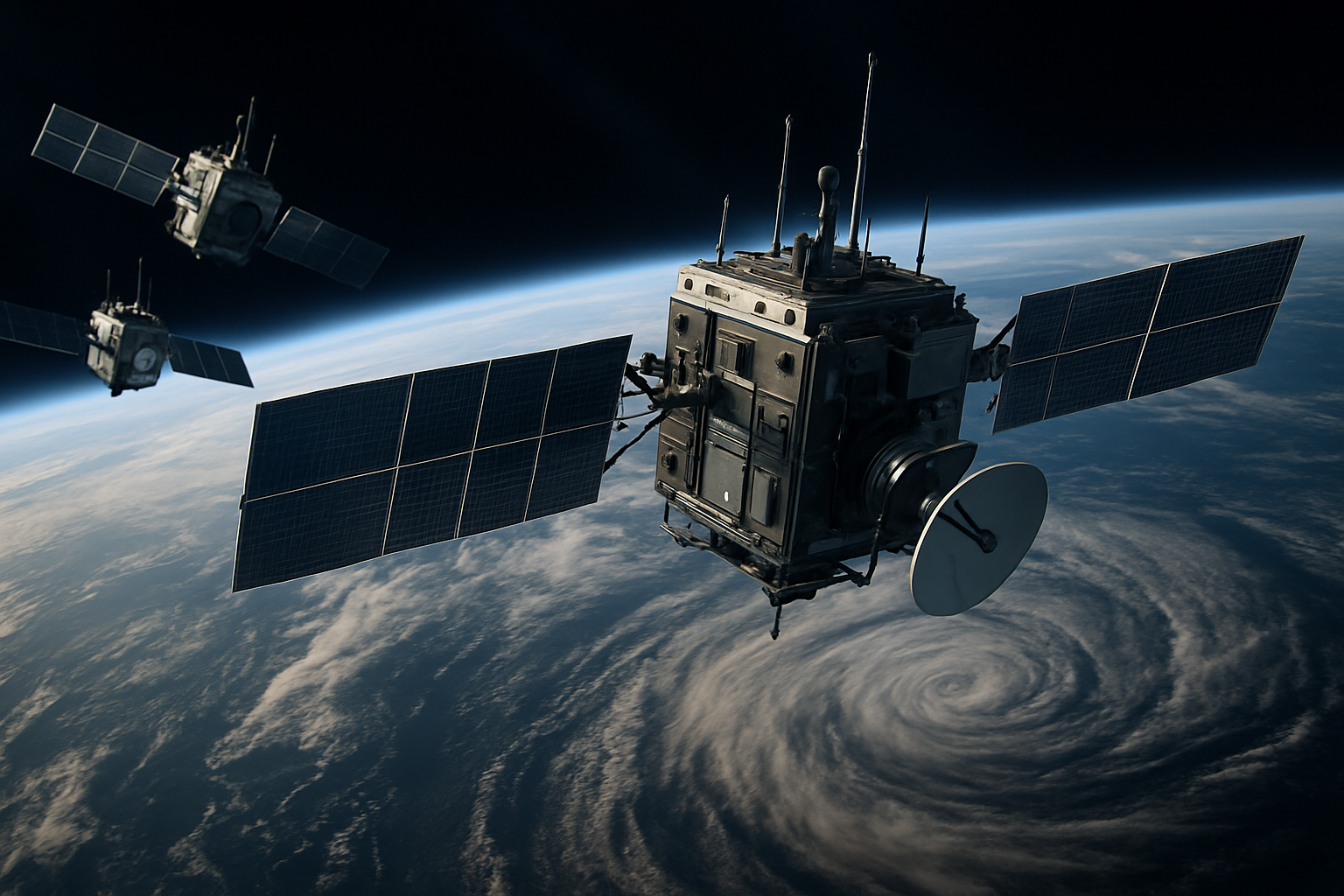
The space technology sector witnessed major developments this week as Israeli-founded weather satellite company Tomorrow.io secured $175 million in funding while Portuguese researchers launched pioneering studies into neurological conditions affecting astronauts, highlighting the dual advancement of commercial space applications and space medicine.
Tomorrow.io, often dubbed the "SpaceX of weather," announced the substantial funding round to accelerate deployment of its next-generation AI-powered satellite constellation designed to revolutionize extreme weather forecasting. The company's satellite network represents a significant leap forward in weather prediction technology, utilizing artificial intelligence to analyze rapidly evolving weather patterns and improve emergency preparedness systems worldwide.
AI-Powered Weather Revolution
The Israeli-founded company has positioned itself at the forefront of the commercial weather satellite industry, developing sophisticated AI systems capable of tracking fast-evolving extreme weather events with unprecedented accuracy. The satellite constellation aims to provide real-time weather data that could transform disaster response and emergency preparedness protocols globally.
Tomorrow.io's technology comes at a critical time when extreme weather events are becoming increasingly frequent and severe. The company's AI-driven approach promises to deliver more precise forecasting capabilities, potentially saving lives and reducing economic losses from weather-related disasters.
The substantial funding round reflects growing investor confidence in the commercial space weather sector, particularly as climate change drives demand for more sophisticated meteorological monitoring systems. The investment will enable Tomorrow.io to expand its satellite deployment and enhance its AI algorithms for better predictive capabilities.
Space Medicine Breakthrough
Meanwhile, Portugal's National Institute of Engineering, Technology and Innovation (INEGI) has launched groundbreaking research into Space-Associated Neuro-Ocular Syndrome (SANS), a condition that affects astronauts during extended space missions. The research initiative represents a significant advancement in understanding the medical challenges faced by space travelers.
SANS manifests through neurological and ocular alterations that can significantly impact astronauts' visual acuity, presenting serious challenges for long-duration space missions. The condition has become a growing concern for space agencies as they plan for extended missions to Mars and establish permanent lunar bases.
The Portuguese research project aims to identify the underlying causes of SANS, which could prove crucial for future deep space exploration missions. Understanding and potentially preventing this condition will be essential for the success of planned missions to Mars and the establishment of sustainable human presence in space.
Industry Context and Implications
These developments occur within a broader context of rapid advancement in the global space industry. Recent months have seen significant progress across multiple sectors, from SpaceX's expanded Starlink constellation providing global coverage to NASA's successful deployment of fully AI-planned Mars rover missions.
The European space industry has also shown remarkable growth, with companies like Germany's Isar Aerospace establishing new testing facilities in Sweden capable of testing 30 rocket engines monthly, reflecting the continent's push for launch independence and technological sovereignty.
The convergence of commercial satellite technology and space medicine research highlights the maturation of the space industry beyond traditional government programs. Private companies are now driving innovation in weather forecasting while international research institutions tackle the medical challenges of space exploration.
Future Implications for Space Exploration
Tomorrow.io's AI-powered weather satellites could prove invaluable for future space missions, providing crucial atmospheric data for launch operations and mission planning. The company's technology may also support climate monitoring from space, contributing to global efforts to understand and respond to climate change.
The Portuguese research into SANS represents equally important progress for human space exploration. As space agencies plan missions to Mars that could last several years, understanding and preventing space-induced medical conditions becomes critical for mission success and astronaut safety.
These parallel developments in commercial satellite technology and space medicine research demonstrate the multifaceted nature of modern space industry advancement. While companies like Tomorrow.io focus on Earth-based applications of space technology, research institutions are solving the challenges of human adaptation to space environments.
Global Space Technology Ecosystem
The international nature of these developments reflects the increasingly collaborative and competitive global space ecosystem. Israeli innovation in weather satellites, Portuguese research in space medicine, and broader European space infrastructure development all contribute to a rapidly evolving industry landscape.
This ecosystem approach has accelerated innovation across multiple domains simultaneously, from AI-powered Earth observation to human factors research for deep space missions. The result is a more robust and capable space industry that can address both commercial applications and fundamental challenges of space exploration.
As the space industry continues to mature, the integration of commercial innovation with scientific research will likely drive further breakthroughs. Companies like Tomorrow.io demonstrate the commercial viability of advanced space technologies, while research institutions like INEGI tackle the fundamental challenges that will enable humanity's expansion beyond Earth.