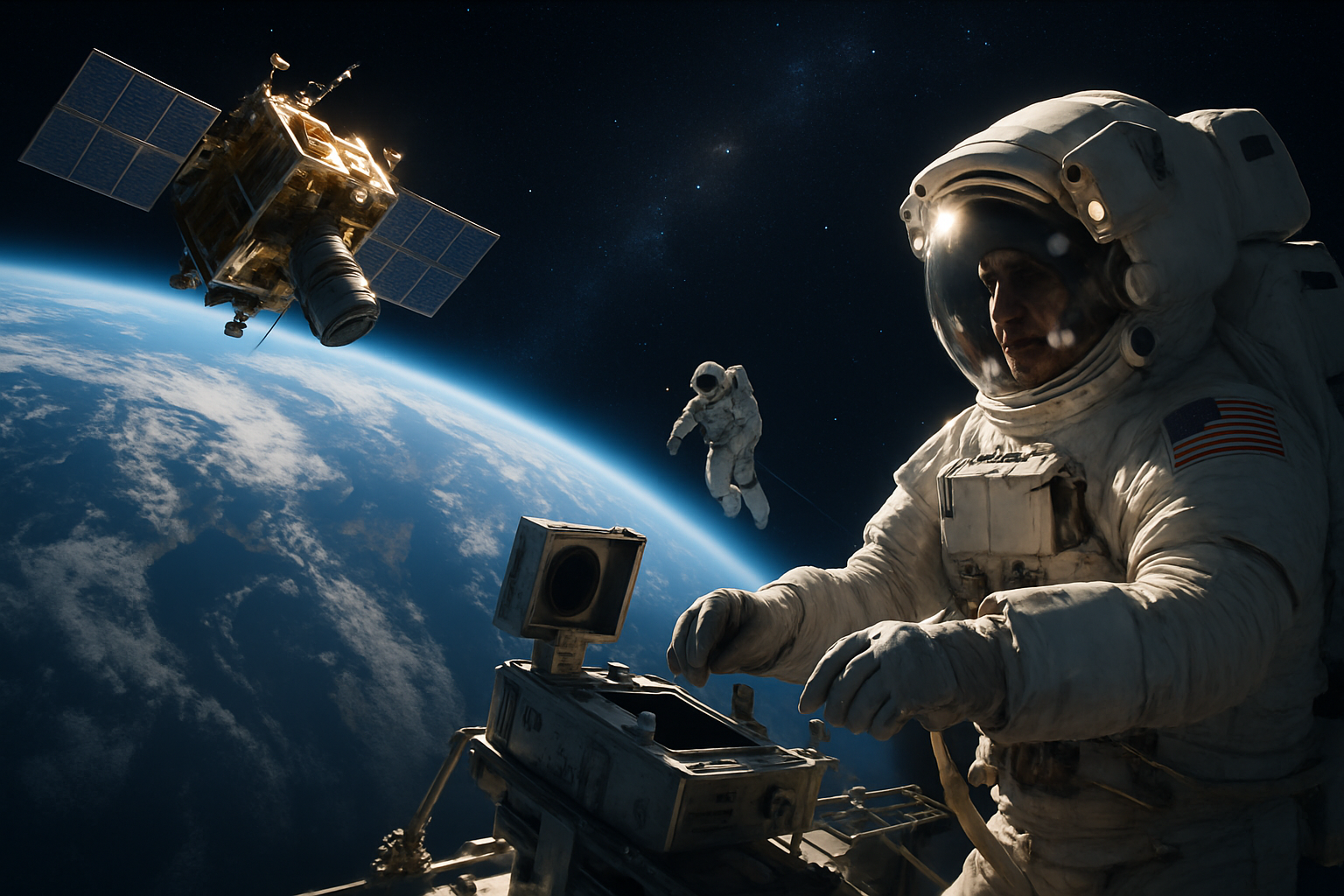
April 2026 has witnessed remarkable achievements in space technology, from groundbreaking satellite missions designed to monitor climate-related hazards to revolutionary discoveries about massive stellar explosions that challenge our understanding of the cosmos.
Climate Monitoring Satellite Success
In a historic collaboration between Kenya, Uganda, and Egypt, scientists successfully launched the ClimCam, the first climate monitoring camera specifically designed for the International Space Station. This innovative instrument represents a significant advancement in Earth observation technology, positioned to monitor floods, droughts, and other climate-related hazards that frequently affect the East African region.
The ClimCam deployment comes at a critical time when accurate climate data is essential for disaster preparedness and agricultural planning across sub-Saharan Africa. The satellite's advanced sensors can detect early warning signs of environmental changes, providing governments and relief organizations with crucial data to implement preventive measures.
"This represents not just a technological achievement, but a vital tool for protecting vulnerable communities across East Africa from climate-related disasters."
— African Space Consortium Representative
Stellar Physics Breakthrough: Evidence of Gargantuan Star Explosions
Simultaneously, scientists have uncovered compelling evidence for theorized "gargantuan star explosions" – supernovas so immensely powerful they leave absolutely nothing behind, not even compact stellar remnants like neutron stars or black holes. This groundbreaking research, led by Hui Tong, a doctoral student in astrophysics at Monash University in Australia, has been published in the prestigious journal Nature.
These ultra-powerful supernovas are predicted to occur in the most enormous stars – those with masses 140 to 260 times greater than our Sun. Despite their colossal size, these stellar giants live relatively short lives of only a few million years before meeting their spectacular end.
Revolutionary Detection Methods
The evidence for these extreme stellar events comes through innovative research involving black holes and gravitational waves – ripples in spacetime itself. Scientists since the 1960s have theorized the existence of these ultra-powerful supernovas, but only now have they developed the sophisticated detection methods needed to find indirect evidence of their occurrence.
The research methodology represents a convergence of multiple cutting-edge technologies: gravitational wave detectors, advanced computational models, and artificial intelligence systems capable of processing vast amounts of cosmic data. This technological integration exemplifies the current "golden age of space observation," where international cooperation and advanced instrumentation are revealing previously hidden cosmic phenomena.
Context of Space Technology Renaissance
These achievements occur during what space industry experts describe as humanity's transition from the "AI revolution to the space economy golden age." The period is characterized by unprecedented international cooperation, with nations like Pakistan preparing astronaut missions to China's Tiangong space station, while commercial entities like SpaceX prepare for potentially trillion-dollar valuations.
The ClimCam mission demonstrates the democratization of space technology, where emerging nations can develop specialized capabilities that address regional challenges while contributing to global scientific knowledge. This contrasts with traditional space programs that required massive resource investments typically available only to major powers.
Implications for Future Space Exploration
The stellar explosion research provides critical insights for deep space exploration safety. Understanding the most extreme cosmic events helps scientists assess potential hazards for future interplanetary missions and long-term space settlements. The findings also contribute to ongoing planetary defense initiatives, as scientists work to catalog and understand cosmic threats.
Meanwhile, the success of regional satellite missions like ClimCam establishes templates for international cooperation that could accelerate space-based solutions to terrestrial challenges. Climate monitoring from space offers precision and coverage impossible through ground-based systems alone.

Technological Integration and AI Enhancement
Both achievements highlight the crucial role of artificial intelligence in modern space technology. Climate monitoring satellites now employ AI algorithms for rapid data analysis and threat assessment, while stellar physics research relies on machine learning to process gravitational wave signatures and identify patterns that would be impossible for human researchers to detect manually.
This integration of AI with traditional space technology creates capabilities that surpass the sum of their parts, enabling real-time decision-making across cosmic distances and processing data volumes that previously required months or years of analysis.
Economic and Strategic Significance
The space economy is projected to exceed $1 trillion by 2030, with specialized satellite missions and breakthrough scientific discoveries driving both immediate applications and long-term economic development. Climate monitoring satellites provide direct economic benefits through improved disaster preparedness and agricultural optimization, while fundamental research into stellar physics contributes to the knowledge base essential for advanced space exploration.
Countries investing in space capabilities position themselves for leadership in emerging markets while addressing immediate national needs through space-based solutions.
International Cooperation Framework
The success of these missions demonstrates that effective space technology development increasingly depends on international collaboration. The ClimCam project shows how regional partnerships can address shared challenges, while the stellar physics research exemplifies global scientific cooperation where researchers from multiple institutions contribute specialized expertise.
This cooperative framework represents a fundamental shift from the competitive space race era toward collaborative exploration that benefits all humanity while enabling individual nations to develop specialized capabilities aligned with their particular strengths and needs.
Looking Toward the Future
As we advance through 2026, these achievements establish foundations for even more ambitious projects. Climate monitoring capabilities will expand to cover global environmental challenges, while stellar physics research opens new frontiers in understanding cosmic evolution and the potential for life throughout the universe.
The convergence of practical applications like climate monitoring with fundamental research into cosmic phenomena exemplifies the maturation of space technology as both an essential infrastructure for addressing terrestrial challenges and a gateway to expanding human presence beyond Earth.
April 2026 thus represents a watershed moment where space technology achievements demonstrate humanity's growing capability to address immediate challenges while simultaneously expanding our cosmic horizons through scientific discovery and technological innovation.