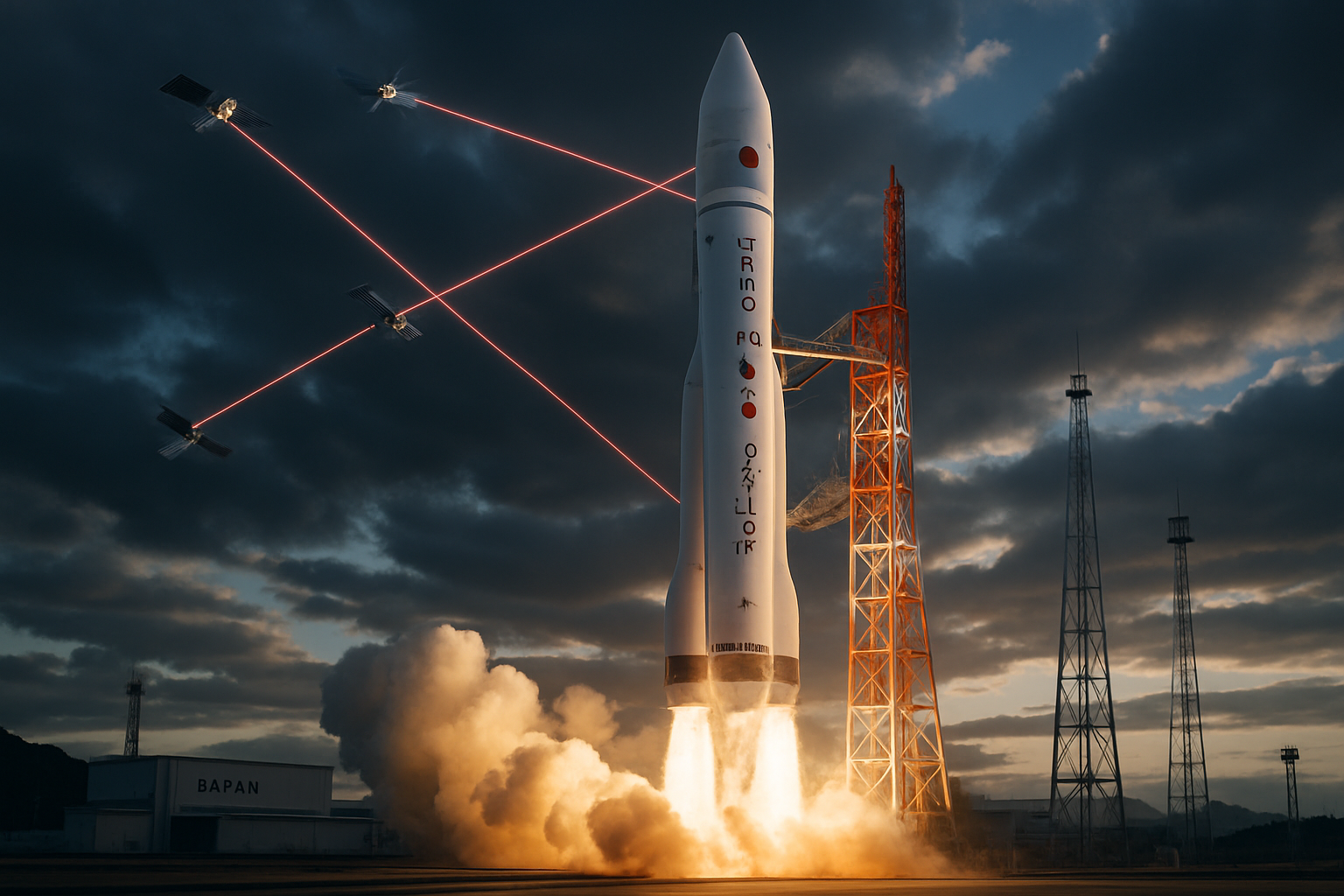
The global space industry confronts mounting technical challenges and infrastructure limitations as Japan's Space One cancels its third rocket launch attempt within a week, while European researchers work on revolutionary laser-based solutions to address the growing data bottleneck threatening satellite internet operations.
Space One's 18-meter Kairos rocket faced yet another weather-related cancellation on March 1, 2026, marking the second postponement in five days following Wednesday's scrubbed attempt. The repeated delays underscore the persistent operational challenges facing Japan's emerging commercial space sector, which aims to compete in the rapidly expanding small satellite launch market.
Weather Dependency Challenges Private Launch Operations
The consecutive cancellations of Space One's Kairos rocket highlight a fundamental challenge in commercial spaceflight: the critical dependency on favorable weather conditions for safe launch operations. Unlike larger government programs with extended scheduling flexibility, private companies face intense pressure to maintain regular launch cadences to remain economically viable.
Space One's struggles occur within the broader context of Japan's strategic pivot toward private-sector space capabilities, designed to complement government programs and address growing demand in the small satellite market. The company's setbacks demonstrate the sophisticated engineering and operational expertise required for routine space access, even as the industry transitions from experimental ventures to essential infrastructure.
Satellite Internet Faces Data Congestion Crisis
While companies struggle to reach orbit, those already operating in space confront a different but equally critical challenge: managing the explosive growth in data transmission demands. Swiss research reveals that satellite internet networks risk becoming overwhelmed before achieving widespread adoption, with optical laser links emerging as a potential solution.
The research, published by Swiss scientists, indicates that traditional radio frequency communications may soon reach capacity limits as satellite constellations expand and user demands increase. Laser-based optical communication offers dramatically higher data transfer rates but faces its own technical obstacles, particularly cloud interference that can disrupt laser links between satellites and ground stations.
"Satellite internet networks face the threat of overload before properly establishing themselves. Optical links to Earth could provide relief – if not for the clouds."
— Swiss Research Analysis
Optical Communication: The Next Frontier
Laser communication technology represents a fundamental shift from traditional radio frequency systems, offering bandwidth capabilities orders of magnitude greater than current satellite internet infrastructure. However, the technology's vulnerability to atmospheric conditions, particularly cloud cover, presents significant engineering challenges that must be overcome for reliable commercial deployment.
European researchers are investigating adaptive systems that could automatically switch between optical and radio frequency communications based on atmospheric conditions, potentially providing the reliability needed for critical applications while maximizing data throughput during optimal conditions.
Commercial Space Industry at Crossroads
The convergence of launch challenges and data transmission limitations illustrates the complex technical landscape facing the commercial space industry as it matures from experimental operations to essential infrastructure. Companies must simultaneously solve problems of getting to space reliably and cost-effectively while managing the increasing demands of space-based services once operational.
Space One's repeated delays occur during what industry analysts call the "space economy golden age," a period of unprecedented commercial activity and investment. The company's challenges reflect broader industry dynamics where technical excellence, operational reliability, and economic sustainability must align for long-term success.
International Competition Intensifies
Japan's commercial space ambitions face increasing international competition as countries worldwide develop independent launch capabilities and satellite technologies. SpaceX continues to dominate the commercial launch market with regular Falcon 9 missions, while China advances its reusable spacecraft programs and European companies expand manufacturing capabilities.
The technical setbacks experienced by Space One highlight the sophisticated engineering challenges that separate successful space operations from ambitious plans. Weather dependency, precision timing requirements, and complex systems integration demand sustained investment in both technology and operational expertise.
Infrastructure Solutions for Space-Based Economy
The dual challenges of reliable space access and efficient data communication reflect the infrastructure requirements of an emerging space-based economy. Success requires not only getting payloads to orbit but also ensuring those space-based assets can communicate effectively with ground-based users and systems.
Swiss research into laser communication solutions demonstrates the innovative approaches required to address capacity limitations before they constrain the growth of satellite-based services. The development of hybrid communication systems could enable the reliable, high-capacity data links essential for everything from internet access to autonomous vehicle coordination.
Looking Forward: Technical Innovation and Operational Excellence
The space industry's current challenges emphasize the need for continued innovation in both launch systems and space-based infrastructure. Weather-resistant launch operations, advanced communication technologies, and reliable orbital systems form the foundation for sustainable commercial space activities.
Space One's commitment to overcoming technical and operational challenges reflects the broader industry's determination to establish space as a routine domain for commercial activity. The resolution of current launch reliability and data capacity issues will determine whether the space economy fulfills its transformative potential or remains limited by fundamental infrastructure constraints.
As the industry approaches what many consider a critical inflection point, success will depend on companies' ability to balance ambitious goals with rigorous engineering standards, ensuring that space-based services become as reliable and accessible as terrestrial infrastructure.