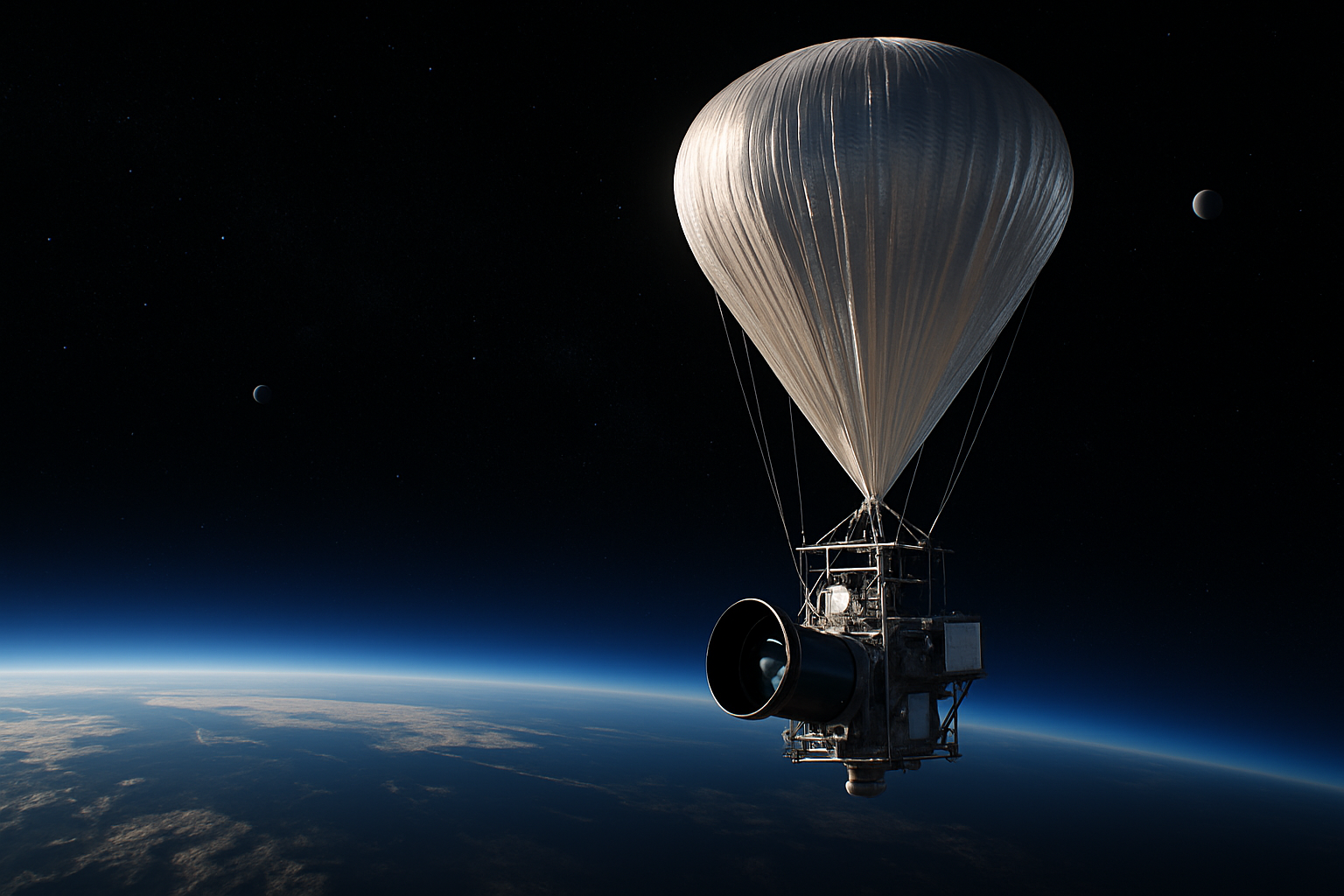
Engineers and astronomers have unveiled a revolutionary balloon telescope design for studying exoplanet atmospheres, offering near-space observations at a fraction of the cost of orbital missions, while NASA prepares for its second complete fueling attempt of the Space Launch System rocket this week.
The groundbreaking developments represent significant advances in space technology accessibility and NASA's ongoing efforts to return humans to the Moon, occurring during what experts describe as the transition from the "AI revolution to space economy golden age."
Balloon Telescope Innovation Democratizes Space Science
The new balloon telescope design represents a paradigm shift in astronomical observation, providing researchers with near-space capabilities without the massive costs associated with traditional satellite missions. Operating at the edge of Earth's atmosphere, these high-altitude balloons can carry sophisticated telescopic equipment above most atmospheric interference while maintaining significantly lower operational costs than orbital platforms.
This innovation addresses one of astronomy's greatest challenges: accessing the pristine observational conditions of space while remaining economically feasible for research institutions worldwide. The balloon-based approach allows for extended observation periods of exoplanet atmospheres, crucial for understanding the composition and potential habitability of distant worlds.
The technology builds on decades of high-altitude balloon research but incorporates advanced stabilization systems, precision guidance, and cutting-edge atmospheric sensors that enable telescope-quality observations previously only possible from space-based missions costing hundreds of millions of dollars.
NASA SLS Program Advances Toward Artemis Goals
Simultaneously, NASA is preparing for a critical second complete fueling attempt of its Space Launch System (SLS) rocket, aiming to load more than 700,000 gallons of liquid hydrogen and liquid oxygen as part of a comprehensive launch countdown rehearsal. This massive undertaking represents the culmination of years of engineering development toward returning humans to lunar orbit and eventually the Moon's surface.
The SLS rocket, standing as the most powerful launch vehicle NASA has ever built, will serve as the backbone of the Artemis program. The successful completion of fueling tests demonstrates the agency's commitment to safety-first protocols while advancing toward the historic Artemis II mission, currently scheduled for March 2026 following previous delays due to hydrogen leak issues.
"This represents a critical milestone in our return to deep space exploration,"
— NASA Engineering Teams
The fueling rehearsal involves complex procedures requiring precise coordination between ground crews, automated systems, and safety protocols. The 700,000-gallon capacity represents one of the largest cryogenic fuel loading operations in spaceflight history, requiring specialized equipment to handle the extremely cold liquid hydrogen and oxygen propellants.
Historical Context and Technological Convergence
These developments occur within a remarkable period of space technology advancement. Recent months have witnessed unprecedented breakthroughs including NASA's DAGGER AI system achieving 30-minute geomagnetic storm prediction capabilities, the successful deployment of fully AI-planned Mars rover missions, and major astronomical discoveries challenging our understanding of planetary formation.
The balloon telescope innovation connects to broader trends in space technology democratization. Countries like Pakistan have selected astronaut candidates for China's Tiangong space station, while emerging nations are developing independent satellite capabilities through strategic international partnerships.
Space medicine research continues advancing with studies on Space-Associated Neuro-Ocular Syndrome (SANS) affecting astronauts during extended missions. The International Space Station recently restored full seven-person operational capacity with the successful Crew-12 mission, demonstrating continued international cooperation despite global competitive dynamics.
Economic and Strategic Implications
The balloon telescope technology represents more than scientific advancement—it signals fundamental changes in space research accessibility. Universities and research institutions previously unable to afford space-based observation missions can now conduct sophisticated atmospheric studies of exoplanets and other celestial phenomena.
This democratization aligns with broader space economy trends. SpaceX continues preparing for its potential June 2026 IPO with valuations exceeding $1 trillion, while the company has strategically pivoted from Mars colonization toward lunar city development within the next decade.
The global memory crisis, with semiconductor prices increasing sixfold, has accelerated interest in space-based computing solutions and alternative technologies. Companies are exploring space-based data centers leveraging continuous solar power and elimination of atmospheric interference.
Technical Challenges and Solutions
Both the balloon telescope and SLS programs face significant technical hurdles. High-altitude balloon operations must contend with extreme temperature variations, atmospheric turbulence, and precise positioning requirements for astronomical observations. Advanced stabilization systems and autonomous navigation capabilities address these challenges while maintaining observation quality comparable to space-based platforms.
The SLS fueling operations present their own complexities. Handling cryogenic propellants requires specialized infrastructure, precise temperature control, and extensive safety protocols. Previous hydrogen leak issues during testing demonstrate the meticulous attention to detail required for successful deep space missions.
Both technologies benefit from advances in artificial intelligence and autonomous systems. AI-enhanced navigation enables balloon telescopes to maintain precise positioning, while automated systems support SLS ground operations and safety monitoring.
International Cooperation and Competition
The space technology advances occur amid evolving international dynamics. While cooperation continues through programs like the International Space Station, competitive elements intensify with China's advancing Shenlong reusable spacecraft program and European efforts toward launch independence through facilities like Germany's Isar Aerospace Swedish testing center.
The balloon telescope innovation provides opportunities for international scientific collaboration without the political complexities sometimes associated with major orbital missions. Research institutions globally can participate in exoplanet studies and atmospheric research through shared balloon-based observation campaigns.
Thailand's appointment as chair of the UN Scientific and Technical Subcommittee for space governance reflects the growing influence of emerging nations in space policy. These developments suggest evolution toward more distributed and collaborative approaches to space exploration and research.
Future Implications and Applications
The successful development of balloon telescopes could revolutionize multiple fields of astronomical research. Beyond exoplanet atmospheric studies, the technology enables cost-effective observation of cosmic phenomena, solar system bodies, and deep space objects previously accessible only through expensive orbital missions.
Educational applications present particularly promising opportunities. Universities can provide students with hands-on experience in space-based research without requiring access to orbital platforms. This practical training prepares the next generation of space scientists and engineers for an expanding industry requiring diverse technical skills.
The SLS program's progress toward operational status establishes foundations for sustained lunar exploration and eventual Mars missions. Successful completion of fueling tests brings NASA closer to demonstrating deep space transportation capabilities essential for expanding human presence beyond Earth orbit.
Environmental and Sustainability Considerations
Balloon telescope technology offers environmental advantages over traditional space missions. The reduced energy requirements for high-altitude operations, combined with reusable balloon systems, create more sustainable approaches to space-based research.
The technology also supports climate research applications. High-altitude balloons can monitor atmospheric conditions, greenhouse gas concentrations, and environmental changes with precision comparable to satellite-based systems while maintaining significantly lower carbon footprints.
NASA's SLS program incorporates sustainable practices in ground operations and fuel handling. The agency's commitment to environmental responsibility demonstrates how major space initiatives can advance exploration goals while minimizing ecological impacts.
Looking Forward: The Next Phase of Space Technology
February 2026 represents a watershed moment for space technology development. The convergence of cost-effective observation platforms, advanced rocket systems, international cooperation frameworks, and AI-enhanced operations establishes foundations for unprecedented expansion of human space capabilities.
The balloon telescope innovation suggests that transformative space technologies need not require massive government investments or corporate budgets. Innovative engineering approaches can democratize access to space-based research, enabling broader participation in cosmic exploration and scientific discovery.
Meanwhile, NASA's SLS progress demonstrates the agency's capability to develop and operate the complex systems required for deep space exploration. Successful completion of fueling tests brings humanity closer to sustainable lunar presence and eventual interplanetary travel.
These developments occur within a broader transformation of the space sector from government-dominated programs toward commercial innovation and international collaboration. The space economy's growth potential, combined with technological breakthroughs in areas ranging from AI to materials science, positions 2026 as a pivotal year for establishing the infrastructure and capabilities defining humanity's spacefaring future.
The combination of accessible research platforms and advanced exploration systems creates unprecedented opportunities for scientific discovery, economic development, and international cooperation. As balloon telescopes enable broader participation in astronomical research and SLS rockets prepare for lunar missions, the foundations emerge for a more inclusive and ambitious approach to space exploration serving both scientific advancement and human expansion beyond Earth.