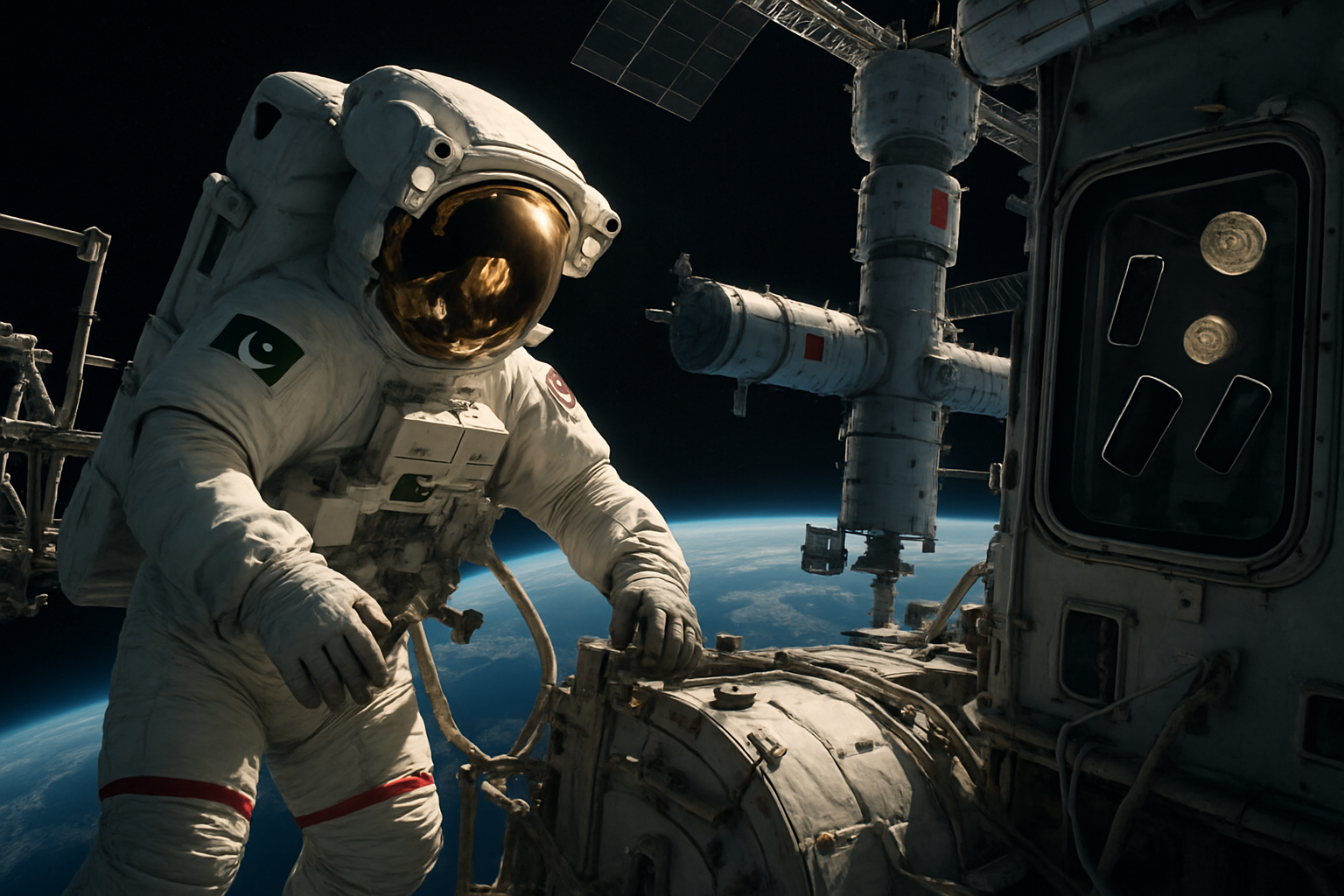
Pakistan Space and Upper Atmosphere Research Commission (SUPARCO) has achieved a groundbreaking milestone in the nation's Human Spaceflight Programme, shortlisting two candidates for Pakistan's first-ever astronaut mission to the Chinese Space Station in late 2026, marking a transformative moment for South Asian space exploration.
Following comprehensive medical, psychological, and aptitude assessments conducted at the Astronauts Centre of China (ACC) in accordance with international human spaceflight standards, two Pakistani candidates have been selected from an initial screening process. The shortlisted candidates will now undergo six months of advanced astronaut training at ACC, with one ultimately chosen for the historic spaceflight mission aboard the Chinese Space Station scheduled for October-November 2026.
Historic Pakistan-China Space Partnership
This cooperation is anchored in the bilateral "Astronaut Cooperation Agreement" signed in February 2025 between Pakistan's Space and Upper Atmosphere Research Commission (SUPARCO) and the China Manned Space Agency (CMSA). The agreement represents a significant expansion of the countries' strategic partnership into the space domain, with Pakistan becoming one of the few nations to participate in China's rapidly expanding space program.
"This cooperation is anchored on the bilateral Astronaut Cooperation Agreement, signed in February 2025, under the leadership of the Prime Minister of Pakistan, whose vision and support has been instrumental in achieving this milestone."
— SUPARCO Official Statement
The mission will take Pakistan's first astronaut to the Tiangong space station, operated by Beijing as part of its ambitious space exploration program. This achievement positions Pakistan among an elite group of nations with human spaceflight capabilities and demonstrates the growing democratization of space exploration through international partnerships.
NASA Revolutionizes Space Technology Access
Simultaneously, the space industry is witnessing unprecedented technological integration as NASA announced that astronauts will now be permitted to use smartphones in space missions. This historic decision marks a departure from decades of specialized equipment requirements and represents the first integration of consumer technology into official space photography protocols.
The smartphone authorization comes as space agencies worldwide recognize the advanced capabilities of commercial technology, particularly in photography and communication applications. This development is expected to enhance astronaut capabilities during missions while reducing the need for specialized, costly equipment traditionally required for space operations.
The timing of this announcement coincides with NASA's preparation for the Artemis II lunar mission, currently scheduled for March 2026 following delays due to hydrogen leak issues during testing. The mission will send four astronauts, including Canadian Jeremy Hansen, on a 10-day lunar flyby—the first crewed mission beyond Earth orbit since Apollo 17 in 1972.
Global Space Economy Momentum
The current period represents what analysts describe as a transition from the "AI revolution" of 2020-2025 to the emerging "space economy golden age." This shift is evidenced by numerous developments including SpaceX's planned June IPO with a potential valuation exceeding $1 trillion, and the company's demonstration of strategic control over satellite networks, as seen in blocking Russian military use of Starlink terminals in Ukraine.
The space industry's commercial revolution is being driven by multiple factors including satellite infrastructure expansion, space-based data centers, and military positioning considerations. SpaceX's Starlink has achieved global coverage, while European companies like Germany's Isar Aerospace are building rocket testing facilities in Sweden with capacity to test 30 engines monthly, reflecting Europe's drive for launch independence.
Kazakhstan's Cultural Space Recognition
Adding a cultural dimension to global space achievements, Kazakhstan's National Bank announced the release of a commemorative coin celebrating Olympic Games 2026 Short Track as part of its Sports series. The 1,000-tenge coin, made of 925 sterling silver and produced using advanced color printing technology, represents the intersection of cultural celebration and technological achievement.
While not directly space-related, this commemorative coin reflects the broader global recognition of technological and sporting achievements, occurring within the context of a year that has seen unprecedented space exploration milestones across multiple nations.
Space-Based Infrastructure Solutions
As the global economy faces a critical memory crisis with sixfold price increases affecting major manufacturers like Samsung, SK Hynix, and Micron, space-based infrastructure is emerging as a potential solution. Elon Musk recently predicted that space-based AI data centers will become cost-effective within 36 months, citing advantages including superior solar energy capture, no atmospheric interference, elimination of day-night cycles, and no battery requirements.
This concept is part of the broader SpaceX-xAI vertical integration strategy, valued at $1.25 trillion following their merger announcement. The approach addresses Earth's memory crisis by offering unlimited expansion capabilities, no cooling requirements, and continuous solar power availability.
International Cooperation and Competition
The current space technology landscape is characterized by both unprecedented international cooperation and intensifying competition. Thailand's appointment as chair of UN space governance demonstrates emerging nations' growing influence in space policy, while the US-China orbital arms race continues to drive trillion-dollar investments in space infrastructure.
Recent discoveries have also advanced our understanding of space science, including the University of Washington's record-breaking asteroid discovery using the Vera C. Rubin Observatory, and European scientists' identification of the largest sulfur-containing organic molecule ever found in interstellar space, described as a "missing link" in understanding cosmic chemistry and life origins.
Challenges and Opportunities Ahead
Despite the rapid advancement, the space industry faces significant challenges including infrastructure constraints, regulatory coordination requirements, and the ongoing global memory crisis affecting AI and space technology development. The shortage of critical materials, with China controlling 60% of production and 90% of refining capacity for lithium, cobalt, and rare earth elements, threatens the scaling of space technology infrastructure.
Space medicine also presents ongoing challenges, including Space-Associated Neuro-Ocular Syndrome (SANS) affecting astronauts during extended missions. Research institutions, including Portugal's National Institute of Engineering, Technology and Innovation, are conducting groundbreaking research to address these health challenges crucial for future deep space exploration to Mars and lunar bases.
Looking Forward: The New Space Age
Pakistan's imminent entry into human spaceflight, combined with NASA's embrace of commercial technology and the global expansion of space infrastructure, signals the beginning of a new era in space exploration. This period is characterized by the convergence of commercial capabilities, international cooperation, and scientific discovery, establishing space as a critical frontier for human technological development.
As 2026 progresses, the space industry continues to demonstrate that the boundaries between nations, technologies, and capabilities are becoming increasingly fluid. The success of Pakistan's astronaut mission, scheduled for late 2026, will mark not just a national achievement but a testament to the power of international cooperation in advancing human presence in space.
The developments across Pakistan, NASA, and other space agencies worldwide represent more than individual achievements—they signify humanity's collective advancement toward becoming a truly spacefaring civilization, with democratized access to space exploration and technology integration that was unimaginable just a decade ago.