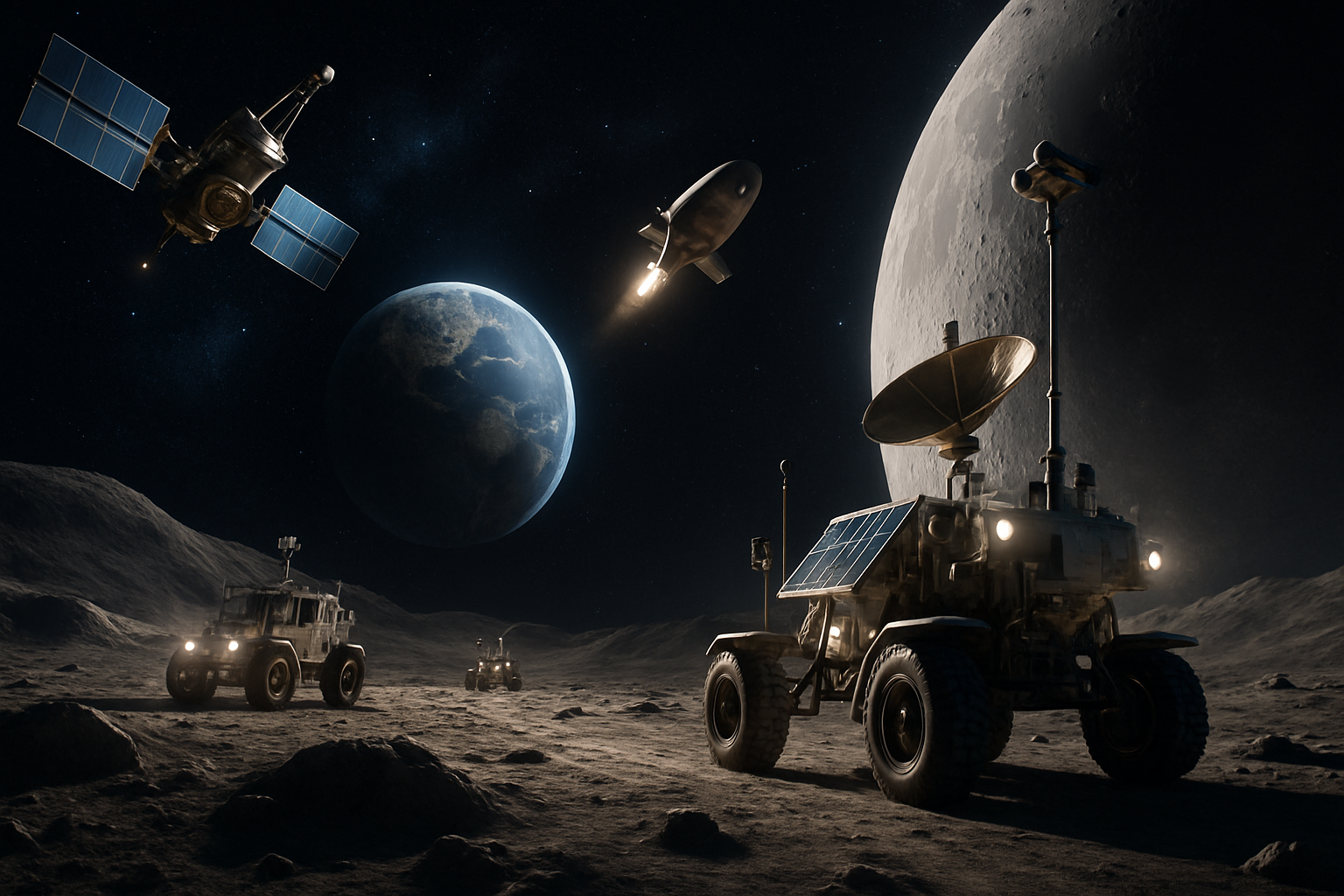
As the historic Artemis II mission successfully completed humanity's return to deep space exploration in April 2026, a new wave of technological innovations and international collaborations is rapidly transforming the landscape of space exploration and lunar development.
The Post-Artemis Space Economy Boom
The successful completion of Artemis II—which saw Canadian astronaut Jeremy Hansen become the first Canadian beyond Earth orbit alongside crew members Reid Wiseman, Christina Koch, and Victor Glover—has catalyzed unprecedented investment in space technology. With SpaceX preparing for its trillion-dollar IPO in June 2026, the space economy is projected to exceed $1 trillion by 2030, marking what experts call the "space economy golden age."
This economic transformation extends far beyond traditional government programs. Commercial enterprises are now leading innovation in areas previously dominated by national space agencies. The shift represents a fundamental change from experimental space ventures to essential infrastructure development.
AI Revolution in Space Operations
Artificial intelligence has emerged as a game-changing technology in space exploration. Chinese scientists at Shanghai Institute of Technical Physics achieved a historic breakthrough by using AI to determine the Moon's far side chemical composition through Chang'e-6 samples—the first detailed mapping of permanently hidden lunar regions representing nearly half the Moon's surface.
"This AI breakthrough unlocks one of lunar science's enduring mysteries, providing detailed chemical mapping that would have taken significantly longer using traditional analysis methods."
— Shanghai Institute of Technical Physics Research Team
Meanwhile, NASA has successfully implemented fully AI-planned Mars rover missions, demonstrating autonomous navigation capabilities crucial for future operations where real-time Earth communication is impossible. This technology directly informs protocols for lunar bases and Mars expeditions where astronauts may operate independently for extended periods.
Revolutionary Lunar Technology Development
European institutions are advancing sophisticated lunar exploration technologies. Aalborg University in Denmark is developing autonomous lunar rovers with radiation-hardened electronics and advanced AI navigation systems. These self-driving robots are designed for deployment by 2027 as part of Luxembourg's role as one of eight founding Artemis program members.
Scientists have also proposed revolutionary ultra-stable laser navigation systems constructed inside lunar craters, enabling unprecedented precision guidance with centimeter-level accuracy. This technology could revolutionize both lunar operations and Earth-based timekeeping systems through stable light source applications.
International Competition and Collaboration
China continues demonstrating steady space program advancement through its government-led approach, recently launching its fourth Shenlong reusable spacecraft and planning crewed lunar missions by 2030. This contrasts with SpaceX's commercial innovation model, which has pivoted strategically from Mars colonization to lunar settlement development.
Pakistan's selection of astronaut candidates for China's Tiangong station in October-November 2026 exemplifies the democratization of space capabilities, allowing emerging nations to participate in human spaceflight programs previously limited to major powers.
Space-Based Infrastructure Development
The global memory crisis, with semiconductor prices increasing sixfold, is driving innovative solutions in space-based data centers. Blue Origin has filed applications for a 51,600-satellite constellation supporting orbital computing facilities that offer continuous solar power and unlimited expansion potential without terrestrial cooling requirements.
These developments align with the broader transition from terrestrial constraints to space-based solutions for humanity's growing technological needs.
Medical Breakthroughs for Deep Space
Space medicine research has achieved critical advances through French astronaut Sophie Adenot's record eight-month ISS mission, conducting lung tissue cultivation and Space-Associated Neuro-Ocular Syndrome (SANS) research. This work is essential for extended missions beyond Earth's evacuation possibility.
Researchers have also made breakthrough progress in cryogenic brain tissue preservation, demonstrating that complex neural tissue can survive extreme cold and maintain biological function upon thawing—a potential game-changer for multi-year Mars journeys.
Nuclear Propulsion for Interplanetary Travel
NASA's Space Reactor 1 Freedom nuclear spacecraft program represents a significant advancement in interplanetary travel capabilities. Nuclear propulsion enables faster transit times, continuous power generation, and reduced radiation exposure—critical factors for missions where solar power is insufficient.
This technology positions humanity for sustained deep space operations and multi-planetary expansion, moving beyond the Moon to establish permanent settlements throughout the solar system.
Commercial Space Ventures and Lunar Resources
An intriguing case study in lunar commercialization emerged with Dennis Hope, an American entrepreneur who claimed Moon property ownership in 1980 and built a business selling lunar parcels. While legally questionable under international space treaties, Hope's venture highlights growing interest in lunar resource utilization and property rights—issues that will require new international frameworks as permanent settlements become reality.
SpaceX President Gwynne Shotwell's declaration that humans could return to the Moon by 2030 through commercial missions demonstrates the maturation of private space capabilities from speculative ambitions to achievable objectives.
Challenges and Future Outlook
Despite remarkable progress, significant challenges remain. Space debris poses an escalating threat, with over 30,000 tracked orbital objects potentially creating cascade collision effects that could trap humanity on Earth. European research has documented atmospheric pollution from rocket debris, emphasizing the need for sustainable space development practices.
Space medicine also faces critical challenges, including reproduction difficulties in microgravity environments that require artificial gravity solutions for permanent settlements.
The Path Forward
The period following Artemis II represents a watershed moment in human space exploration. The convergence of commercial innovation, international cooperation, AI integration, and breakthrough technologies is establishing space as critical infrastructure rather than experimental endeavor.
Success in these endeavors will determine humanity's trajectory toward becoming a truly spacefaring civilization through sustained cosmic expansion. From autonomous lunar rovers to nuclear-powered Mars missions, the foundations are being laid for permanent extraterrestrial settlements and the development of humanity as a multi-planetary species.
"We are witnessing the transition from brief space visits to sustained human presence beyond Earth orbit for the first time in human history."
— Space Industry Analysis, 2026
As these technologies mature and international cooperation frameworks solidify, the next phase of human space exploration promises to transform not just our presence in space, but our understanding of humanity's cosmic future among the stars.