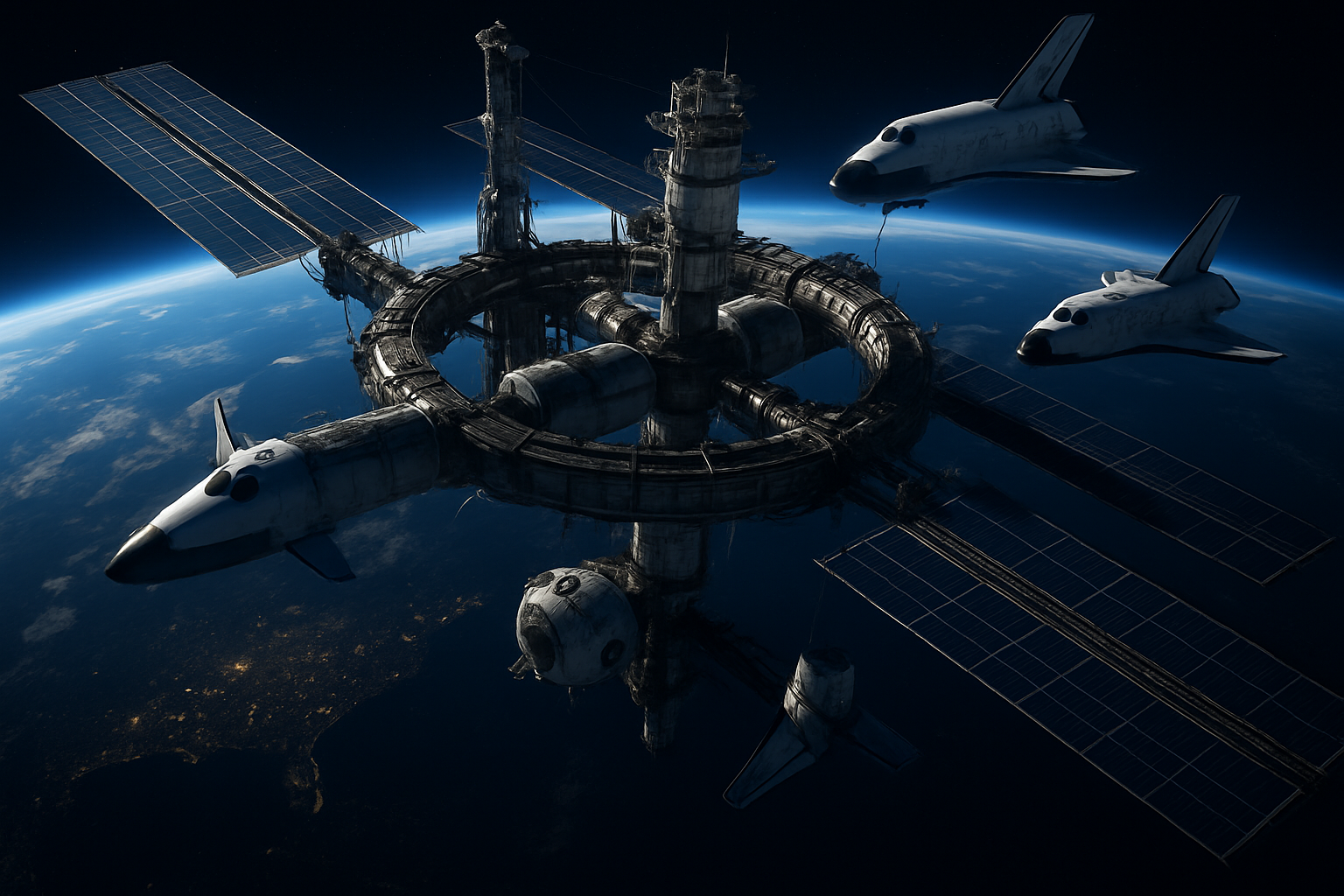
The year 2026 has emerged as a pivotal moment in space exploration history, marking the transition from the artificial intelligence revolution to what experts are calling the "golden age of the space economy." Recent developments from China, Russia, and international space programs signal a fundamental shift from Earth-based digital transformation to the commercialization and militarization of low-orbit space.
This transformation is driven by multiple converging factors: SpaceX's preparation for a June initial public offering that could value the company at over $1 trillion, Russia's successful orbital missions demonstrating continued space capabilities despite geopolitical tensions, and NASA's ambitious Artemis program preparing for humanity's return to the Moon after more than five decades.
The US-China Space Competition Intensifies
According to analysis from the South China Morning Post, the years 2020-2025 were defined by the AI revolution that created tech titans like Nvidia, OpenAI, and Oracle. However, 2026 represents "a far more exciting and expansive paradigm shift" as the global focus pivots from digitizing Earth to capitalizing on low-orbit space.
The US-China orbital arms race is forging what economists predict will become a trillion-dollar space economy. This competition encompasses not just national prestige, but critical infrastructure including satellite communications, space-based data centers, and strategic military positioning in orbit.
"We are now pivoting from the digitisation of the Earth to the capitalisation and domination of low-orbit space. The golden age of the space economy has arrived."
— South China Morning Post Analysis
The timing is significant as memory shortages and infrastructure limitations on Earth drive innovation toward space-based solutions. Elon Musk's recent $1.25 trillion SpaceX-xAI merger specifically targets space-based data centers powered by solar energy to address terrestrial computing constraints.
Russian Space Capabilities Remain Robust
Despite international sanctions and geopolitical tensions, Russia demonstrated its continued space prowess with the successful deployment of a Defense Ministry spacecraft into its target orbit on February 6, 2026. According to TASS, "the launch of the carrier rocket and the insertion of spacecraft into the target orbit took place in the regular mode."
This mission represents Russia's ongoing commitment to maintaining strategic space capabilities even amid the ongoing conflict in Ukraine. The success comes as Russia's space program continues operating independently of international cooperation frameworks that have been disrupted since 2022.
Russian space activities remain closely watched by Western intelligence agencies, particularly given the dual-use nature of many orbital technologies that can serve both civilian and military purposes. The February launch demonstrates Moscow's ability to maintain complex space operations despite economic pressures and technological restrictions.
NASA's Artemis Program Prepares for Lunar Return
The most ambitious component of 2026's space developments centers on NASA's Artemis II mission, which will send four astronauts on a 10-day journey around the Moon - humanity's first crewed mission beyond Earth orbit since Apollo 17 in 1972.
According to Argentine space coverage, the Artemis II crew will travel approximately 7,400 kilometers beyond the far side of the Moon, offering unprecedented views of both Earth and the lunar surface from the Orion spacecraft windows. This mission serves as the critical stepping stone toward Artemis III, planned for 2027, which aims to land the first humans on the lunar surface in over half a century.
The mission represents more than symbolic achievement. NASA's successful December 2025 deployment of fully AI-planned Mars rover missions demonstrates the space agency's integration of artificial intelligence into exploration operations, enabling real-time decision-making across the vast distances of space without Earth-based mission control delays.
Commercial Space Revolution Accelerates
The commercial space sector is experiencing unprecedented growth, with private companies increasingly driving innovation that was once the exclusive domain of government programs. SpaceX's Starlink constellation now provides global coverage, with satellites visible across Argentina for three consecutive observation periods, demonstrating the maturation of commercial satellite networks.
European companies are also expanding rapidly. German rocket manufacturer Isar Aerospace is constructing advanced testing facilities at Sweden's Esrange Space Center near Kiruna, capable of testing 30 rocket engines monthly. This development reflects Europe's drive for launch independence and expanded space manufacturing capabilities.
The convergence of commercial satellite technology and space medicine research demonstrates the industry's evolution beyond government programs toward private innovation addressing both technological challenges and human spaceflight limitations.
Space-Based Infrastructure Solutions
Perhaps the most revolutionary development is the emergence of space-based infrastructure as a solution to Earth's technological constraints. The global memory crisis, with sixfold price increases affecting major manufacturers like Samsung, SK Hynix, and Micron, is driving innovation toward orbital solutions.
Space-based data centers offer several advantages: unlimited expansion potential, no cooling requirements, continuous solar power, and freedom from terrestrial regulatory constraints. However, technical challenges include radiation exposure, maintenance complexity, and launch costs that must be balanced against operational benefits.
International Cooperation and Competition
The space domain in 2026 is characterized by both unprecedented cooperation and intensifying competition. Thailand's appointment as chair of the UN Scientific and Technical Subcommittee demonstrates emerging nations' growing influence in space governance discussions.
Meanwhile, SpaceX's demonstrated ability to control access to its Starlink network - including successfully blocking Russian military use of terminals in Ukraine - highlights the strategic importance of private space infrastructure in geopolitical conflicts.
This dual nature of cooperation and competition extends to scientific discoveries as well. Recent breakthroughs include the University of Washington's record-breaking asteroid discovery using the new Vera C. Rubin Observatory in Chile, and European scientists' identification of the largest sulfur-containing organic molecule found in interstellar space, advancing our understanding of life's cosmic origins.
Challenges and Future Outlook
The rapid expansion of space activities brings significant challenges. Space-Associated Neuro-Ocular Syndrome (SANS) affecting astronauts during extended missions represents a major obstacle for long-duration flights to Mars and permanent lunar bases. Portuguese research institutions are leading efforts to understand and mitigate these health impacts.
Weather forecasting is also being revolutionized through space technology, with companies like Tomorrow.io raising $175 million to deploy AI-powered weather satellite constellations for extreme weather prediction and emergency preparedness.
The space economy's growth trajectory suggests 2026 will be remembered as the year when orbital commerce transitioned from experimental to essential. With SpaceX's planned IPO, NASA's lunar missions, and the US-China space competition intensifying, the foundations are being laid for what could become humanity's first truly space-based economic sector.
Looking Ahead
As 2026 progresses, the space technology sector faces both unprecedented opportunities and significant challenges. The convergence of artificial intelligence, commercial space capabilities, and international competition is creating a new paradigm where space-based infrastructure becomes critical to Earth's technological future.
The success of current missions - from Russia's ongoing orbital deployments to NASA's Artemis program and commercial satellite networks - will determine whether the promise of a trillion-dollar space economy becomes reality or remains an ambitious vision. What is certain is that 2026 has established space technology as the defining frontier for the next phase of human technological development.