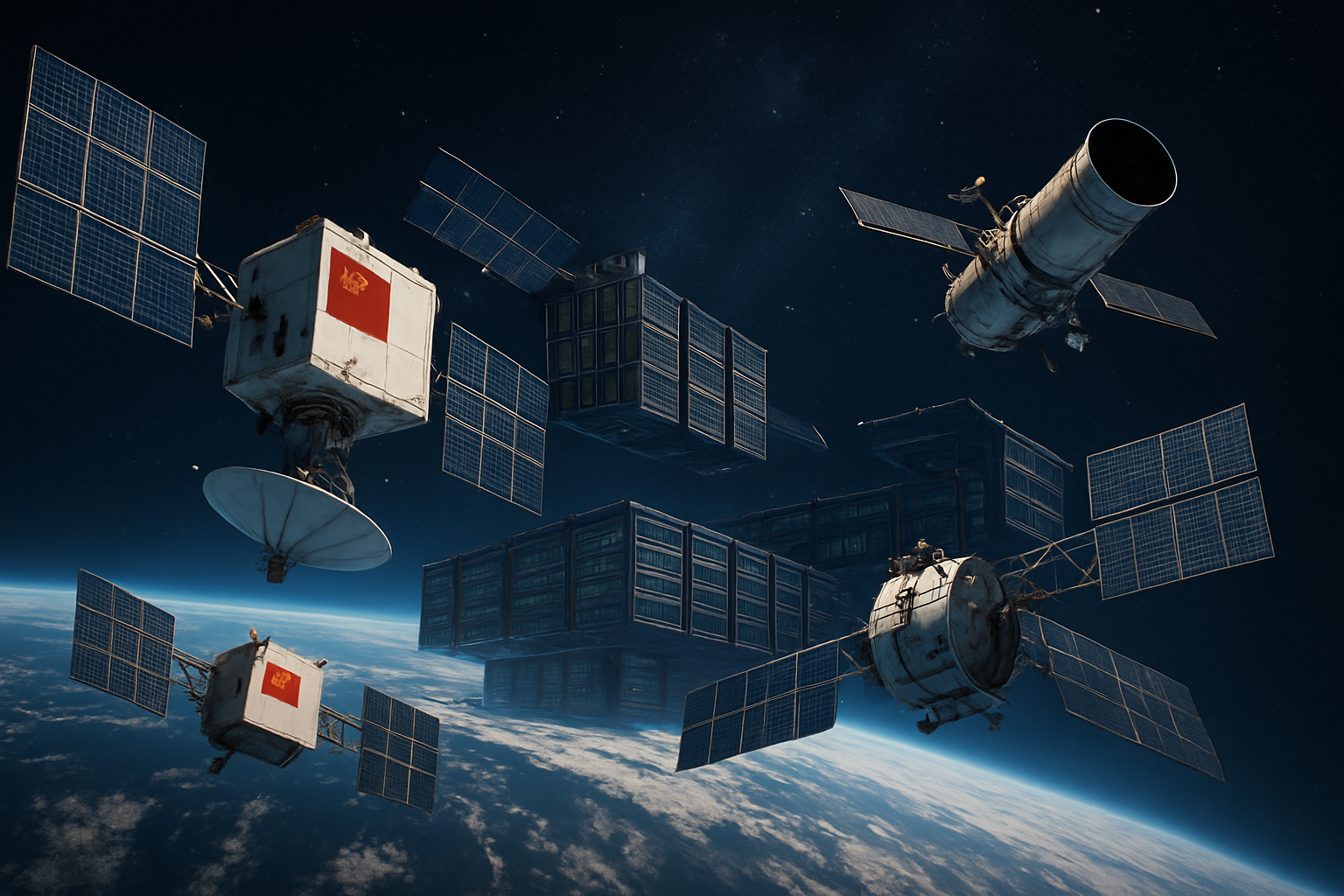
As the global space economy transitions into what analysts call the "Golden Age," two major powers are pushing the boundaries of space technology in dramatically different directions, with China accelerating development of orbital computing infrastructure while Russia prepares an ambitious mission to search for signs of life throughout the cosmos.
China's Ministry of Industry and Information Technology announced Friday that the nation is systematically advancing its space computing industry, representing a strategic pivot toward addressing terrestrial limitations through orbital solutions. Meanwhile, Russia's Spektr-M space observatory mission promises to revolutionize our understanding of the universe through dedicated searches for water traces and complex organic compounds that could indicate extraterrestrial life.
China's Orbital Computing Revolution
Space computing, as defined by Chinese officials, involves deploying computational capabilities directly in orbit, utilizing satellite networks to achieve seamless global coverage with unprecedented advantages over ground-based data centers. The technology addresses three critical challenges facing modern digital infrastructure: explosive demand for AI computing power, limitations of terrestrial data centers, and breakthroughs in reusable rocket technology that make orbital deployment economically viable.
The timing of China's announcement proves particularly significant given the global semiconductor crisis that has driven memory chip prices up sixfold, affecting major manufacturers including Samsung, SK Hynix, and Micron. Traditional data centers consume billions of gallons of water annually for cooling while facing energy constraints that limit expansion potential. Space-based alternatives offer continuous solar power, unlimited expansion capability, and elimination of cooling requirements that plague terrestrial facilities.
"The development of space computing is being driven by multiple factors, including the explosive demand for AI computing power, breakthroughs in reusable rocket technology and the limitations of energy and space faced by ground-based data centers."
— Ministry of Industry and Information Technology Official
This development occurs within the broader context of China's expanding space capabilities, including recent achievements in lunar exploration through the Chang'e-6 mission, which successfully mapped the Moon's far side chemical composition using AI analysis—representing the first detailed mapping of permanently hidden lunar regions. The nation's space program has demonstrated remarkable progress across multiple domains, from reusable spacecraft development to astronaut training programs.
Russia's Quest for Cosmic Life
Simultaneously, Russia's Spektr-M space observatory represents an entirely different but equally ambitious approach to space exploration. The mission focuses on detecting theoretical signatures that could indicate extraterrestrial life, specifically targeting water traces and radiation from complex organic molecules—the fundamental building blocks that scientists believe necessary for life as we understand it.
The Spektr-M project builds upon decades of theoretical physics work examining traversable wormholes, gravitational wave detection, and exotic matter interactions. The observatory incorporates advanced instrumentation designed to observe extreme cosmic phenomena that might reveal evidence of life processes occurring elsewhere in the universe.
This mission represents a technological leap in observing cosmic architecture, particularly significant given recent discoveries of "impossible" planetary systems and stellar formations that challenge conventional understanding of how celestial bodies develop. The observatory's capabilities could provide empirical evidence for phenomena that have remained theoretical since their mathematical prediction.
International Space Competition and Cooperation
These developments occur during what experts characterize as the transition from the "AI revolution" to the "space economy golden age," with unprecedented competition and cooperation occurring simultaneously across multiple nations. The global space economy is projected to exceed $1 trillion by 2030, driven by commercial enterprises, government investments, and technological innovations spanning satellite constellations, space-based manufacturing, and orbital infrastructure.
Current international dynamics include Pakistan's astronaut candidates preparing for China's Tiangong station missions, Thailand's leadership in UN space governance initiatives, and European nations pursuing space independence through substantial investments in domestic capabilities. SpaceX continues preparing for a potentially trillion-dollar IPO while NASA's Artemis program advances toward permanent lunar settlement establishment.

Technological Convergence and Integration
Both Chinese and Russian initiatives demonstrate sophisticated integration of artificial intelligence with traditional space technologies. China's space computing development leverages AI for autonomous satellite management and real-time data processing, while Russia's Spektr-M mission employs AI-powered analysis to identify potential life signatures from vast cosmic datasets.
This convergence reflects broader trends in space technology where AI enables previously impossible capabilities: autonomous navigation systems for Mars rovers, 30-minute geomagnetic storm predictions protecting satellite infrastructure, and sophisticated weather forecasting that benefits global communities. The integration of AI with space-based platforms creates synergistic effects that amplify both computational and observational capabilities.
The economic implications prove substantial, with space-based computing potentially resolving terrestrial infrastructure limitations while astronomical research drives innovations in materials science, detection technologies, and data analysis methods. These advances often find applications far beyond their original space-focused purposes, contributing to medical technology, environmental monitoring, and communications infrastructure.
Environmental and Sustainability Considerations
Recent Austrian research documenting atmospheric pollution from rocket debris, including tenfold elevation in lithium concentrations, emphasizes the importance of sustainable space development practices. Both Chinese and Russian programs must balance ambitious expansion with environmental protection, particularly as space activity increases exponentially across multiple nations and commercial enterprises.
Space-based computing offers potential environmental benefits by reducing terrestrial data center water consumption and energy demands while enabling more efficient global digital infrastructure. However, sustainable implementation requires careful consideration of launch vehicle environmental impacts, orbital debris management, and long-term space environment protection.
Strategic Implications for Global Development
The divergent yet complementary approaches represented by China's practical computing infrastructure and Russia's fundamental research missions illustrate the multifaceted nature of modern space exploration. While China focuses on addressing immediate technological needs through orbital solutions, Russia pursues questions about humanity's place in the cosmic community through dedicated life detection efforts.
Both initiatives contribute to the broader goal of establishing humanity as a spacefaring civilization capable of sustained presence beyond Earth. Space-based computing infrastructure supports the technical foundation necessary for permanent space settlements, while astronomical research provides the scientific knowledge essential for understanding cosmic environments and potential life-supporting conditions.
"Space computing refers to deploying computing capabilities in orbit, using satellite networks to achieve seamless global coverage. Compared with ground-based data centers, its biggest advantages are real-time processing and wide-area coverage."
— Chinese Space Industry Official
Future Prospects and Challenges
The success of these initiatives depends on continued international cooperation frameworks that balance competition with collaboration, ensuring space development serves human welfare while advancing scientific knowledge. Current governance structures, including the Artemis Accords and UN space treaties, provide foundations but require adaptation to address emerging commercial space activities and technological capabilities.
Technical challenges remain substantial, including radiation exposure effects on computational equipment, orbital maintenance requirements, space debris collision risks, and the complexity of detecting life signatures across cosmic distances. However, both programs demonstrate the sophisticated engineering and scientific capabilities that make such ambitious projects feasible.
As the space economy continues expanding, the integration of practical infrastructure development with fundamental research creates a comprehensive approach to space exploration that serves immediate human needs while advancing our understanding of the universe. The combination of Chinese computational innovation and Russian astronomical research represents the diverse pathways through which humanity is establishing its cosmic presence.
Conclusion: A New Chapter in Space Exploration
April 2026 marks a watershed moment in space exploration, characterized by the convergence of practical problem-solving through orbital computing infrastructure and profound scientific inquiry into the fundamental questions of cosmic life. China's systematic development of space-based computing capabilities and Russia's dedicated search for extraterrestrial life signatures represent complementary approaches to humanity's expansion beyond Earth.
These developments occur within the broader context of unprecedented international cooperation and competition, technological innovation, and economic transformation that defines the current "space economy golden age." Success in both domains requires sustained commitment to scientific excellence, international cooperation, and responsible space development practices that ensure the benefits of space exploration serve all humanity while preserving the cosmic environment for future generations.
As we advance into this new era of space exploration, the integration of practical infrastructure development with fundamental scientific research provides a robust foundation for humanity's continued cosmic expansion, offering both immediate solutions to terrestrial challenges and profound insights into our place within the universe.