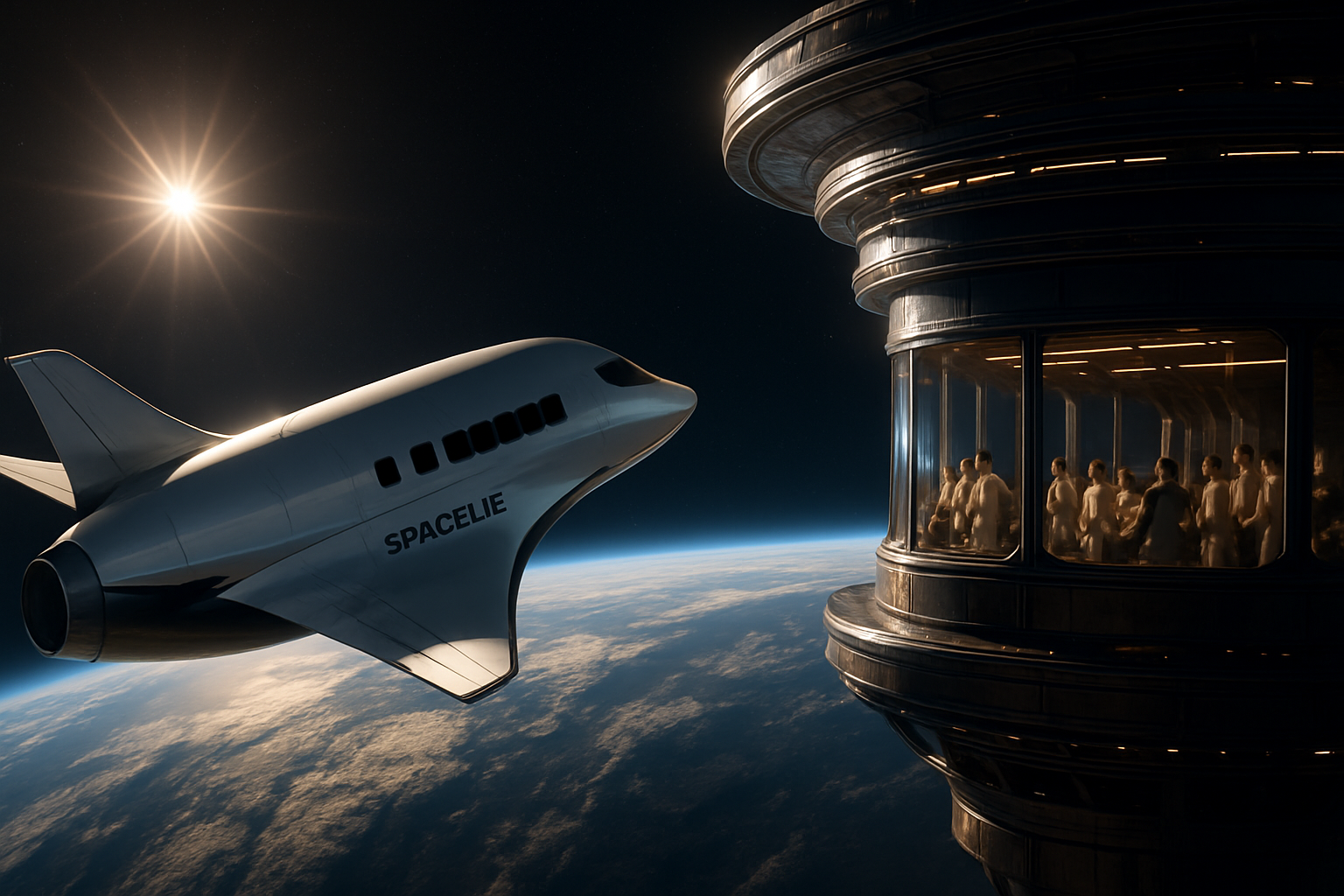
As private companies pioneer commercial space travel opportunities, wealthy adventurers are gaining unprecedented access to cosmic experiences that were once reserved exclusively for professional astronauts, fundamentally transforming humanity's relationship with space exploration.
The emergence of commercial space tourism represents a pivotal shift in the space industry, occurring during what experts are calling the "space economy golden age." With global space economy projections exceeding $1 trillion by 2030, private enterprises are leading an unprecedented expansion of human access to space through increasingly sophisticated and accessible programs.
The Psychological Transformation of Space Travel
Anousheh Ansari, who made headlines by self-funding her own $20 million space mission, exemplifies the profound psychological transformation that space travel offers participants. According to recent analyses, going to space provides enormous psychological benefits that extend far beyond the initial thrill of the experience.
The cosmic perspective gained from viewing Earth from space fundamentally alters participants' worldview, often described as the "overview effect." This phenomenon, where astronauts report a cognitive shift in awareness after seeing Earth from orbit, has become a central selling point for commercial space ventures targeting high-net-worth individuals seeking transformative experiences.
"What fascinates me is not only how far we can travel from Earth, but how these journeys reshape our perception of it. We're all on the same boat, we have to take care of the ship."
— Thomas Pesquet, European Space Agency Astronaut
Commercial Space Infrastructure Revolutionizes Access
The commercial space tourism industry has evolved dramatically from experimental ventures to sophisticated operations. SpaceX, preparing for a potentially trillion-dollar IPO in June 2026, has demonstrated strategic control capabilities and maintains over 5,000 active Starlink satellites, providing the infrastructure foundation for expanded space activities.
Blue Origin, under Jeff Bezos' leadership, has filed applications for a 51,600-satellite constellation supporting space-based data centers, offering continuous solar power and unlimited expansion potential. This infrastructure development addresses the global memory crisis, with semiconductor prices increasing sixfold, making space-based alternatives economically viable within 36 months according to industry projections.
SpaceX's strategic pivot from Mars colonization to lunar settlement development reflects the industry's maturation toward achievable near-term objectives. The company now targets self-sustaining lunar cities within 10 years, leveraging the Moon's advantages including monthly launch windows versus Mars's 26-month cycles and three-day travel times enabling rapid resupply and emergency response.
International Competition Drives Innovation
The commercial space sector operates within an increasingly competitive international environment. China's systematic space program advancement through government-led approaches enables long-term strategic planning without market pressures, including concrete plans for crewed lunar missions by 2030. The Shanghai Institute of Technical Physics achieved AI breakthroughs determining Moon far side chemical composition through Chang'e-6 samples, marking first detailed mapping of permanently hidden lunar regions.
European nations are pursuing space independence through substantial investments, including Germany's €10 billion SATCOMBw 4 satellite system and Sweden's Isar Aerospace facility testing 30 rocket engines monthly. This international competition drives innovation while creating new opportunities for wealthy individuals seeking space experiences.
Space Medicine and Safety Protocols
The commercial space tourism industry benefits from decades of space medicine research conducted aboard the International Space Station. French astronaut Sophie Adenot's record eight-month mission has provided invaluable data on long-duration spaceflight effects, including lung tissue cultivation research and Space-Associated Neuro-Ocular Syndrome (SANS) studies essential for understanding extended missions beyond Earth.
European research reveals significant challenges including microgravity's effects on human reproduction, requiring artificial gravity solutions for future permanent settlements. These medical insights directly inform safety protocols for commercial space ventures, ensuring participant well-being during increasingly sophisticated space experiences.
Economic Accessibility and Exclusivity
Current commercial space tourism remains economically exclusive, with experiences ranging from hundreds of thousands to tens of millions of dollars. Anousheh Ansari's $20 million investment represents the high end of space tourism costs, though industry observers predict decreasing prices as technology matures and competition increases.
The space economy's transition from experimental ventures to essential infrastructure creates opportunities for various pricing tiers. As launch costs decrease through reusable rocket technology and increased competition, space tourism may gradually expand beyond ultra-high-net-worth individuals to broader affluent markets.
Environmental Considerations and Sustainability
The rapid expansion of commercial space activities raises environmental concerns that the industry must address. Austrian research has documented atmospheric pollution from rocket debris, including tenfold lithium concentration elevations from Falcon-9 launches. Over 34,000 tracked orbital objects create collision risks at 17,500 mph, highlighting the need for sustainable space development practices.
The industry faces regulatory challenges as the 1967 Outer Space Treaty proves inadequate for massive commercial constellations. Space debris cascade effects could potentially render orbital regions unusable, requiring unprecedented international cooperation and environmental stewardship.
The Future of Cosmic Adventures
NASA's successful Artemis II mission completion in April 2026, ending a 54-year gap in human deep space exploration, validates systems essential for sustained lunar presence. The agency's historic $20 billion commitment to establishing a permanent lunar surface base by 2030 represents the largest space infrastructure investment in NASA history, creating new opportunities for commercial partnerships and space tourism ventures.
The convergence of commercial innovation, international cooperation, and advanced technology establishes space tourism as a stepping stone toward permanent extraterrestrial settlements. As humanity transitions from brief space visits to sustained cosmic expansion capabilities, commercial space tourism serves as both economic driver and cultural catalyst for our species' spacefaring future.
The emergence of space tourism during this watershed moment in human space exploration represents more than luxury adventure travel. It embodies humanity's transition toward becoming a truly spacefaring civilization, where space access evolves from exclusive government programs to commercially accessible experiences that could fundamentally reshape our collective relationship with the cosmos.