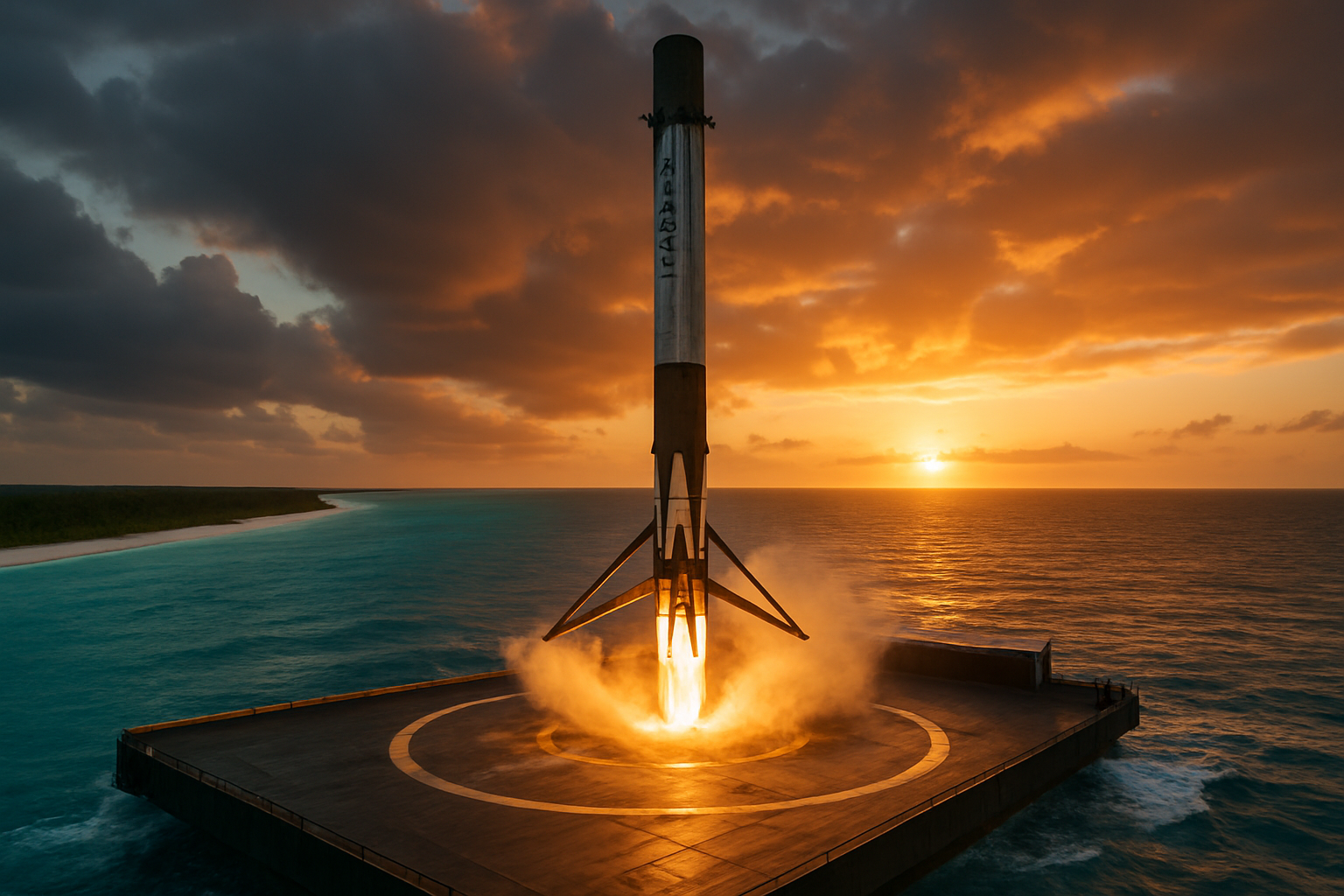
SpaceX has successfully completed its second rocket landing in Bahamas territorial waters, marking a significant expansion of the company's Caribbean operations as it prepares for what could become the largest IPO in history.
The February 21, 2026 landing represents a growing pattern of SpaceX utilizing international waters and partnerships to support its unprecedented mission tempo, which has reached over 573 successful booster recoveries across the company's global operations network.
Strategic Caribbean Expansion
The Bahamas landing operations come as SpaceX has fundamentally shifted its strategic focus from Mars colonization to lunar city development, targeting the establishment of self-sustaining Moon settlements within 10 years. This strategic pivot reflects the company's maturation toward pragmatic objectives that leverage the Moon's advantages: three-day travel times from Earth, monthly launch windows instead of Mars' 26-month cycles, and real-time communications capabilities.
According to industry analysts, the Caribbean operations provide SpaceX with additional recovery zones that reduce mission constraints and enable more frequent launches supporting both the Starlink constellation expansion and upcoming lunar missions. The company has demonstrated remarkable operational flexibility, with recent missions including the successful Starlink 10-34 deployment that marked the 26th flight of Falcon 9 booster B1077.
Public Opinion and Regulatory Considerations
The expansion has sparked debate among Bahamas residents and officials about the long-term implications of hosting SpaceX operations. Questions have emerged regarding environmental impact, territorial sovereignty, and the economic benefits versus potential risks of increased space activity in Caribbean waters.
The debate reflects broader international discussions about space operations governance, particularly as commercial space activities transition from experimental ventures to essential infrastructure. Thailand's recent appointment as chair of the UN Scientific and Technical Subcommittee for space governance highlights the growing need for international frameworks to manage commercial space activities.
"The democratization of space capabilities brings both opportunities and challenges for smaller nations hosting international space operations."
— Space Policy Expert, International Space Governance Institute
Context of Space Economy Transformation
SpaceX's Bahamas operations occur during what industry leaders term the transition from the "AI revolution to space economy golden age." The company is preparing for a June 2026 IPO that could value the combined SpaceX-xAI entity at over $1 trillion, making it the most valuable private company in history.
This historic merger combines SpaceX's rocket technology and Starlink satellite network with xAI's artificial intelligence platform, creating unprecedented vertical integration. The combined company plans to address the global memory crisis—with semiconductor prices increasing sixfold—through space-based data centers powered by solar energy.
Elon Musk has predicted that space-based AI data centers will become cost-effective within 36 months, citing superior solar energy capture, elimination of atmospheric interference, continuous power without day-night cycles, and no terrestrial cooling requirements.
International Space Competition Context
The Caribbean expansion also positions SpaceX advantageously in intensifying global space competition. China has advanced its Shenlong reusable spacecraft program with four successful launches, while European manufacturers like Germany's Isar Aerospace are building rocket testing facilities capable of testing 30 engines monthly in Sweden.
Pakistan recently selected astronaut candidates for China's Tiangong space station mission scheduled for October-November 2026, demonstrating the ongoing democratization of space capabilities. Meanwhile, NASA's Artemis II mission, delayed to March 2026 due to hydrogen leak issues, represents the first crewed mission beyond Earth orbit since Apollo 17 in 1972.
Technical Achievements and Operational Excellence
SpaceX's operational achievements extend far beyond recovery statistics. The company has successfully demonstrated strategic control capabilities, including blocking unauthorized Russian military use of Starlink terminals in Ukraine, showcasing the geopolitical significance of commercial space infrastructure.
Recent missions have achieved remarkable precision, with Dragon capsules traveling at over 27,000 kilometers per hour while executing pinpoint orbital rendezvous with the International Space Station. The Crew-12 mission successfully restored the ISS to full seven-person operational capacity, including French astronaut Sophie Adenot's historic eight-month mission.
Environmental and Economic Implications
The environmental impact of increased space activity has become a significant concern. Austrian scientists recently achieved the first direct measurement of atmospheric pollution from Falcon-9 rocket stage reentry, documenting lithium concentrations elevated tenfold above normal levels. This research establishes crucial baseline data for assessing the environmental impact of expanding space operations.
For the Bahamas, hosting SpaceX operations presents both economic opportunities and environmental responsibilities. The space economy is projected to become a trillion-dollar sector, offering substantial economic benefits for nations that can successfully integrate space operations with environmental protection and community interests.
Future of Caribbean Space Operations
As SpaceX prepares for its lunar colonization initiatives, the Caribbean operations may play an increasingly important role in supporting frequent Moon missions. The company's strategic shift from Mars to lunar objectives requires sustained, high-frequency launch capabilities that benefit from multiple recovery zones and international partnerships.
The success of Bahamas operations could influence other Caribbean nations to consider similar partnerships, potentially creating a regional space operations hub that supports both commercial missions and scientific research. This development would align with broader trends toward space capability democratization and international cooperation in space exploration.
Regulatory Framework Development
The expansion of commercial space operations in international waters highlights the urgent need for comprehensive regulatory frameworks. Current international space law, established during the government-dominated space age, requires updates to address commercial activities, environmental protection, and equitable benefit-sharing.
The Bahamas' experience with SpaceX operations may provide valuable precedents for other nations considering similar partnerships. Key considerations include environmental monitoring, safety protocols, economic benefit optimization, and maintaining national sovereignty while participating in global space infrastructure development.
As February 2026 represents a watershed moment in space exploration—combining mature human space capabilities with breakthrough technologies—the success of SpaceX's Caribbean operations could establish templates for sustainable international space commerce that balances innovation with community and environmental protection.