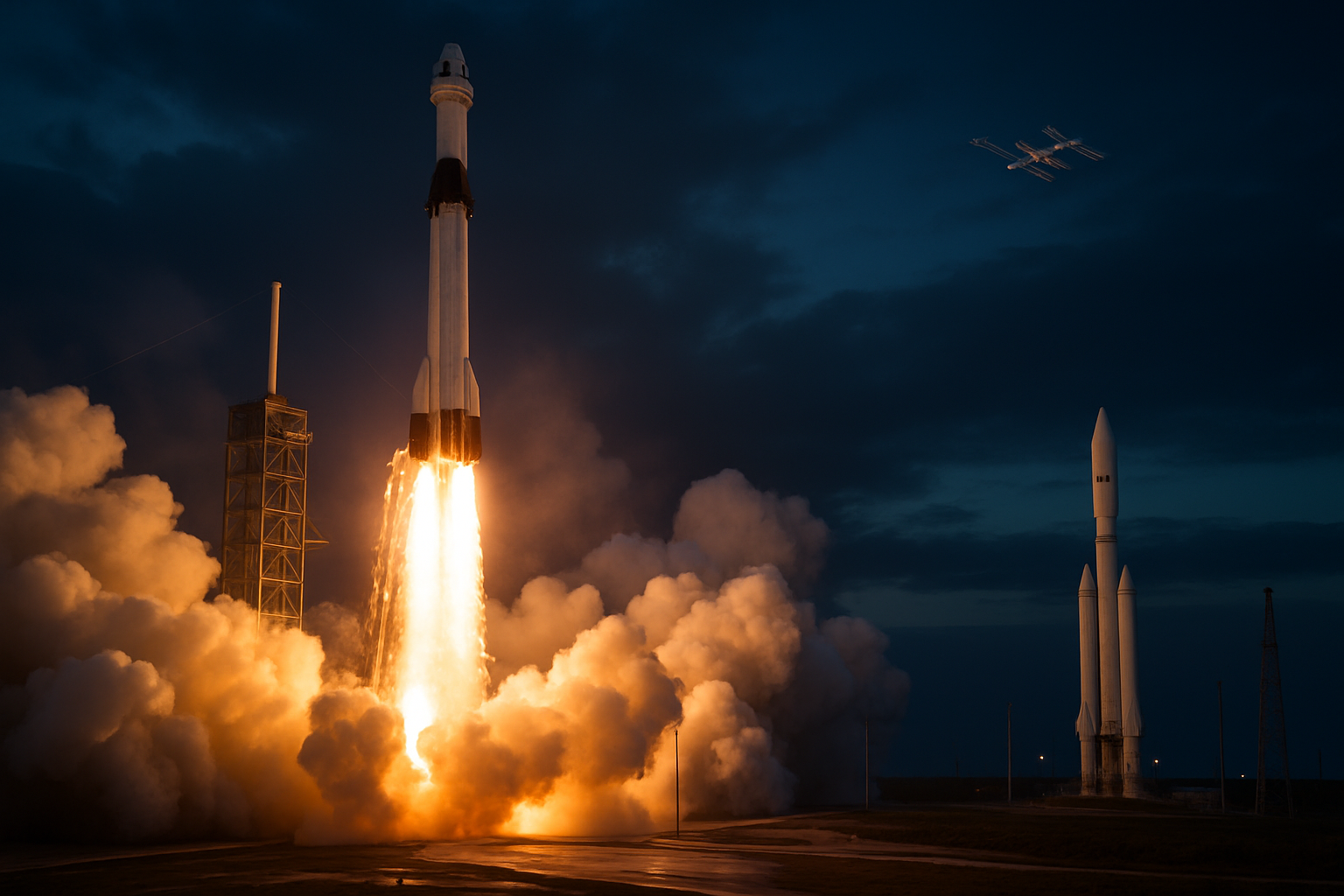
February 13, 2026, marks a watershed moment in global space exploration as SpaceX's Crew-12 mission successfully launches four astronauts to the International Space Station while Europe's largest rocket deploys 32 Amazon satellites and Elon Musk announces a $1 billion investment in Texas space infrastructure.
The convergence of these major developments underscores the rapid transformation of the space industry from government-dominated programs to a thriving commercial ecosystem, occurring during what analysts describe as the transition from the "AI revolution to space economy golden age."
Historic Crew-12 Launch Restores ISS Operations
At 5:15 AM EST on February 13, SpaceX's Falcon 9 rocket thundered skyward from Cape Canaveral Space Force Station, carrying the Crew Dragon capsule "Freedom" with four international astronauts aboard. The mission, led by veteran astronaut and marine biologist Jessica Meir, represents a critical crew rotation that restores the ISS to its full seven-person complement after an unprecedented medical evacuation left only a skeleton crew of three.
The international crew includes French astronaut Sophie Adenot, making history as the second French woman to reach space and the first to serve on the ISS. Adenot, a 43-year-old helicopter pilot and engineer, will conduct an eight-month mission—a record duration for a European astronaut. Joining her are NASA pilot Jack Hathaway and Russian cosmonaut Andrey Fedyaev as Mission Specialist.
"This mission represents the maturation of our commercial crew capabilities and demonstrates the strength of international cooperation in space exploration,"
— NASA Administrator, Kennedy Space Center
The launch comes after weather and technical delays that have characterized recent ISS operations, including the postponement of previous missions and ongoing challenges with NASA's Artemis II program, which faces hydrogen leak issues pushing the lunar flyby to March 2026.
Europe's Ariane 6 Achieves Major Milestone
Simultaneously, Europe celebrated a significant achievement as its new Ariane 6 rocket successfully deployed 32 Amazon satellites, marking another milestone in the continent's push for launch independence. The mission demonstrates Europe's growing capabilities in the commercial satellite deployment market, traditionally dominated by SpaceX's Falcon 9.
This launch occurs within the broader context of European space industry expansion, including Germany's Isar Aerospace constructing new testing facilities in Sweden capable of testing 30 rocket engines monthly. The development reflects Europe's strategic drive to reduce dependence on foreign launch services while building indigenous space capabilities.
Musk's Billion-Dollar Texas Investment
Adding to February's space developments, Elon Musk announced a massive investment exceeding $1 billion in Texas for a new SpaceX facility. The investment encompasses not only rocket construction capabilities but also infrastructure for what Musk envisions as a space-focused city, building on SpaceX's existing Starbase facility near the Mexican border.
This announcement comes amid SpaceX's strategic pivot from Mars colonization to lunar city development, with Musk targeting self-sustaining lunar settlements within 10 years. The shift leverages the Moon's logistical advantages, including three-day travel times for rapid resupply and emergency response, frequent launch windows, and real-time communication capabilities.
Scientific Priorities and Long-Duration Research
The Crew-12 mission carries particular scientific significance, with research focusing on microgravity effects on human biology crucial for future deep space exploration. Key investigations include lung tissue cultivation research, essential for understanding how human organs adapt to space conditions during extended missions to the Moon and Mars.
The eight-month mission duration enables comprehensive study of Space-Associated Neuro-Ocular Syndrome (SANS), a condition affecting astronaut vision during extended missions. Portuguese scientists have been conducting groundbreaking research into SANS, which represents a critical challenge for deep space exploration requiring medical solutions for lunar and Mars settlements.
Commercial Space Economy Transformation
These developments occur during a period of unprecedented growth in the commercial space sector, with SpaceX preparing for a potential June 2026 IPO that could value the company at over $1 trillion. The broader space economy is experiencing rapid expansion, driven by satellite infrastructure, space-based data centers, and emerging technologies.
The global memory crisis, with semiconductor prices surging sixfold, has accelerated interest in space-based computing alternatives. SpaceX's merger with xAI, creating a $1.25 trillion entity, aims to build solar-powered data centers in orbit, offering unlimited expansion potential without terrestrial constraints.
International Cooperation Amid Competition
Despite growing international competition in space capabilities, the Crew-12 mission exemplifies continued cooperation through the ISS program. The international crew composition—American, French, and Russian astronauts working together—demonstrates space exploration's unique ability to transcend geopolitical tensions.
This cooperation contrasts with intensifying competition in other areas, including China's advancement of its Shenlong reusable spacecraft program and emerging nations developing independent space capabilities. Pakistan recently launched its second indigenous Earth observation satellite and selected astronaut candidates for China's Tiangong space station mission.
Technical Challenges and Future Outlook
The current period highlights both achievements and ongoing challenges in space exploration. NASA's Artemis II mission faces continued delays due to hydrogen leak issues with the Space Launch System, pushing the first crewed lunar mission since Apollo 17 to March 2026. These technical challenges underscore NASA's commitment to safety-first approaches following historical lessons from previous space tragedies.
Space medicine research continues addressing challenges like SANS while developing countermeasures for radiation exposure and bone density loss during long-duration missions. These medical advances are crucial for the success of future lunar settlements and Mars exploration missions.
Economic and Strategic Implications
The convergence of commercial success, international cooperation, and technological advancement positions February 2026 as a pivotal moment in space exploration history. The integration of AI technologies with space operations, demonstrated by NASA's recent success with fully AI-planned Mars rover missions, represents a fundamental shift toward autonomous space exploration capabilities.
The economic implications extend beyond the space industry itself, with satellite infrastructure supporting global communications, weather forecasting, and navigation systems essential to modern civilization. Space-based data centers could address terrestrial infrastructure constraints while providing unlimited expansion potential for AI development.
As the space economy enters its "golden age," the successful Crew-12 mission, European launch capabilities, and massive infrastructure investments signal humanity's transition toward becoming a truly spacefaring civilization. The combination of commercial innovation, international partnership, and scientific advancement establishes the foundation for sustained human presence beyond Earth, marking February 2026 as a defining moment in the history of space exploration.