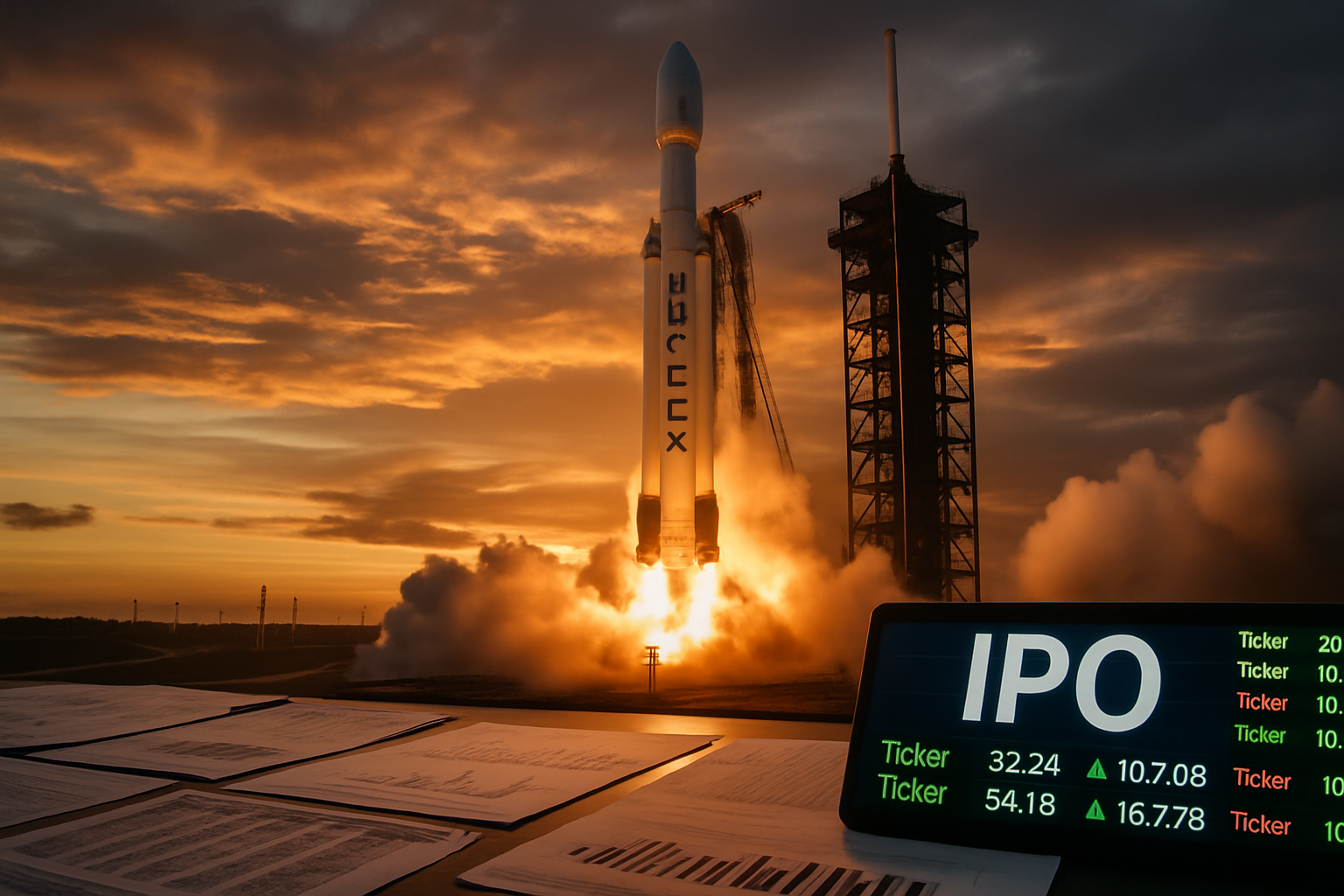
SpaceX has confidentially submitted its initial public offering filing to the U.S. Securities and Exchange Commission, setting the stage for what could become the largest IPO in financial history with a potential valuation exceeding $1.7 trillion.
The filing, reported by Bloomberg citing sources familiar with the matter, comes as Elon Musk's space exploration company reaches a critical juncture following its February merger with artificial intelligence firm xAI, creating a unified entity valued at $1.25 trillion.
According to reports from multiple international sources, including Finnish broadcaster Yle and Russian outlet Meduza, the IPO is expected to launch in June 2026, with the number of shares and price range to be disclosed in later filings.
Merger Creates Space-AI Powerhouse
The IPO filing follows SpaceX's transformative acquisition of xAI, which combined the rocket manufacturer's space capabilities with advanced artificial intelligence platforms, including the X social network and Grok AI service. This vertical integration strategy aims to build space-based data centers powered by solar energy, addressing the AI industry's mounting energy consumption challenges.
Industry analysts suggest the merged entity could be valued above $1.7 trillion at the time of public listing, driven by SpaceX's proven rocket technology, the global Starlink satellite network, and xAI's AI development capabilities.
"This represents the most ambitious, vertically-integrated innovation engine on (and off) Earth," Musk previously stated regarding the merger.
— Elon Musk, CEO of SpaceX
Strategic Pivot to Lunar Focus
SpaceX has undergone a strategic transformation, shifting its primary focus from Mars colonization to establishing lunar settlements within the next decade. This pivot leverages the Moon's practical advantages, including three-day travel times versus Mars's 26-month launch windows and real-time communication capabilities with Earth.
The company's lunar strategy aligns with NASA's Artemis program, positioning SpaceX as the primary commercial partner for America's return to the Moon. This pragmatic approach has enhanced investor confidence in the company's near-term revenue potential.
Global Memory Crisis Drives Space Computing
The timing of SpaceX's IPO coincides with a global semiconductor crisis that has seen memory chip prices increase sixfold, affecting major manufacturers including Samsung, SK Hynix, and Micron. This shortage is expected to persist until 2027, creating unprecedented demand for alternative computing solutions.
SpaceX's space-based data centers offer several advantages over terrestrial facilities: unlimited expansion potential, continuous solar power, elimination of cooling requirements, and no consumption of the billions of gallons of water typically used by ground-based data centers.
Market Revival Potential
The SpaceX IPO could provide a much-needed boost to the sluggish public offering market, which has struggled with volatility and reduced investor appetite for new listings. The company's proven track record of successful missions, including over 573 successful booster recoveries and regular International Space Station operations, has established it as the most reliable commercial space operator.
Financial analysts predict the offering could attract both institutional and retail investors, given SpaceX's unique position bridging traditional aerospace, cutting-edge AI technology, and the emerging space economy.
Regulatory and Technical Challenges
Despite its achievements, SpaceX faces several challenges ahead of its public debut. The company has experienced recent setbacks, including satellite explosions and ongoing regulatory scrutiny in multiple jurisdictions. European authorities have intensified oversight of Musk's business empire, with investigations into content moderation practices and AI safety protocols.
The global space industry also confronts growing concerns about orbital debris and environmental impact. Austrian researchers recently documented atmospheric pollution from rocket debris, showing lithium concentrations ten times above normal levels.
International Competition Intensifies
SpaceX's IPO preparations come amid intensifying international space competition. China has advanced its Shenlong reusable spacecraft program, while Jeff Bezos's Blue Origin has filed for a 51,600-satellite constellation - ten times larger than the current Starlink network.
European nations are also pursuing space independence, with Germany's Isar Aerospace expanding operations to Sweden and establishing facilities capable of testing 30 rocket engines monthly.
The Space Economy Golden Age
Industry experts characterize the current period as a transition from the "AI revolution" to a "space economy golden age," with commercial enterprises leading innovation beyond traditional government programs. SpaceX's potential trillion-dollar valuation reflects this broader transformation of space from an experimental frontier to essential infrastructure.
The company's strategic control capabilities were demonstrated when it successfully blocked unauthorized Russian military use of Starlink terminals in Ukraine, showcasing the geopolitical significance of commercial space assets.
Looking Ahead
If successful, the SpaceX IPO would mark a watershed moment for both the space industry and public markets. The offering would provide the company with substantial capital for its ambitious lunar colonization plans, space-based infrastructure development, and continued innovation in reusable rocket technology.
For investors, it represents an unprecedented opportunity to participate in humanity's expansion beyond Earth, while for the broader market, it could signal the beginning of a new era where space-based companies become integral to the global economy.
As the June 2026 timeline approaches, all eyes will be on whether SpaceX can successfully navigate the complex regulatory approval process and deliver on its promise to make space accessible for both commerce and human settlement.