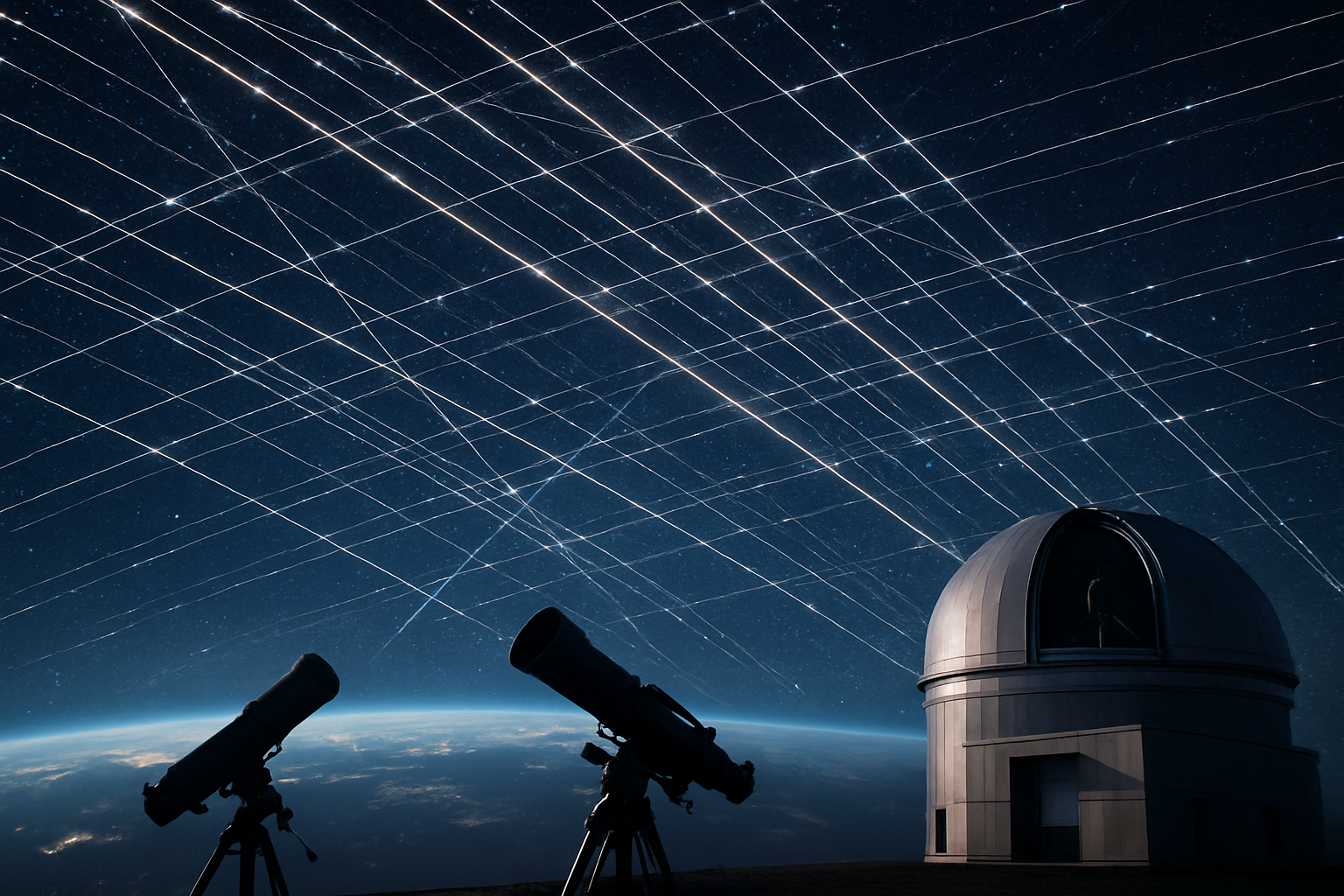
SpaceX's ambitious proposal to launch one million satellites into Earth's orbit has triggered unprecedented scientific alarm, with researchers warning of catastrophic consequences for both atmospheric integrity and humanity's access to the cosmos.
The revelation of Elon Musk's company's massive expansion plans represents a quantum leap from current satellite constellations, potentially creating what scientists describe as an "orbital cage" around Earth that could fundamentally alter humanity's relationship with space and the night sky.
The Scale of Environmental Concern
According to CBC reporting, scientists express "deep concern" about impacts ranging from "a loss of the natural night sky and our access to space, to the environmental impact on our atmosphere." The proposed constellation would dwarf current satellite networks, including SpaceX's existing Starlink system, which already comprises thousands of active satellites.
Recent Austrian research has documented the first direct measurements of atmospheric pollution from rocket debris, revealing lithium concentrations elevated tenfold above normal levels following Falcon-9 rocket stage reentry. This baseline study, conducted in February 2026, establishes concerning environmental impact precedents as space activity increases exponentially.
"We're seeing atmospheric contamination that's ten times higher than natural levels from just current launch activities. A million satellites would require unprecedented launch frequencies with proportionally massive atmospheric impact."
— Austrian Space Research Team, February 2026
Space Debris Crisis Intensification
The European Space Agency's Space Safety Programme head Holger Krag has warned that space is becoming dangerously overcrowded with over 34,000 tracked objects larger than 10 centimeters currently orbiting Earth, plus millions of smaller untrackable debris pieces capable of catastrophic damage at 17,500 mph orbital speeds.
A million-satellite constellation would exponentially increase collision risks, potentially triggering what scientists call a "cascade effect" where collisions generate additional debris, causing more collisions in a chain reaction that could render orbital regions unusable within decades.
ESA has responded by developing active debris removal technologies including "space janitor" spacecraft equipped with robotic arms and nets to capture defunct satellites for controlled atmospheric reentry. However, these cleanup efforts would be overwhelmed by the sheer scale of SpaceX's proposed constellation.
Astronomical Heritage Under Threat
The impact on astronomical observation represents what scientists term the systematic erasure of humanity's "astronomical heritage." Recent research indicates that over 1 billion children can barely see stars in the night sky above their homes due to existing light pollution, and satellite constellations would compound this crisis.
Ground-based observatories worldwide report increasing interference from satellite trails in deep-space observations. The James Webb Space Telescope and other space-based instruments face potential disruption from the proposed satellite swarm, threatening fundamental astronomical research including the search for potentially habitable exoplanets.
Atmospheric and Climate Implications
The atmospheric impact extends beyond immediate pollution concerns. Each satellite eventually requires deorbiting, typically through controlled atmospheric reentry that releases metallic particles and chemical compounds into the upper atmosphere. Multiplying current satellite numbers by a factor of hundreds could alter atmospheric chemistry in unprecedented ways.
Climate researchers note that the upper atmosphere plays crucial roles in Earth's energy balance and protective systems. Large-scale satellite deployment and eventual disposal could affect these delicate systems during a period when Earth is already experiencing its 18th consecutive month exceeding 1.5°C above pre-industrial levels.
International Governance Challenges
The proposal emerges during a critical period for space governance, with Thailand chairing the UN Scientific and Technical Subcommittee addressing commercial space activities that extend far beyond traditional government-era space law frameworks.
Current international space treaties lack comprehensive provisions for mega-constellations of this scale. The 1967 Outer Space Treaty requires that space activities be conducted "for the benefit of all mankind," but provides limited guidance for preventing one company's activities from compromising global access to space and astronomical observation.
NASA has issued warnings that Earth remains "completely defenseless" against approximately 15,000 undetected medium-sized asteroids capable of destroying entire cities. A dense satellite constellation could complicate both detection efforts and potential deflection missions, as demonstrated by NASA's successful DART asteroid deflection experiment.
Economic and Strategic Context
The satellite proposal occurs as SpaceX prepares for a potential June 2026 IPO that could value the company at over $1 trillion, reflecting the "space economy golden age" transition where space activities evolve from experimental to essential infrastructure.
The company's recent $1.25 trillion merger with xAI aims to build space-based data centers powered by solar energy, addressing terrestrial AI computing energy consumption issues. This economic momentum creates pressure for rapid deployment that may outpace environmental and safety assessments.
Industry analysis reveals that space-based infrastructure is becoming critical for modern civilization, supporting communications, navigation, weather monitoring, and research systems. However, this dependency raises questions about concentrating such infrastructure control in a single commercial entity.
Scientific Community Response
The international scientific community has mobilized unprecedented cooperation to address space debris challenges, but researchers emphasize that the window for effective remediation is narrowing rapidly. Success in managing the proposed constellation would require international cooperation on a scale previously unseen in space governance.
Recent achievements in space cooperation include coordinated asteroid monitoring, shared ISS operations despite terrestrial tensions, and collaborative climate research using satellite data. However, these efforts pale in comparison to the coordination required for managing a million-satellite constellation safely.
Alternative Approaches and Solutions
Scientists propose several mitigation strategies, including international orbital traffic management systems, mandatory debris removal bonds for satellite operators, and altitude-based zoning to preserve critical orbital regions for scientific research and space access.
Advanced laser communication technologies being developed by Swiss researchers offer potential alternatives to traditional radio frequency satellite systems, potentially reducing the number of satellites required for global internet coverage while providing higher bandwidth.
Some researchers advocate for space-based telescopes positioned beyond the satellite constellation zones, though this approach would require unprecedented international funding and cooperation to maintain humanity's astronomical observation capabilities.
Critical Decision Point
The SpaceX proposal represents what many scientists consider a defining moment for humanity's future relationship with space. The decision to approve or regulate such a massive constellation will determine whether space remains accessible for scientific research, future exploration, and the preservation of the night sky for future generations.
Environmental justice advocates note that while the benefits of satellite internet primarily serve wealthy populations and commercial interests, the environmental and astronomical costs affect all humanity, particularly indigenous communities and developing nations that rely on dark skies for cultural and navigational purposes.
As one leading space scientist warned, "We're at a crossroads. The choices we make about space development today will determine whether our children inherit a cosmos they can explore and wonder at, or find themselves trapped beneath an artificial ceiling of our own making."
The coming months will prove crucial as regulatory bodies, international organizations, and the scientific community grapple with balancing technological advancement against environmental protection and equitable access to humanity's cosmic heritage. The outcome may well determine whether the space age represents liberation or limitation for human civilization's relationship with the universe.