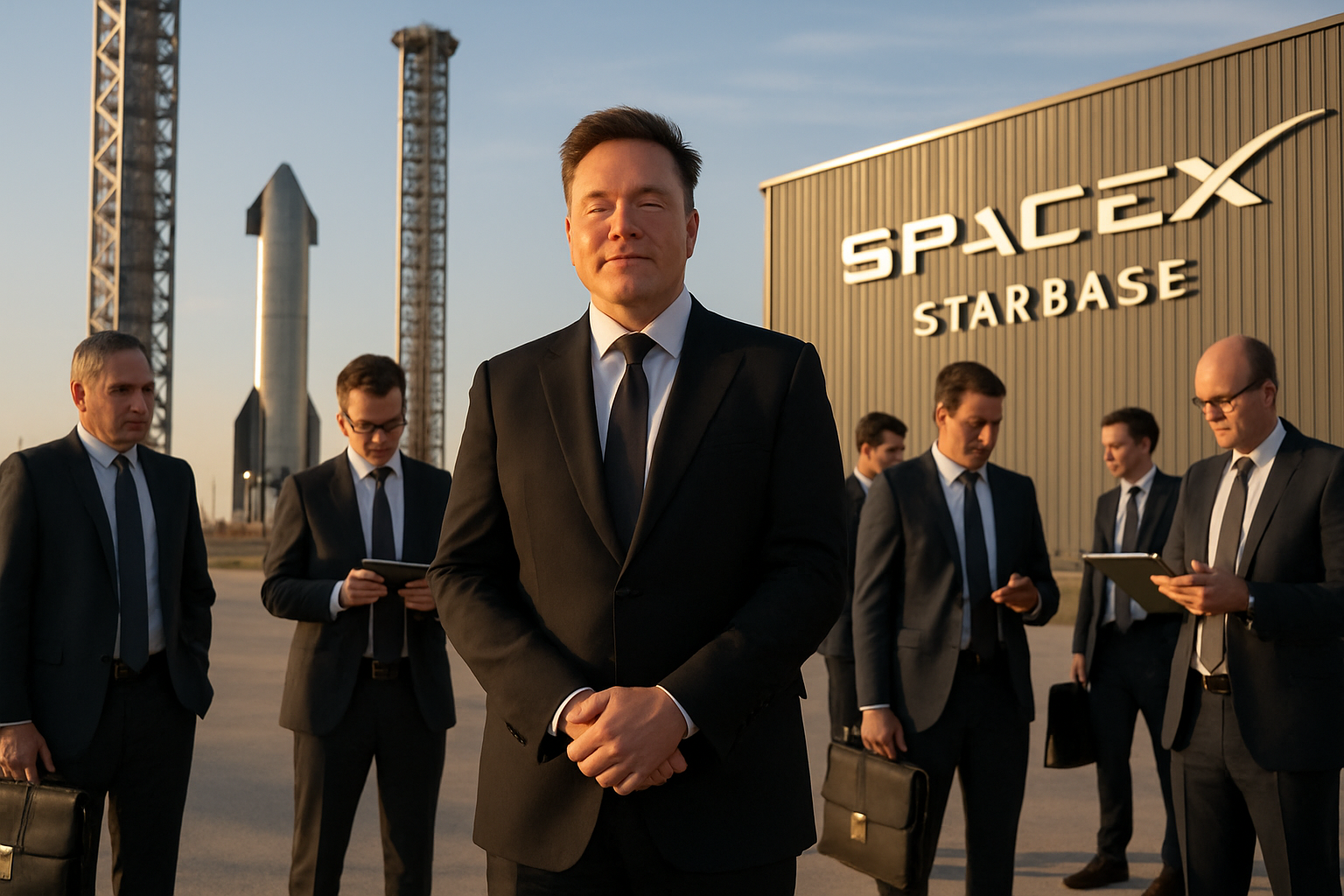
SpaceX is moving ahead with plans for one of the most anticipated IPOs in history, hosting analysts this week for three days of closed-door meetings at its launch facility in Texas and mega-sized data center in Tennessee, as Elon Musk's aerospace empire prepares to go public with an unprecedented $75 billion offering.
The secretive briefings mark a crucial step toward what industry analysts are calling the world's biggest-ever initial public offering, with executives targeting a late June trading debut that could value the merged SpaceX-xAI entity at over $1.7 trillion. The presentations represent the culmination of months of preparation following the February 2026 merger that created the world's most valuable private company.
Three-Day Analyst Marathon
According to three sources familiar with the matter, the presentations kick off with an all-day meeting and analyst tour on Tuesday at the satellite and rocket maker's Starbase launch facilities in Boca Chica, Texas. The carefully orchestrated sessions are designed to showcase SpaceX's revolutionary rocket recovery technology, with over 573 successful booster landings demonstrating routine space operations that have transformed launch economics.
On Wednesday, another group of analysts representing institutional investors, including major mutual funds and pension plans, will receive separate briefings at the same facility. The segregated sessions allow SpaceX to tailor presentations to different investor categories while maintaining strict confidentiality around financial projections and operational metrics.
Thursday's agenda moves to Tennessee, where analysts have been invited to review the company's ambitious space-based data center operations - a key differentiator that addresses the global memory crisis with semiconductor prices having surged sixfold due to AI demand. Musk has predicted that space-based AI computing will become cost-effective within 36 months, citing continuous solar power, unlimited expansion potential, and elimination of the billions of gallons of water consumed annually by terrestrial data centers.
Strategic Transformation
The IPO preparations come as SpaceX has undergone a significant strategic evolution. In February 2026, Musk announced a dramatic pivot from Mars colonization to lunar settlement development, targeting self-sustaining cities on the Moon within 10 years. This shift leverages practical advantages including monthly launch windows versus Mars' 26-month cycles, three-day travel times enabling rapid resupply and emergency response, and real-time communication capabilities.
This strategic realignment aligns perfectly with NASA's $20 billion lunar base commitment for 2030 and the Artemis program, positioning SpaceX as the primary commercial partner for America's return to the Moon. The timing coincides with successful Artemis II missions and growing international cooperation in space exploration, even as competition intensifies globally.
"We're transitioning from the AI revolution to the space economy golden age. SpaceX represents the convergence of space transportation, satellite communications, and artificial intelligence in ways that have never been attempted before."
— Industry Analyst, speaking on condition of anonymity
Unprecedented Valuation Drivers
The staggering valuation reflects multiple converging factors that position SpaceX uniquely in the global economy. The February 2026 merger with xAI created a vertically integrated empire combining rocket technology, the Starlink satellite constellation, AI platforms, the X social network, and Grok chatbot services. This integration addresses critical infrastructure constraints while creating new revenue streams across multiple sectors.
The space-based data center initiative represents perhaps the most revolutionary aspect of the offering. As terrestrial infrastructure struggles with AI's massive computational demands and water requirements - the World Bank projects AI will require 4.2-6.6 billion cubic meters annually by 2027 for cooling alone - SpaceX's orbital computing solution offers unlimited expansion without environmental constraints.
Starlink's strategic importance has been demonstrated through its role in global communications, including the controlled blocking of unauthorized Russian military use in Ukraine. With over 5,000 active satellites, the constellation has proven its ability to provide essential services while maintaining strategic control capabilities that governments worldwide now view as critical infrastructure.
Regulatory and Competitive Landscape
The IPO preparations occur amid increasing regulatory scrutiny, particularly in Europe. French authorities have conducted cybercrime raids on X offices over Grok AI violations, while Spain has implemented criminal executive liability frameworks for social media platforms. These challenges, however, have not deterred investor interest, particularly given SpaceX's operational separation from some of the more controversial aspects of Musk's broader platform empire.
International competition in the space sector is intensifying rapidly. China's Shenlong reusable spacecraft program continues advancing, while European space independence initiatives include Germany's €10 billion SATCOMBw 4 program and Sweden's Isar Aerospace expansion, testing 30 engines monthly. Pakistan has selected astronaut candidates for China's Tiangong station missions, demonstrating the democratization of space capabilities worldwide.
Amazon's Project Kuiper represents the most direct competitive threat, with plans for a 51,600-satellite constellation and recent partnerships including Delta Air Lines for 500 aircraft. Jeff Bezos's Blue Origin has also achieved breakthrough reusable rocket technology, successfully landing a previously-flown New Glenn booster, intensifying competition in the commercial space sector.
Environmental and Governance Challenges
Environmental concerns present ongoing challenges that analysts are closely monitoring. Austrian research has documented atmospheric pollution from rocket launches, including lithium concentrations ten times above normal levels from Falcon-9 debris. The European Space Agency warns that over 34,000 tracked orbital objects create collision risks at 17,500 mph, potentially leading to cascade effects that could render orbital regions unusable.
Current international space law, based on the 1967 Outer Space Treaty, is inadequate for managing commercial mega-constellations. Thailand's leadership of UN space governance initiatives represents efforts to develop modern regulatory frameworks, but progress remains slow relative to the pace of commercial space deployment.
SpaceX has faced operational setbacks, including satellite explosions and safety concerns, but the company's overall trajectory continues upward. The successful demonstration of strategic control capabilities, combined with essential services for both civilian and military applications, positions Starlink as infrastructure too critical to fail.
Market Context and Timing
The IPO comes during what industry experts call the transition from "AI revolution to space economy golden age," with global space economy projections exceeding $1 trillion by 2030. This timing is crucial as investors seek exposure to space-based infrastructure becoming essential rather than experimental.
The global memory crisis, with semiconductor prices up sixfold affecting Samsung, SK Hynix, and Micron operations until 2027, creates urgent demand for alternative computing solutions. SpaceX's space-based approach offers immediate scalability without terrestrial supply chain constraints, potentially revolutionizing how AI infrastructure is deployed globally.
Elon Musk's personal wealth has reached historic levels, exceeding $839 billion and positioning him as the world's first potential trillionaire. The SpaceX IPO could add hundreds of billions to his net worth while providing public investors access to what many consider the most transformative technology company of the modern era.
Investment Implications
For institutional investors, the SpaceX IPO represents access to multiple transformative trends simultaneously: space commercialization, satellite communications, artificial intelligence, and sustainable computing solutions. The company's demonstrated ability to generate revenue across multiple sectors while maintaining technological leadership creates a unique investment proposition.
The June timing allows investors to evaluate Q2 2026 performance data while positioning for what analysts expect will be accelerating demand for space-based services. The success of recent missions, including international partnerships and commercial contracts, provides tangible evidence of market demand for SpaceX's integrated capabilities.
Risk factors include regulatory challenges, technical complexity, competitive pressures, and the concentrated control under Musk's leadership. However, the company's track record of overcoming engineering challenges while expanding market opportunities has created investor confidence that extends beyond traditional aerospace sector metrics.
Global Implications
The SpaceX IPO represents more than a single company going public - it marks humanity's transition toward becoming a spacefaring civilization. The success or failure of this offering will influence global space policy, international cooperation frameworks, and the pace of technological development for decades to come.
As governments worldwide grapple with space governance, commercial space capabilities, and strategic technology dependencies, SpaceX's public market debut will establish precedents for how democratic societies balance innovation with regulation, competition with cooperation, and national interests with global benefits.
The analyst briefings this week represent the final preparation phase for what could become the most significant public offering in financial history. As Wall Street's top minds evaluate SpaceX's revolutionary integration of space, AI, and communications technologies, the stage is set for an IPO that will likely reshape both capital markets and humanity's relationship with space exploration.
With June rapidly approaching, all eyes are on Starbase as Elon Musk prepares to transform his private space empire into a public company that could define the next era of human technological advancement. The success of these analyst presentations will ultimately determine whether SpaceX achieves its ambitious valuation targets and secures its position as the leading force in humanity's expansion beyond Earth.