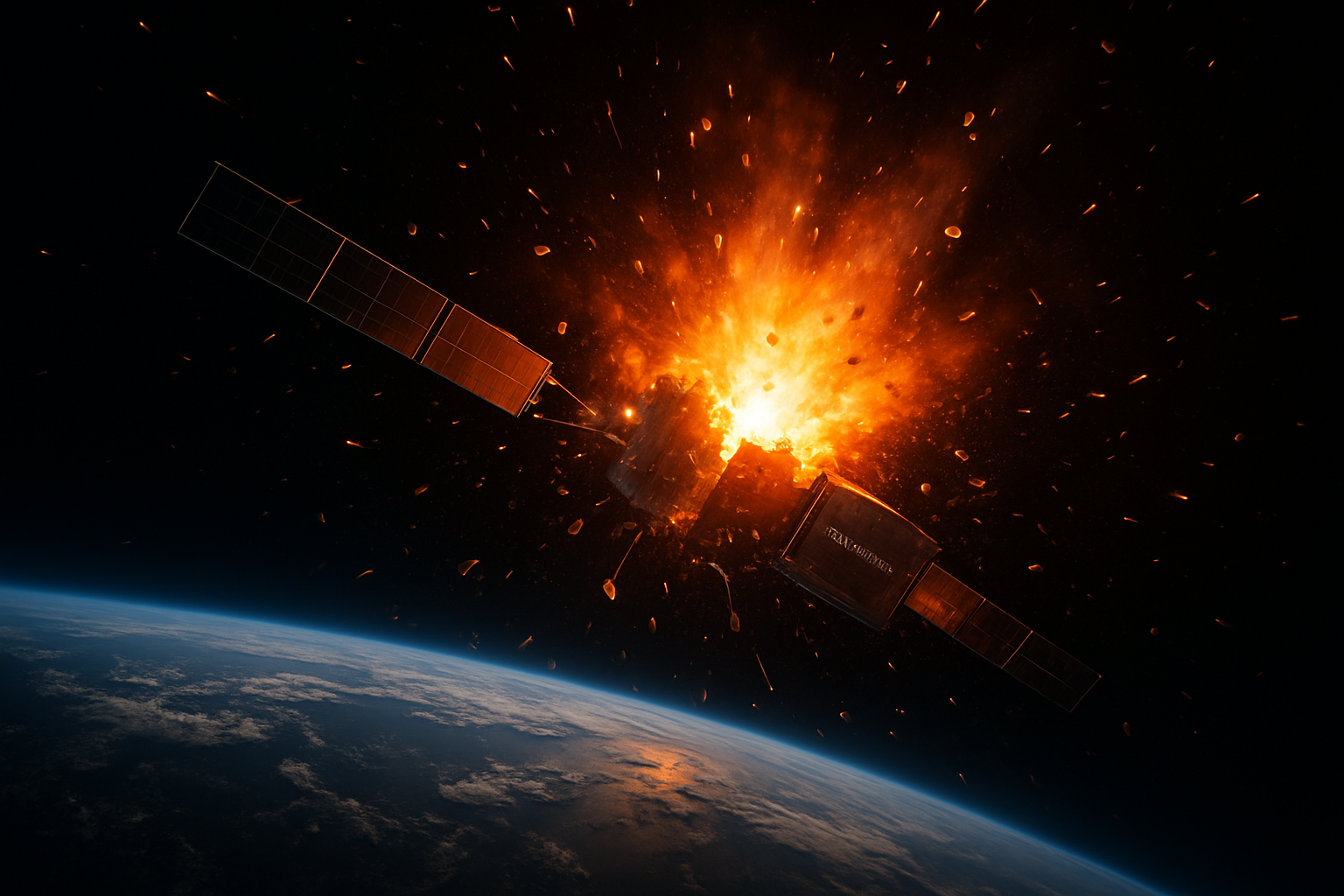
SpaceX faces mounting scrutiny as another Starlink satellite has unexpectedly exploded in orbit, marking the second such incident within months as the company prepares for what could be history's largest initial public offering valued at over $1 trillion.
The latest explosion, reported by Austrian media on April 1, 2026, occurred without any apparent collision cause, deepening the mystery surrounding the safety of SpaceX's massive satellite constellation. The incident comes at a critical juncture for Elon Musk's space enterprise, which is positioning itself for a blockbuster June 2026 IPO amid intensifying global competition in the commercial space sector.
Starlink Safety Concerns Mount
Austrian researchers have been at the forefront of documenting the environmental impact of SpaceX operations, including the first direct measurements of atmospheric pollution from Falcon-9 rocket debris. Their studies revealed lithium concentrations elevated tenfold above normal levels following rocket reentry, establishing crucial baselines for assessing the environmental cost of the space economy's rapid expansion.
The recurring satellite explosions raise fundamental questions about the safety protocols governing SpaceX's constellation of over 5,000 active Starlink satellites. With the company previously proposing to eventually deploy up to one million satellites, any systematic failure could have catastrophic implications for orbital safety.
European Space Agency's Space Safety Programme head Holger Krag has repeatedly warned that space is becoming dangerously overcrowded with over 34,000 tracked objects larger than 10 centimeters orbiting Earth, plus millions of smaller untrackable debris pieces capable of catastrophic damage at 17,500 mph orbital speeds.
Chinese Competition Challenges SpaceX Dominance
The satellite explosions coincide with China's aggressive push into the commercial space market, with companies like CAS Space developing cost-competitive alternatives to SpaceX's offerings. The Kinetica-2 Y1 carrier rocket, also known as the Lijian-2 Y1, recently completed its inaugural flight at a price point reportedly lower than SpaceX's Falcon 9 reusable launch vehicle.
The Chinese rocket successfully delivered three satellites into orbit, including a prototype commercial cargo spacecraft and a mini-orbiting space laboratory, demonstrating China's growing capabilities in the commercial space sector. This advancement comes as China has also launched sophisticated orbital servicing technology, including the Hukeda-2 satellite equipped with flexible "octopus tentacle" robotic arms for refueling and debris disposal operations.
Industry analysts note that China's space program benefits from substantial government backing and strategic coordination that allows for aggressive pricing strategies. This poses a significant challenge to SpaceX's market dominance, particularly as the company faces technical setbacks and safety concerns.
The Trillion-Dollar IPO Question
Despite the mounting challenges, SpaceX is reportedly moving forward with plans for a public offering that could value the company at over $1 trillion, making it potentially the largest IPO in history. Bloomberg News reports indicate that SpaceX has registered to take the rocket maker public, though specific timing and valuation details remain closely guarded.
The IPO preparations come at the height of what industry observers call the "space economy golden age," with the global space economy projected to exceed $1 trillion by 2030. SpaceX's valuation would be buoyed by its diverse portfolio including rocket launches, satellite internet services, space-based data centers, and ambitious lunar colonization plans.
The $1.25 trillion merger with xAI announced in February 2026 created additional complexity for the public offering structure, as the combined entity integrates SpaceX's transportation capabilities with advanced artificial intelligence platforms, the X social network, and Grok AI services.
Blue Origin's Orbital Ambitions
Adding to competitive pressures, Jeff Bezos' Blue Origin has filed applications with the Federal Communications Commission for a massive 51,600-satellite constellation to support space-based data centers. This constellation would be nearly ten times larger than SpaceX's current Starlink deployment, representing a direct challenge to SpaceX's satellite internet dominance.
Blue Origin's space-based data center concept leverages space's advantages of continuous solar power, no cooling requirements, and unlimited expansion potential. Industry projections suggest such systems could become cost-effective within 36 months, fundamentally altering computing economics through orbital processing capabilities.
The satellite internet market has become increasingly strategic, with applications extending far beyond consumer internet access to include military communications, autonomous vehicle networks, and Internet of Things infrastructure. Control over these orbital networks carries significant geopolitical implications, as demonstrated by SpaceX's ability to selectively block Russian military use of Starlink terminals in Ukraine.
International Regulatory Challenges
The space industry's rapid expansion has outpaced international regulatory frameworks, creating governance challenges for mega-constellations. Thailand currently chairs the UN Scientific and Technical Subcommittee addressing commercial space activities, but current international space law remains inadequate for managing contemporary commercial operations.
The 1967 Outer Space Treaty requires space activities to benefit "all mankind," but provides limited guidance for preventing individual companies from compromising global space access. Environmental justice concerns are mounting, as the benefits of space-based services primarily serve wealthy populations while the environmental costs affect all humanity.
NASA has warned of approximately 15,000 undetected potentially hazardous asteroids, and dense satellite constellations could complicate detection and deflection missions. The European Space Agency is developing "space janitor" spacecraft equipped with robotic arms and nets for debris removal, but such systems would be overwhelmed by proposed million-satellite deployments.
Strategic Implications for Space Economy
The convergence of satellite explosions, competitive pressures, and regulatory challenges comes as SpaceX has strategically pivoted from Mars colonization to lunar settlement development. The company now prioritizes self-sustaining lunar cities within 10 years, leveraging the Moon's advantages of monthly launch windows versus Mars' 26-month cycles and three-day travel times enabling rapid resupply and emergency response.
This strategic shift aligns with NASA's historic $20 billion commitment to establishing a permanent lunar surface base by 2030, the largest space infrastructure investment in agency history. The Artemis program represents a critical stepping stone toward sustained human space presence, with international partners including Canada's Jeremy Hansen becoming the first Canadian astronaut beyond Earth orbit.
The space economy transformation extends beyond transportation to include space-based manufacturing, orbital data centers, and resource extraction. Success in these ventures could generate trillions in economic value while establishing humanity as a truly spacefaring civilization.
Environmental and Safety Considerations
Austrian research documenting atmospheric pollution from rocket debris has highlighted the environmental costs of space economy expansion. Each satellite requires eventual deorbiting through atmospheric reentry, releasing metallic particles and chemical compounds that could alter upper atmospheric chemistry during a critical climate period.
The million-satellite proposal would require exponential increases in launch frequency, with proportional atmospheric contamination. Scientists warn of a potential "orbital cage" around Earth that could affect humanity's access to space and the natural night sky, with over one billion children already unable to see stars due to light pollution.
Space debris cascade effects represent perhaps the greatest long-term threat, where collisions generate additional debris causing chain reactions that could render orbital regions unusable. The window for effective debris remediation is narrowing rapidly, requiring unprecedented international cooperation and sustained funding.
Market Dynamics and Investment Implications
The space industry's maturation from experimental ventures to essential infrastructure has attracted massive capital investments. Alphabet has committed $185 billion to AI infrastructure in 2026, while Amazon exceeds $1 trillion in space-related development plans. SoftBank Group announced an unprecedented $500 billion AI data center investment, designed to complement space-based computing capabilities.
The global memory crisis, with semiconductor prices increasing sixfold and affecting Samsung, SK Hynix, and Micron operations until 2027, has accelerated interest in space-based alternatives. Space-based data centers offer solutions to terrestrial infrastructure constraints, providing unlimited expansion without the billions of gallons of water consumed annually by terrestrial facilities.
However, the technical challenges are substantial, including radiation exposure, micrometeorite impacts, orbital maintenance costs, and launch expenses. The recent satellite explosions underscore the risks inherent in space-based infrastructure development, particularly as systems become critical to modern civilization.
Looking Forward: Critical Decisions Ahead
The coming months represent a critical decision point for the space economy's trajectory. SpaceX's ability to resolve its satellite safety issues while completing its IPO will significantly influence investor confidence in commercial space ventures. The company's response to competitive pressures from China and Blue Origin will determine market dynamics for the next decade.
International governance frameworks must evolve rapidly to address the challenges of mega-constellations, environmental protection, and equitable access to space resources. The success of current regulatory efforts will determine whether space represents liberation or limitation for humanity's cosmic relationship.
The convergence of commercial capabilities, international competition, AI integration, and environmental concerns creates unprecedented complexity requiring coordinated responses from governments, corporations, and international institutions. The decisions made in 2026 will establish the foundation for humanity's transition to a spacefaring civilization, determining whether space activities support human flourishing while protecting our cosmic heritage for future generations.
As SpaceX prepares for its historic IPO amid satellite explosions and intensifying competition, the space economy stands at a crossroads. The outcome will shape not only the commercial space sector but humanity's fundamental relationship with the cosmos for decades to come.