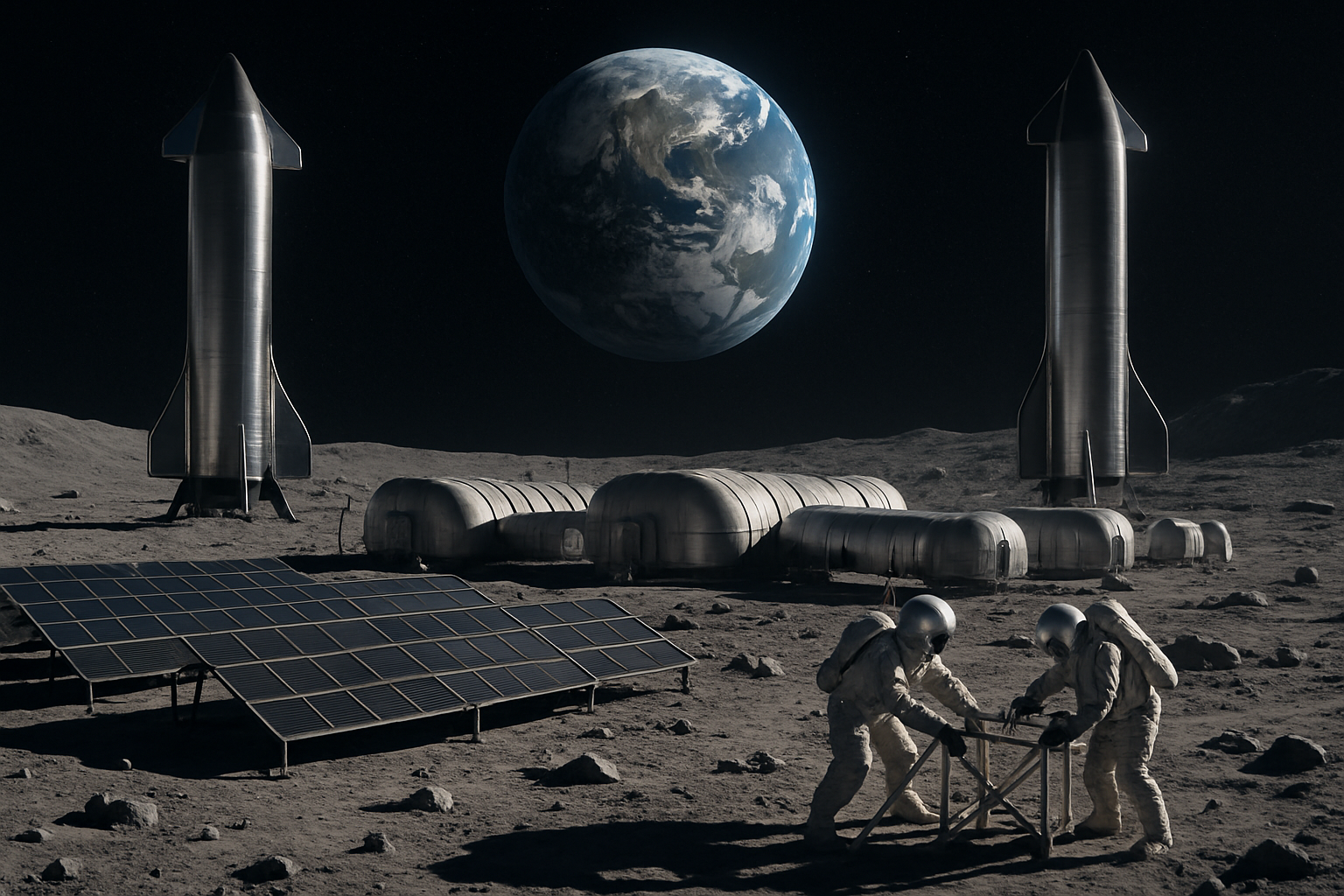
In a dramatic strategic shift that could reshape the future of human space exploration, Elon Musk has announced that SpaceX is now prioritizing lunar colonization over its long-held Mars ambitions, aiming to establish the first self-sustaining city on the Moon within the next decade.
The announcement represents a fundamental departure from SpaceX's traditional Mars-first approach that has dominated the company's vision since its founding. According to sources, the decision reflects both practical considerations and strategic alignment with evolving U.S. space exploration priorities.
Strategic Pivot to Lunar Priority
SpaceX's new focus centers on developing a permanent human presence on the Moon, with Musk stating that a functioning lunar city could emerge within 10 years. This timeline represents a significant acceleration compared to previous Mars colonization estimates, which critics have long characterized as overambitious.
The shift aligns SpaceX's commercial ambitions with NASA's Artemis program goals, creating potential synergies between private industry and government space exploration efforts. The Moon offers more frequent launch windows compared to Mars, where optimal transfer opportunities occur only every 26 months due to planetary alignment requirements.
Industry observers note that Musk has repeatedly blown through previous estimates for Mars missions, with timelines consistently proving unrealistic. The lunar focus may represent a more achievable near-term objective that could demonstrate the viability of large-scale space colonization before attempting the more complex Mars mission.
Technical and Logistical Advantages
The Moon presents several logistical advantages over Mars for establishing an initial human settlement. The three-day journey to the Moon allows for more frequent supply missions and rapid emergency response capabilities, compared to the months-long travel time to Mars with limited rescue possibilities.
Lunar colonization also benefits from the Moon's proximity to Earth-based resources and communication systems. Real-time communication remains possible, unlike Mars missions where signal delays range from 4 to 24 minutes depending on planetary positions.
SpaceX's Starlink satellite network experience could prove valuable for establishing lunar communications infrastructure, building on the company's demonstrated capability to deploy and manage orbital communication systems at scale.
Context of SpaceX's Expanding Empire
The lunar colonization announcement comes amid SpaceX's dramatic expansion through its recent $1.25 trillion merger with xAI, creating the world's most valuable private company. This combined entity integrates rocket technology, satellite networks, and artificial intelligence capabilities under unified management.
The merger specifically aims to develop space-based data centers powered by solar energy, addressing the AI industry's growing energy consumption challenges. Musk has predicted that space-based AI computing could become cost-effective within 36 months, citing advantages including continuous solar power, elimination of day-night cycles, and no atmospheric interference.
NASA's recent certification of consumer smartphones for Artemis II lunar photography missions demonstrates the democratization of space technology, potentially supporting civilian activities in future lunar settlements.
International Space Competition Context
SpaceX's lunar pivot occurs during an intensifying international space race. China continues advancing its reusable spacecraft capabilities with successful Shenlong missions, positioning itself as a potential rival to U.S. space dominance. Multiple nations are developing independent space capabilities, creating a multipolar space exploration environment.
The timing also coincides with NASA's Artemis II mission preparations, though the lunar flyby has faced delays due to technical challenges including persistent hydrogen leak issues. The mission, when successful, will mark the first crewed mission beyond Earth orbit since Apollo 17 in 1972.
European space initiatives continue expanding, with countries like Germany building rocket testing facilities capable of producing 30 engines monthly, demonstrating growing international competition in space technology manufacturing.
Economic and Infrastructure Implications
The transition from AI revolution to what analysts term the "space economy golden age" positions lunar colonization as potentially the next major economic frontier. SpaceX's planned June IPO could value the company at over $1 trillion, providing substantial capital for ambitious space infrastructure projects.
The global memory crisis, with semiconductor prices increasing sixfold, adds urgency to developing space-based computing alternatives that could support both lunar colonies and Earth's digital infrastructure needs.
Lunar resource extraction possibilities, including rare earth elements and Helium-3 for fusion energy, could provide long-term economic justification for large-scale lunar settlement investments.
Technical Challenges and Realistic Timelines
Despite Musk's optimistic 10-year timeline, establishing a self-sustaining lunar city faces enormous technical challenges. These include radiation protection, life support systems, in-situ resource utilization for construction materials, and psychological factors affecting long-term human habitation in isolated environments.
Space medicine research continues identifying challenges like Space-Associated Neuro-Ocular Syndrome (SANS) that affects astronauts during extended missions, requiring solutions before permanent lunar residence becomes viable.
Critics point to Musk's history of ambitious timeline predictions that have consistently proven unrealistic, suggesting the 10-year lunar city goal may face similar delays and technical obstacles.
International Cooperation and Competition
The lunar colonization initiative will require unprecedented international cooperation for success, building on existing partnerships like the International Space Station program. Thailand's recent appointment to chair the UN Scientific and Technical Subcommittee for space governance demonstrates emerging nations' growing influence in space policy.
Pakistan's upcoming astronaut mission to China's Tiangong space station illustrates the expanding international participation in human spaceflight, creating opportunities for collaborative lunar development programs.
However, geopolitical tensions could complicate international cooperation, particularly given the strategic implications of lunar resource control and the precedent set by SpaceX's ability to control Starlink access during military conflicts.
Long-term Vision and Mars Future
While Mars remains a long-term objective, SpaceX's lunar focus represents a stepping-stone approach to interplanetary colonization. Successful lunar settlement could provide crucial experience in closed-loop life support systems, space construction techniques, and psychological adaptation to extraterrestrial living.
The lunar colony could also serve as a staging point for future Mars missions, offering lower gravity launch advantages and serving as a testing ground for technologies essential for Martian settlement.
NASA's continued Mars exploration through AI-powered rover missions demonstrates ongoing scientific interest in the Red Planet, suggesting that lunar and Martian exploration may eventually proceed in parallel rather than sequentially.
Conclusion
SpaceX's strategic shift toward lunar colonization represents a pragmatic evolution of human space exploration ambitions. While the 10-year timeline remains ambitious given the technical challenges involved, the Moon's proximity and alignment with government space programs provide more realistic prospects for success than previous Mars-focused initiatives.
The success of this lunar colonization effort will likely determine the pace and scope of humanity's expansion into the solar system, potentially establishing the foundation for the space-based civilization that has long captured human imagination. Whether Musk's latest timeline proves more accurate than previous predictions remains to be seen, but the shift toward lunar priorities reflects a maturing approach to the practical challenges of space colonization.