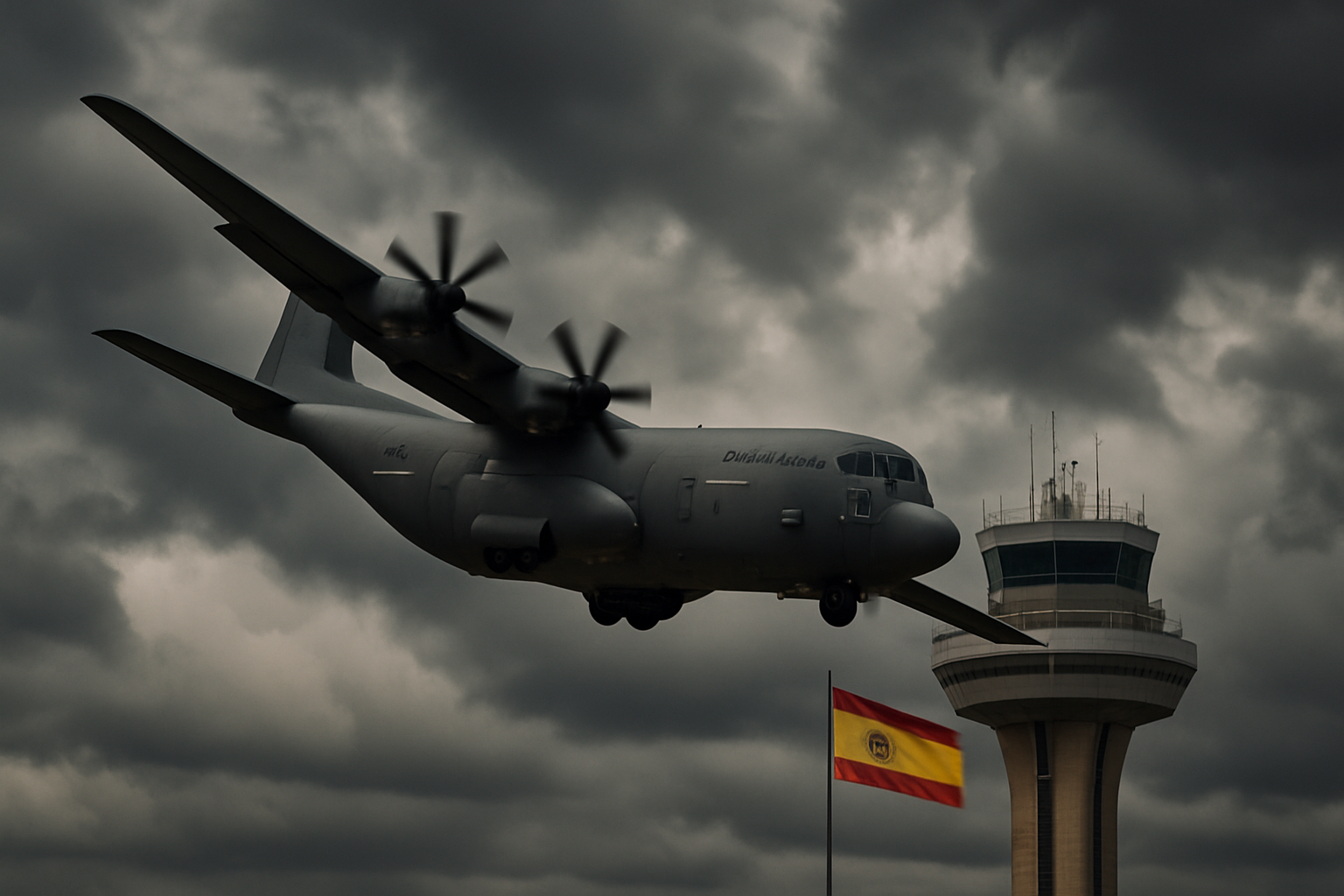
Spain has escalated its opposition to US military operations in Iran by closing Spanish airspace to American military aircraft involved in the ongoing conflict, Defense Minister Margarita Robles announced Monday, marking an unprecedented diplomatic crisis within NATO.
The airspace closure goes beyond Spain's previous refusal to allow US forces to use jointly operated military bases on Spanish territory, forcing American military aircraft to bypass the NATO member country entirely on their way to Middle East operations. The move represents the most serious alliance fracture since NATO's formation over 75 years ago.
"We don't authorize either the use of military bases or the use of airspace for actions related to the war in Iran," Robles told reporters in Madrid. She emphasized that Spain had "made this clear to the American government from the beginning" of the crisis.
NATO's Most Severe Test
The Spanish decision comes as the Iran conflict enters its fourth week, with Operation Epic Fury having cost $11.3 billion in its first week alone and showing no signs of quick resolution. The Pentagon has prepared operations to continue through September, far beyond President Trump's initial 4-6 week timeline.
Spain's position is grounded in international law compliance, with Prime Minister Pedro Sánchez's government maintaining that US forces can only use Spanish facilities for activities "consistent with the UN Charter and international law." This marks the first time since the 1950s defense agreements that Spain has explicitly denied base access for a major US military operation.
The crisis has strained transatlantic relations to the breaking point, with Trump previously threatening to "cut off all trade" with Spain after Sánchez condemned the Iran operations as a "breach of international law." The President has already ordered Treasury Secretary Scott Bessent to "cut off all dealings" with Madrid.
European Strategic Autonomy in Action
Despite refusing to support US operations in the Persian Gulf, European nations have demonstrated unprecedented unity in defending their own territory. When Iranian drones struck RAF Akrotiri in Cyprus - the first attack on European soil since World War II - Spain immediately joined a four-nation naval coalition alongside Britain, France, and Italy to protect Cyprus.
This response illustrates what Spanish officials describe as the distinction between "European territorial defense" and "discretionary military interventions." Sánchez has stated: "No to war in Iran, but solidarity with Cyprus, an EU country victim of this war."
The paradox reflects a new paradigm in European security policy, where allies coordinate rapidly to defend European territory while refusing to participate in what they view as optional American military adventures beyond the alliance's core defensive mission.
Global Crisis Reaches Critical Point
The Iran conflict has created the most severe international crisis since the Cold War ended, with Iran's closure of the Strait of Hormuz affecting 40% of global oil transit and causing unprecedented disruption to international aviation. Over 18,000 flights have been cancelled worldwide - the most extensive disruption since the COVID-19 pandemic.
Oil prices have surged past $119 per barrel, prompting the International Energy Agency to authorize the largest strategic petroleum reserve release in its 50-year history - 400 million barrels from 32 countries. The global economic impact has been severe, with Pakistan's stock market suffering its largest single-day decline in history.
"This decision is part of the decision already made by the Spanish government not to participate in or contribute to a war which was initiated unilaterally and against international law."
— Carlos Cuerpo, Spanish Economy Minister
Nuclear Diplomacy Breakdown
The current military escalation stems from the complete collapse of nuclear diplomacy despite what had been the most promising US-Iran engagement in years. Geneva talks in February achieved "broad agreement on guiding principles" - the most progress since the 2018 JCPOA collapse - but fundamental disagreements over scope proved insurmountable.
Iran insisted on nuclear-only discussions, excluding ballistic missiles and regional proxy groups as "red lines," while the US demanded comprehensive talks covering missiles, armed groups, and human rights. Iran continues enriching uranium to 60% purity with over 400 kilograms of material, approaching the 90% weapons-grade threshold.
The diplomatic failure occurred amid a broader nuclear governance crisis, with the New START treaty having expired in February 2026, marking the first time in over 50 years without US-Russia nuclear constraints.
Congressional and International Opposition
The Iran war faces unprecedented opposition in Congress, with only 25% of Americans supporting the operations - historically low approval for military action. Senator Richard Blumenthal has expressed being "more concerned than ever" about potential ground troop deployment as costs mount and the timeline extends indefinitely.
Internationally, the crisis has exposed deep divisions within Western alliances. Germany's Defense Minister Boris Pistorius led European resistance to Trump's demands for naval support in the Persian Gulf, asking: "What does Donald Trump expect a handful of European frigates to do that the powerful US Navy cannot?"
The regional coalition that initially supported diplomatic solutions has also been severely strained, with Egypt's President Sisi condemning Iranian attacks on "sisterly Arab countries" and warning of "comprehensive chaos" spreading across the region.
Historical Precedent and Long-term Implications
Spain's airspace closure represents a template-setting moment for 21st-century alliance relations, testing the balance between national sovereignty and collective security obligations. The precedent established could influence how middle powers navigate relationships with major allies when core principles are at stake.
The crisis occurs against the backdrop of Spain's historical memory of the Iraq War, when Spanish opposition contributed to the conservative Popular Party's electoral defeat in 2004. Sánchez has explicitly invoked this precedent, positioning Spain as having learned from history to prevent what he calls "humanity's great disasters."
UN Secretary-General António Guterres has described the current situation as "the greatest test of multilateral cooperation in the modern era," with implications extending far beyond the immediate military conflict to fundamental questions about international law enforcement, nuclear governance credibility, and the sustainability of the post-World War II international order.
Energy and Economic Warfare
Iran's strategic closure of the Strait of Hormuz has weaponized energy markets, with the narrow 21-mile waterway's blockade exposing the vulnerability of modern logistics systems to single-point failures. The Revolutionary Guard has deployed between 2,000 and 6,000 naval mines throughout the strait, effectively blocking the passage of over 150 tankers carrying billions of dollars in cargo.
The energy crisis has forced fundamental reconsiderations of supply chain resilience, with Qatar's LNG production halted and natural gas prices surging 24% in Europe and 78% in the United States. Airlines have implemented emergency fuel surcharges as jet fuel prices have risen from $85-90 per barrel to $150-200, representing increases of up to 122%.
The Path Forward
As the crisis enters its fourth week, the prospects for diplomatic resolution remain dim. Trump has demanded Iran's "unconditional surrender" and claims the right to personally choose Iran's next Supreme Leader - the most direct assertion of American control over Iranian affairs since the 1979 revolution.
The Iranian side, now led by Mojtaba Khamenei in the first hereditary succession in the Islamic Republic's 47-year history, shows no signs of capitulation. The Revolutionary Guards' unprecedented control over governance represents a hardline military shift from traditional clerical leadership.
Spain's position reflects broader European sentiment that the alliance should focus on collective defense rather than discretionary interventions. The success or failure of managing this crisis through diplomatic channels could determine whether institutional cooperation frameworks are strengthened or whether Western unity fragments at a critical moment for international stability.
The stakes extend far beyond the immediate conflict, encompassing regional war prevention, global energy security, nuclear governance credibility, and the enforcement of international law principles that have underpinned the global order since 1945. How the international community navigates this unprecedented challenge will likely influence conflict resolution approaches for decades to come, establishing precedents for how democracies coordinate responses to major security crises while maintaining respect for sovereignty and international law.