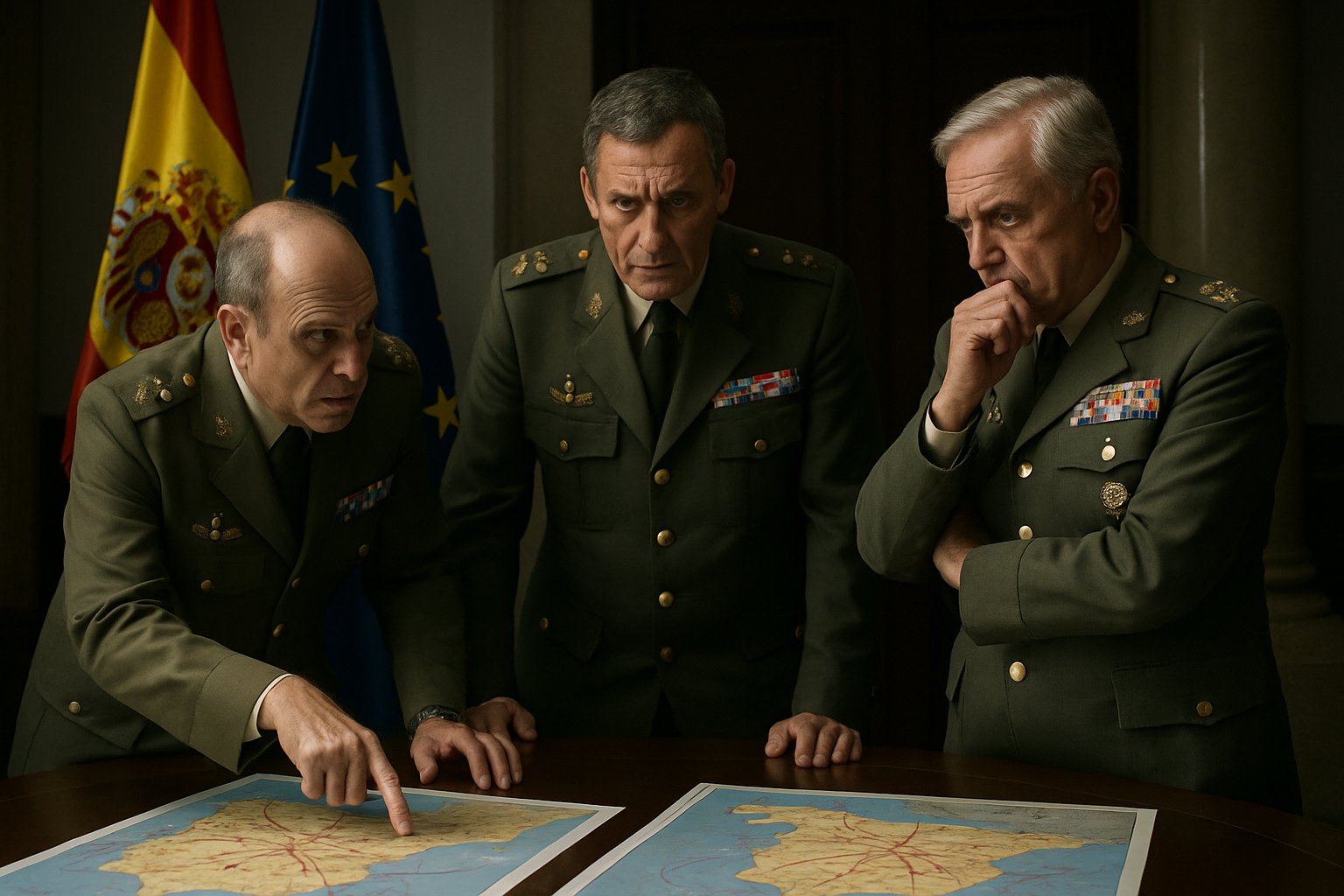
Spain has closed its airspace to US military aircraft involved in operations against Iran, escalating beyond its previous denial of military base access to mark the most serious NATO diplomatic crisis since World War II.
Spanish Defense Minister Margarita Robles announced Monday that Spain has completely closed its airspace to US military aircraft participating in the ongoing Iran war operations, forcing American planes to bypass Spain entirely for Middle East missions. The decision represents a dramatic expansion of Spain's resistance to what Madrid calls an "illegal war."
The airspace closure, confirmed by El País citing military sources, affects all US aircraft involved in Operation Epic Fury—the largest US-Israeli military campaign since 2003. Emergency situations are excluded from the ban, but the measure forces fundamental rerouting of American military logistics to the Middle East.
Unprecedented NATO Alliance Crisis
The Spanish decision marks the most serious confrontation between major NATO allies since the alliance's formation. Spain's position is grounded in UN Charter and international law compliance requirements, distinguishing it from traditional alliance obligations.
Prime Minister Pedro Sánchez had previously declared "No to war," refusing to allow US forces to use Spanish bases at Rota Naval Station and Morón Air Base for Iran operations. The airspace closure represents a significant escalation of Spain's resistance to American military actions Madrid views as violating international law.
"Spain will not be accomplices in something that is bad for the world simply out of fear of retaliation. We are prouder than ever to be Spanish."
— Pedro Sánchez, Spanish Prime Minister
President Trump had threatened to "cut off all trade" with Spain and ordered Treasury Secretary Scott Bessent to "cut off all dealings" with Madrid following the initial base access denial. The US has already relocated 15 aircraft including refueling tankers from Spanish facilities—the first such denial of base access since the 1950s defense agreements.
European Strategic Autonomy in Action
Spain's actions demonstrate a careful balance between European territorial defense and discretionary military interventions. While refusing US base and airspace access for Iran operations, Spain immediately joined an unprecedented naval coalition protecting Cyprus after Iranian drone attacks—the first attack on European territory since WWII.
The coalition includes HMS Dragon, Italian and French vessels, and Greek naval assets, representing the most concrete expression of European strategic autonomy in decades. Spain's position: "No to war in Iran, but solidarity with Cyprus, an EU country victim of this war."
This distinction between defensive European coordination and offensive military adventures establishes a template for how middle powers might navigate alliance pressure when core principles are at stake.
Context of the Iran Crisis
Spain's defiance comes amid the most dangerous international crisis since the Cold War. The Iran conflict began following the complete collapse of Geneva nuclear talks despite achieving "broad agreement on guiding principles"—the most progress since the 2018 JCPOA breakdown.
The war has led to unprecedented global disruption:
- Over 18,000 flights cancelled worldwide—the most since COVID-19
- Oil prices surging past $100 per barrel with the Strait of Hormuz effectively closed
- Natural gas prices up 24% in Europe and 78% in the US
- The death of Iranian Supreme Leader Ali Khamenei and ongoing succession crisis
- First US military casualties: 3 confirmed killed, 150+ wounded
Operation Epic Fury has cost $11.3 billion in its first week alone, with Pentagon operations expected to continue through September—far beyond the initial 4-6 week timeline.
International Law vs. Alliance Obligations
Spain's stance reflects a fundamental challenge facing 21st-century alliances: balancing sovereignty with collective security obligations when military actions raise legal and moral questions.
Spanish officials argue that their interpretation of bilateral defense agreements requires international law compliance for military cooperation. Economy Minister Carlos Cuerpo justified the position as part of Spain's refusal to "participate in or contribute to a war which was initiated unilaterally and against international law."
The European Union has rallied behind Madrid's position, with Brussels expected to defend Spain's sovereignty in decision-making. French President Macron and German officials have opened diplomatic channels demonstrating European solidarity, while discussions about strategic autonomy have gained urgency amid questions about US alliance reliability.
Congressional and Domestic Pressure
Spain's resistance comes as Trump faces unprecedented domestic opposition to the Iran war. Congressional opposition is bipartisan, with only 25% of Americans supporting the conflict—historically low for a military operation. Senator Richard Blumenthal has expressed being "more concerned than ever" about potential ground troop deployment.
The financial markets have emerged as the "ultimate constraint" on conflict escalation, with global stock crashes including Pakistan's KSE-100 suffering its largest decline in history at -8.97%.
Legal Challenges to US Retaliation
Trump's threats of unilateral trade embargos against Spain would likely violate WTO rules and existing EU-US trade agreements. The president's recent Supreme Court defeat on tariff authority complicates enforcement mechanisms and provides Spain with legal protections through multilateral frameworks.
Spanish officials express confidence in having "necessary resources to contain possible impacts, help affected sectors, and diversify supply chains," backed by EU collective weight and supply chain diversification strategies.
Template-Setting Precedent
Spain's airspace closure represents a watershed moment in post-WWII alliance relations, testing whether national sovereignty can be maintained within collective security frameworks when core principles are challenged.
UN Secretary-General António Guterres has called the current crisis "the greatest test of multilateral cooperation and crisis management in the modern era." The resolution of this dispute will influence how middle powers navigate major ally pressure on controversial security issues for decades to come.
Success in managing this crisis through diplomacy could strengthen institutional cooperation frameworks and demonstrate alliance adaptability. Failure might accelerate Western fragmentation at a critical moment for international stability.
Global Implications
The crisis extends far beyond bilateral US-Spanish relations, affecting fundamental questions about alliance obligations versus international law compliance. European leaders view this as template-setting for how democratic partners can maintain independence on controversial military interventions while honoring defensive commitments.
Spain's approach—territorial defense coordination combined with resistance to discretionary interventions—may become a model for other nations facing pressure to support military actions that conflict with their legal and ethical positions.
As the Iran crisis continues with no diplomatic resolution in sight, Spain's principled stand against what it views as an illegal war represents one of the most significant challenges to American military leadership since the 2003 Iraq invasion. The outcome will shape alliance relations and international law enforcement for the 21st century.