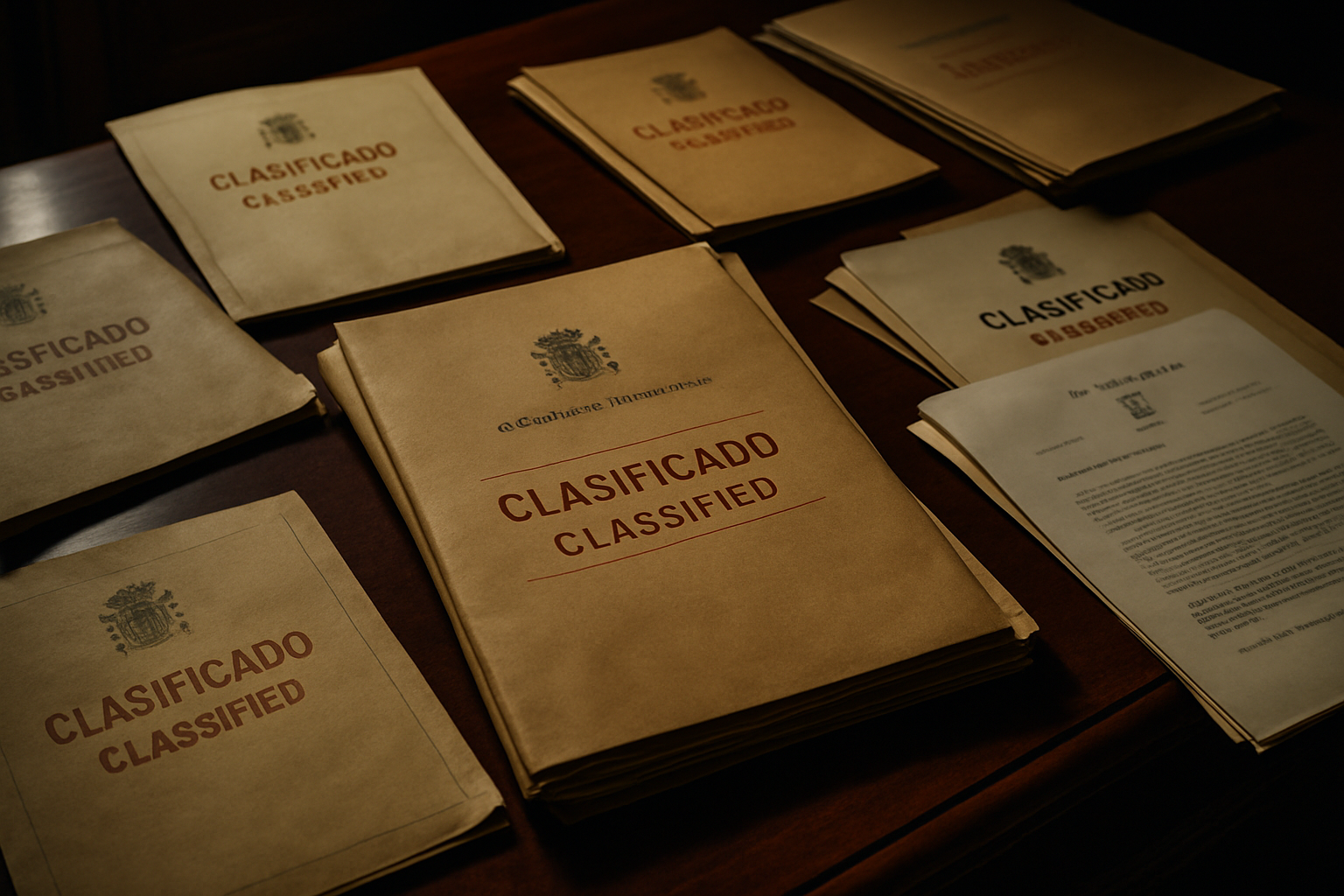
The Spanish government has declassified 153 classified documents related to the failed February 23, 1981 military coup attempt, revealing unprecedented details about intelligence service involvement and the complex conspiracies that nearly derailed Spain's transition to democracy.
The document release, approved by the Spanish Council of Ministers, includes internal reports from the CESID (Centro Superior de Información de la Defensa), the predecessor to Spain's current National Intelligence Center (CNI), which explicitly acknowledge that several of its operatives "participated actively in the events of February 23." This marks the first official admission of intelligence service complicity in the coup attempt that shook Spain's young democracy just six years after Franco's death.
Intelligence Service Complicity Confirmed
Among the most damning revelations is an internal CESID report stating that investigations confirmed "some members of this Unit participated actively in the events of February 23." The document specifies that "this participation is concretized in the persons who planned operational support that they carried out and who subsequently tried to cover up their participation in the coup."
The CESID report details how six of its agents were directly implicated in the conspiracy, with evidence showing they "either knew about the events beforehand, planned operational support, or tried to cover it up." This systematic involvement by Spain's intelligence services reveals the coup attempt was not merely the work of rogue military officers but part of a broader institutional conspiracy.
"From the investigations carried out, it has been possible to verify that some members of this Unit participated actively in the events of February 23"
— Internal CESID Report, declassified February 2026
The documents reveal that the intelligence operatives worked under the direction of Commander José Cortina, who led the AOME (Agrupación Operativa de Misiones Especiales), a special operations unit within CESID. Their involvement included providing logistical support and intelligence to the coup plotters, demonstrating the extent to which state security apparatus had been compromised.
Personal Testimonies Expose Human Drama
The declassified files include transcribed phone conversations that provide intimate glimpses into the personal tragedies surrounding the coup attempt. Among the most revealing are recorded calls between Carmen Díez Pereira, wife of Civil Guard Lieutenant Colonel Antonio Tejero, and other family members during the night of February 23.
In these intercepted conversations, Carmen Díez repeatedly refers to her husband as "tonto" (fool) and "desgraciao" (wretch), telling her contacts: "They have left him abandoned like a cigarette butt." Her desperate attempts to contact her husband reveal the human cost of the conspiracy, as she realized that Tejero had been used as a pawn in a larger game orchestrated by higher-ranking military officials.
The transcripts show Carmen Díez's growing awareness that her husband had been abandoned by his co-conspirators. In one particularly poignant exchange, she laments that "the Army was behind it and they have left him abandoned like a cigarette butt, he is a wretch." These recordings provide unprecedented insight into the personal dimensions of the political crisis that threatened Spanish democracy.
Systematic Documentation of the Conspiracy
The 153 documents, held across the Ministries of Defense, Interior, and Foreign Affairs, paint a comprehensive picture of the coup attempt that began when Tejero and his Civil Guard unit stormed the Spanish Parliament during the investiture of Prime Minister Leopoldo Calvo Sotelo. The files reveal that the conspiracy involved multiple layers of military and intelligence personnel, with coordination extending far beyond the visible perpetrators.
Documentation shows that military units had prepared to take control of Spanish Television (RTVE), with one intercepted conversation revealing that soldiers were ordered to "shoot to kill" if resistance was encountered. A member of the unit told an interceptor that they took RTVE at 8:00 PM "with loaded magazines and no safety or anything," highlighting the violent potential of the coup attempt.
The documents also include a handwritten planning document from November 1980 that outlines various scenarios for overthrowing the government of Adolfo Suárez, ranging from a motion of censure to outright military coups. In multiple scenarios, the document references potential roles for Manuel Fraga, demonstrating the political calculations underlying the conspiracy.
Royal Response and Democratic Resilience
The declassified files shed new light on King Juan Carlos I's crucial role in defeating the coup attempt. Intelligence reports detail how the King conveyed his concerns about military morale to the CESID, noting that "Armed Forces victorious in a sad civil war, who did not obtain notable benefits after their victory, were accustomed to greater respect."
Despite these concerns, Juan Carlos I's televised address to the nation on the night of February 23 proved decisive in isolating the coup plotters. The documents reveal the careful balance the monarchy had to maintain between understanding military grievances and defending constitutional democracy.
The files also document how various military commanders chose to remain loyal to the constitutional order despite pressure from coup plotters. This institutional resilience proved crucial in limiting the conspiracy's reach and ensuring its ultimate failure.
International Context and Modern Implications
The document release comes at a significant moment in Spanish politics, as the country continues to grapple with questions about its democratic transition and the legacy of the Franco dictatorship. The Spanish government's decision to declassify these materials represents a commitment to historical transparency that contrasts with previous decades of official silence.
The revelations about intelligence service involvement parallel contemporary concerns about institutional integrity and democratic oversight of security services across Europe. The documents serve as a historical reminder of how quickly democratic institutions can be threatened from within, making their lessons particularly relevant in an era of rising authoritarianism globally.
"This participation is concretized in the persons who planned operational support that they carried out and who subsequently tried to cover up their participation in the coup"
— CESID Internal Investigation Report
Uncovering Disinformation Campaigns
Among the most intriguing documents is an unsigned report detailing what it describes as a "malicious campaign" to implicate King Juan Carlos I in the coup attempt. The document argues that this "campaign" was orchestrated by lawyers representing "those truly implicated" to minimize their responsibility, along with "sympathizers" of the coup cause.
The report claims that false rumors were spread suggesting the King "has a plane to flee Spain" and other allegations designed to create doubt about the monarchy's opposition to the coup. This early example of systematic disinformation demonstrates how political conspirators have long used information warfare to protect their interests and deflect blame.
These revelations about disinformation tactics provide historical context for understanding how authoritarian movements have consistently sought to undermine public trust in democratic institutions through the strategic spread of false narratives.
Lasting Impact on Spanish Democracy
The February 23, 1981 coup attempt, known in Spain as "23-F," represented the most serious threat to Spanish democracy since the end of the Franco dictatorship in 1975. The declassified documents reveal just how close Spain came to losing its democratic gains, with only the decisive action of King Juan Carlos I and the loyalty of key military commanders preventing a return to authoritarian rule.
The involvement of intelligence services in the conspiracy highlights the institutional vulnerabilities that existed during Spain's democratic transition. The documents show how elements within the state security apparatus actively worked against the constitutional order they were sworn to protect, creating internal threats that complemented external challenges to the young democracy.
For contemporary Spain, these revelations serve as both a historical reckoning and a warning about the fragility of democratic institutions. They demonstrate that democracy cannot be taken for granted and requires constant vigilance against both external threats and internal subversion.
Institutional Accountability and Transparency
The decision to declassify these documents after more than four decades represents a significant step toward historical accountability. Previous Spanish governments had maintained strict secrecy around the coup attempt, citing national security concerns and the need to protect the democratic transition process.
The current government's approach reflects a more mature democracy's ability to confront difficult truths about its past. By releasing these materials, Spanish authorities acknowledge that transparency and accountability ultimately strengthen rather than weaken democratic institutions.
The documents also provide valuable lessons for other countries undergoing democratic transitions or facing threats to their democratic institutions. They illustrate the importance of maintaining civilian control over intelligence services and the dangers posed when security apparatus develop independent political agendas.
As Spain continues to process these historical revelations, the declassified documents serve as a powerful reminder that democracy is not a destination but an ongoing process that requires constant protection and renewal. The courage shown by those who defended Spanish democracy on February 23, 1981, stands as an enduring example of how democratic values can triumph over authoritarian conspiracies when institutions and citizens remain committed to constitutional rule.