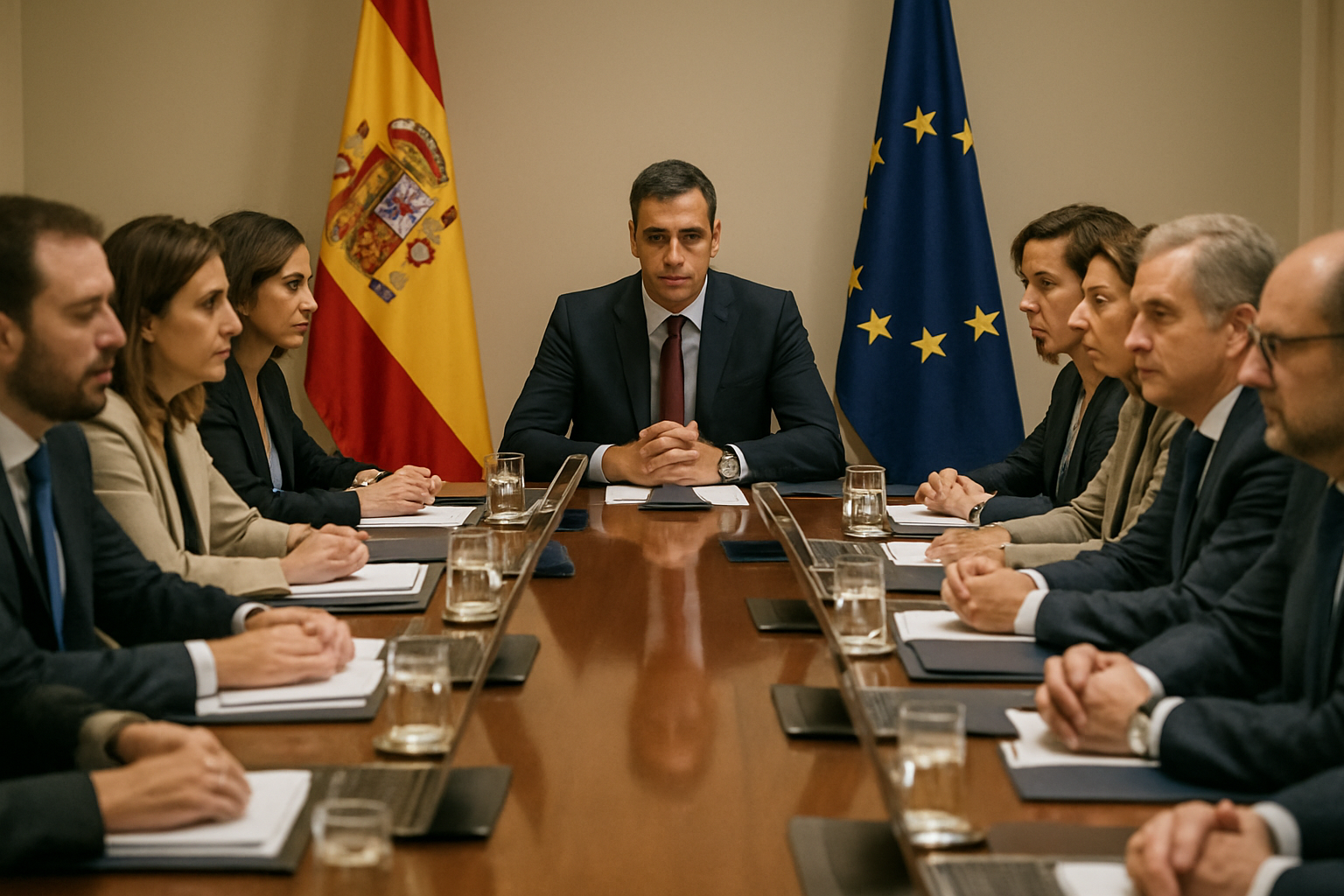
Spanish Prime Minister Pedro Sánchez announced Thursday a major government reshuffle that elevates Carlos Cuerpo to first deputy prime minister and appoints Arcadi España as the new finance minister, filling the void left by María Jesús Montero's departure to lead the PSOE campaign in Andalusia's early elections.
The restructuring represents the most significant cabinet changes since Sánchez returned to power, with the Prime Minister repeating the economic-focused approach that characterized Nadia Calviño's tenure. Cuerpo, who has been serving as Minister of Economy since December 2023, makes a triple leap to become the government's number two, while España transitions from his role as Secretary of State for Territorial Policy to head the crucial Treasury portfolio.
Strategic Economic Focus
Sánchez's decision to place Cuerpo at the heart of government operations reflects a deliberate strategy to center the administration around economic management during a period of international uncertainty. The 45-year-old from Badajoz brings a technical profile and extensive experience in both national and European Union administration, having previously worked at the Public Treasury before his ministerial appointment.
According to sources within La Monclona, Cuerpo has gained considerable weight in the President's inner circle since taking over from Calviño, demonstrating both technical competence and political acumen that has impressed government insiders. His appointment follows the established template of appointing independent technocrats to key economic positions, though Cuerpo lacks formal PSOE membership.
"Carlos Cuerpo represents continuity in our economic approach while bringing fresh perspectives to the challenges ahead,"
— Senior government official
Montero's Political Departure
The reshuffle was necessitated by Montero's decision to step down from her dual roles as Deputy Prime Minister and Finance Minister to focus on leading the Socialist campaign in Andalusia's snap elections, scheduled for May 17, 2026. Her departure removes one of Sánchez's most politically versatile figures – the organic number two of the PSOE and daily defender of the Executive in parliamentary battles.
Montero's exit represents more than a simple cabinet change; she was the government's most visible face in Congress, regularly sparring with opposition leaders and defending administration policies across multiple portfolios. Her departure leaves a significant political void that Cuerpo, despite his technical expertise, may struggle to fill given his less confrontational public profile.
The timing of Montero's departure reflects the electoral pressure facing the Socialist Party in Andalusia, where Popular Party leader Juan Manuel Moreno's decision to advance elections caught the government off-guard and forced difficult personnel choices.
Arcadi España's Profile
The appointment of Arcadi España as Finance Minister comes as something of a surprise, with the 51-year-old Valencian politician emerging from a less visible role in territorial policy to assume one of government's most challenging positions. España, who hails from Carcaixent in Valencia province, brings a background in economics and extensive experience within PSOE structures at both regional and national levels.
España previously served as Finance Counselor in the Valencian Generalitat under Ximo Puig's presidency, where he led progressive tax reforms and managed regional finances during challenging economic periods. His trajectory through various Socialist administrations – including advisory roles under Minister Jesús Caldera and Vice President María Teresa Fernández de la Vega during José Luis Rodríguez Zapatero's government – demonstrates deep institutional knowledge.
"Arcadi España combines technical competence with deep understanding of territorial complexities that will be crucial for managing state finances,"
— Former Valencian government colleague
Colleagues describe España as pragmatic, dialoguing, and moderate – qualities that will be essential as he inherits complex challenges including ongoing negotiations over regional financing systems, European recovery fund management, and maintaining fiscal stability amid international economic pressures.
Political Implications
The reshuffle occurs against a backdrop of mounting electoral pressure on Sánchez's government, with recent regional defeats in Extremadura and Aragón highlighting the opposition's momentum. By elevating Cuerpo to the deputy prime minister role, Sánchez signals his administration's continued focus on economic competence over political confrontation.
The changes also reflect broader strategic calculations within Spanish politics. Félix Bolaños remains as Vice President, maintaining his role in political negotiations and coalition management, though he loses the formal status of first deputy. This arrangement allows Sánchez to maintain both technical economic leadership through Cuerpo and political operational capacity through Bolaños.
Opposition parties have already begun criticizing the appointments, with Popular Party sources questioning whether the changes represent genuine renewal or merely reshuffling existing personnel. Vox leaders characterized the moves as evidence of government instability, though such criticism was predictable regardless of Sánchez's choices.
European and International Context
The government restructuring comes at a moment of significant international challenges for Spain, including ongoing tensions with the United States over military base access, complex negotiations within European Union frameworks, and management of Spain's growing role in global AI regulation initiatives.
Cuerpo's extensive European experience, including work with EU institutions, positions him well to navigate these international dimensions. His technical background in public finance and economic policy will be crucial as Spain continues implementing European recovery programs while managing domestic economic pressures.
España's appointment also reflects territorial considerations, bringing Valencian representation to a key ministry at a time when regional financing negotiations remain contentious across Spain's autonomous communities.
Looking Forward
The success of Sánchez's reshuffle will ultimately depend on the new team's ability to manage both immediate political challenges and longer-term economic policy implementation. Cuerpo faces the daunting task of filling Montero's shoes as the government's primary spokesperson on economic matters while maintaining technical focus on policy development.
Meanwhile, España must quickly master the complexities of national finance management, including ongoing negotiations with autonomous communities over funding formulas, European oversight of Spain's recovery plans, and potential responses to changing international economic conditions.
The appointments signal Sánchez's confidence in technocratic governance approaches, even as political pressures mount from opposition parties and regional electoral challenges continue. Whether this strategy proves effective will become evident in coming months as the new team faces parliamentary scrutiny and public evaluation of government performance.
As Spain approaches crucial regional elections in Andalusia and prepares for potential broader electoral challenges, the government's ability to demonstrate both economic competence and political effectiveness through its new leadership structure will be closely watched by allies and opponents alike.