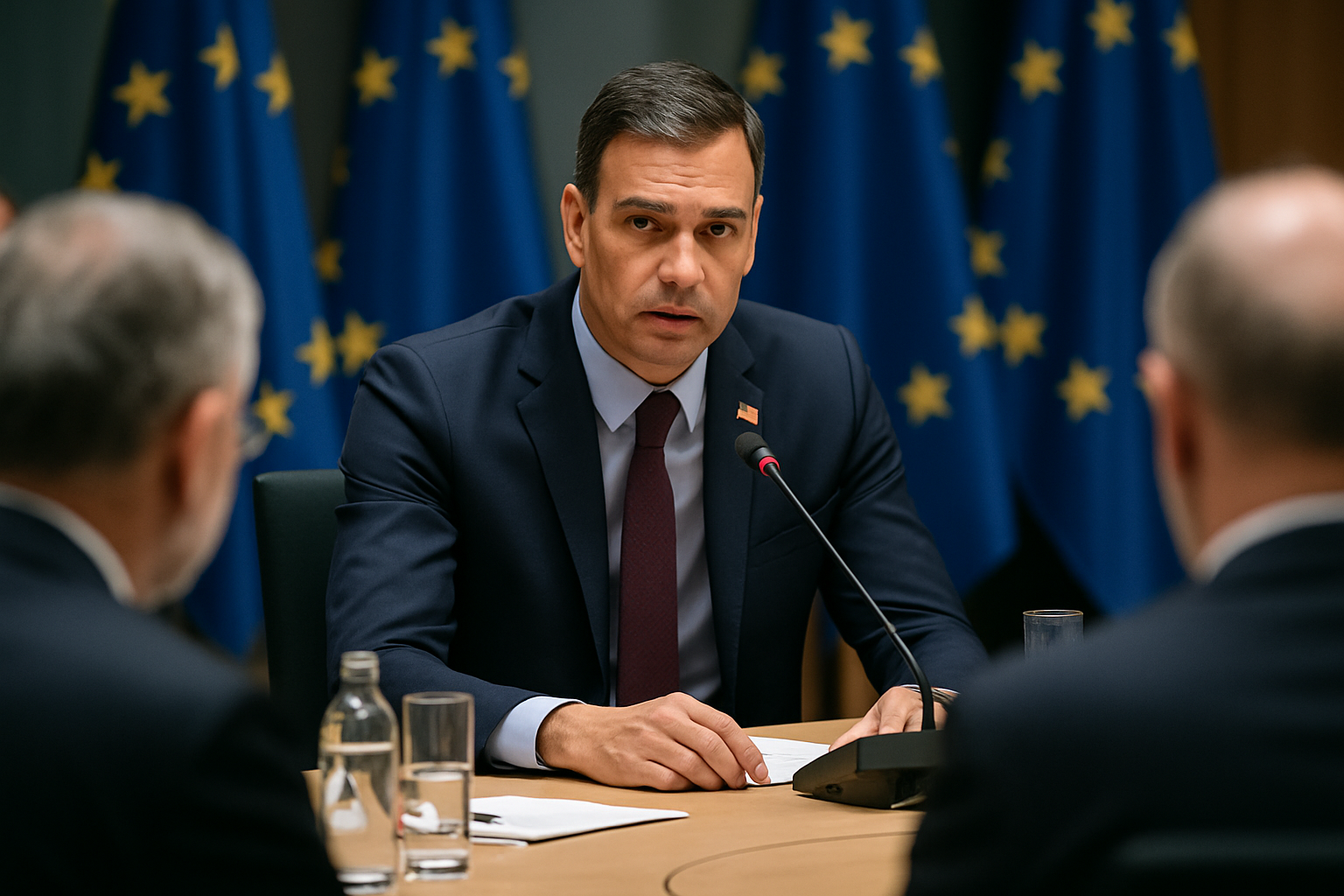
Spanish Prime Minister Pedro Sánchez announced on Sunday that Spain will formally request the European Union to suspend its association agreement with Israel during Tuesday's Foreign Ministers meeting, citing systematic violations of human rights and international law.
Speaking at a campaign rally in Gibraleón, Huelva, Sánchez declared that "any government that violates international law and, consequently, violates the principles and values of the European Union, cannot be an EU partner." The announcement marks a significant escalation in European criticism of Israeli policies and represents Spain's most direct diplomatic challenge to Israel since March when it permanently withdrew its ambassador from Tel Aviv.
Breaking with Traditional Diplomacy
The Spanish Prime Minister framed the initiative not as a partisan political position but as a matter of fundamental values, stating the measure is "not a matter of left or right" but about upholding international legal standards. The formal proposal will be presented during the EU Foreign Ministers meeting scheduled for Tuesday in Luxembourg.
According to Spanish media reports, Sánchez emphasized that Spain seeks to "put an end to Netanyahu's policies" and restore stability to the Middle East. The announcement came as part of the opening of the Spanish Socialist Party's campaign for upcoming Andalusian regional elections, demonstrating how foreign policy has become intertwined with domestic political positioning.
"A government that violates international law or the principles of the EU cannot be its partner."
— Pedro Sánchez, Spanish Prime Minister
Legal Foundation and EU Framework
The EU-Israel Association Agreement, which entered into force in 2000, contains a human rights clause that links the agreement to respect for human rights and democratic principles. This legal provision provides the foundation for Spain's suspension request, though implementing such measures requires unanimous consent from all 27 EU member states.
The association agreement covers trade relations, political dialogue, and cooperation in various sectors including energy, environment, and science. A suspension would significantly impact bilateral economic relations and could set a precedent for how the EU handles disputes with partner nations over human rights violations.
Growing European Pressure
Spain's initiative comes amid mounting European frustration with Israeli policies. In February 2026, Spain joined 85 UN member states in condemning Israeli West Bank expansion policies, citing "systematic violations of international law and human rights." The Spanish position has gained support from various quarters, with Hamas welcoming the Spanish decision and Yemen's Sanaa government praising Madrid's "solidarity with the Islamic Republic of Iran" against what they termed "US-Israeli aggression."
The proposal also builds on broader European discontent, with over 400 EU diplomats having demanded increased pressure on Israel, and a European Left Coalition petition against EU-Israel partnerships gathering more than 400,000 signatures. France has also hinted at reconsidering the partnership agreement, with Foreign Ministry spokesman Pascal Confavre stating that debate on suspending the agreement "cannot be excluded."
Diplomatic Context and Timing
The announcement comes during a particularly tense period in Spanish-Israeli relations. Spain permanently withdrew its ambassador from Israel in March 2026, marking the deepest crisis in bilateral relations in decades. The embassy in Tel Aviv is now led by a chargé d'affaires on an indefinite basis, while the Israeli ambassador has been absent from Madrid since 2024, creating a mutual diplomatic vacuum.
The timing is also significant as it coincides with ongoing concerns about Gaza, where systematic ceasefire violations have been documented. International observers have noted over 1,600 violations since October 2025, resulting in more than 600 Palestinian deaths during what was supposed to be a truce period.
Regional and International Reactions
The Spanish initiative has garnered attention from various international actors. Palestinian sources view it as a continuation of Spain's "honorable positions" regarding the Gaza situation, while Israeli officials are expected to formally respond to what they see as an escalating diplomatic crisis.
Regional powers have also taken note, with eight Arab nations including Saudi Arabia, Jordan, Egypt, and the UAE having previously issued joint condemnations of what they term "systematic violations of international law" aimed at undermining the two-state solution.
Implementation Challenges
While Spain's proposal represents a significant diplomatic initiative, implementing an association agreement suspension faces substantial procedural hurdles. The measure requires unanimous approval from all EU member states, and several countries maintain strong ties with Israel that could complicate achieving consensus.
The proposal will first be debated in Tuesday's Foreign Ministers meeting before potentially advancing to the European Council level. Even if successful, the suspension would likely be temporary and conditional, with mechanisms for restoration based on compliance with international law and human rights standards.
Broader Implications for EU Foreign Policy
Spain's initiative represents a test case for European strategic autonomy and the EU's ability to take independent foreign policy positions. The move comes amid broader questions about how democratic partnerships should navigate security dilemmas while maintaining adherence to international law principles.
The proposal also reflects the growing intersection of domestic and foreign policy considerations within EU member states, as governments face pressure from civil society organizations and public opinion to take stronger stands on human rights issues.
Looking Forward
Tuesday's Foreign Ministers meeting will provide the first formal test of European support for the Spanish proposal. While achieving unanimous consent remains challenging, the initiative has already succeeded in placing the EU-Israel relationship at the center of European foreign policy discussions.
The outcome will likely influence future EU approaches to partnership agreements with countries facing human rights concerns and could establish precedents for how the bloc balances economic relationships with adherence to fundamental values. As Sánchez emphasized, the question is whether the EU will maintain partnerships with governments that systematically violate the principles upon which the European project is founded.