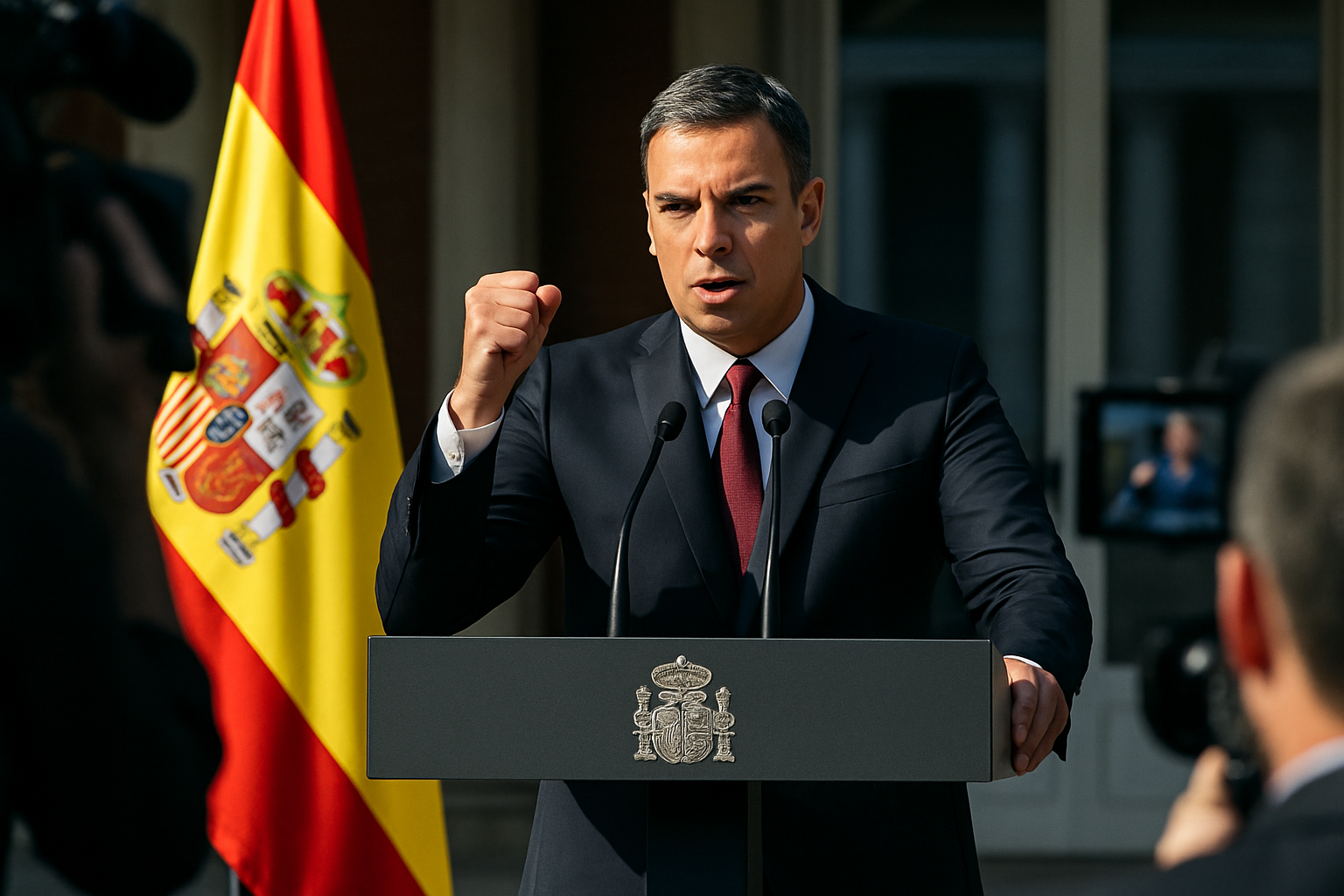
Spanish Prime Minister Pedro Sánchez delivered a defiant response to President Donald Trump's threats Wednesday, declaring Spain's unwavering position as "No to war" after refusing to allow US military bases on Spanish territory to support operations against Iran.
In a televised address lasting approximately 10 minutes, Sánchez responded directly to Trump's threat to "cut off all trade" with Spain following Madrid's decision to deny US forces access to the Rota Naval Station and Morón Air Base for strikes against Iran. The confrontation represents one of the most serious diplomatic rifts between NATO allies in recent decades.
Historic Stand Against Alliance Pressure
Sánchez's response marked a watershed moment in transatlantic relations, as he explicitly refused to be "complicit in something that is bad for the world simply out of fear of retaliation from some." The Spanish leader invoked Spain's historic opposition to the 2003 Iraq War as a moral precedent, stating that Spain's position could be summarized in four words: "No to war."
"We will not be accomplices to something that is bad for the world simply because of fear of reprisals from some," Sánchez declared during his institutional statement, directly challenging Trump's pressure campaign.
"Our position is the same as we had with Ukraine and Gaza. First, no to the violation of international law that protects us all, and especially the most defenseless—the civilian population. Second, no to accepting that the world can solve its problems through bombs."
— Pedro Sánchez, Spanish Prime Minister
Trump's Unprecedented Threats
The diplomatic crisis erupted after Trump publicly criticized Spain as a "terrible" ally and ordered Treasury Secretary Scott Bessent to "cut off all dealings" with Madrid. The threats came following Spain's refusal to allow US military assets to use Spanish bases for Operation Epic Fury, the ongoing US-Israeli military campaign against Iran.
According to multiple sources, the US had relocated 15 aircraft, including refueling tankers, from Spanish bases after Madrid denied their use for Iran operations. This marked the first time since the 1950s defense agreements that Spain explicitly denied base usage for a major US military operation.
The Spanish government maintained that US forces could only use Spanish bases for activities "consistent with the UN Charter and international law," effectively blocking participation in what Madrid viewed as an unlawful military intervention.
International Law and Sovereignty
Sánchez's speech emphasized Spain's commitment to international law and the UN Charter, positioning Madrid's stance as principled resistance to what he characterized as violations of global legal frameworks. The Spanish Prime Minister called on European partners not to engage in "servile submission" to US foreign policy when fundamental principles were at stake.
"It is unacceptable that there are leaders who use the smoke of war to hide their failure and fill the pockets of a few," Sánchez declared, making clear reference to the Iran conflict's economic motivations.
The Spanish position drew support from European capitals, with several EU officials expressing solidarity with Madrid's stance. Brussels was expected to defend Spain's position, accelerating discussions about European strategic autonomy and independence from US military operations.
Military Base Relations Under Strain
Spain hosts approximately 8,000 US military personnel across two major installations: the Rota Naval Station in Cádiz and Morón Air Base in Seville, both in Andalusia. These facilities have been central to US operations in the Middle East and North Africa for decades, making Spain's denial of access particularly significant for American military planners.
The bases operate under bilateral defense agreements dating to the 1950s, but Spain's interpretation that activities must comply with international law created the current impasse. US forces were compelled to relocate aircraft and equipment to alternative facilities, disrupting planned operations.
European Support and Strategic Autonomy
The crisis accelerated ongoing European discussions about strategic autonomy, with France's Emmanuel Macron and Germany's Friedrich Merz reportedly intensifying nuclear deterrence talks in response to questions about American alliance reliability. The confrontation demonstrated growing European willingness to diverge from US foreign policy when core principles were at stake.
Several European leaders privately expressed support for Spain's position, viewing it as defending the rules-based international order that underpins European security architecture. The solidarity reflected broader European concerns about unilateral US military actions and their impact on regional stability.
Economic and Legal Implications
Trump's threatened trade embargo faced significant legal challenges, as unilateral trade restrictions would likely violate World Trade Organization rules and existing EU-US trade agreements. The complexity was compounded by Trump's recent Supreme Court defeat on tariff authority, forcing reliance on alternative legal mechanisms subject to congressional oversight.
Spain responded with confidence that it possessed "necessary resources to contain possible impacts, help affected sectors, and diversify supply chains," suggesting Madrid had prepared for potential economic retaliation. The EU's collective economic weight provided additional leverage against US pressure.
Historical Context and Iraq Precedent
Sánchez explicitly referenced Spain's opposition to the 2003 Iraq War, which contributed to the Popular Party's electoral defeat in 2004. The Iraq precedent remained powerful in Spanish politics, with the conflict viewed as a cautionary example of the costs of blind alliance loyalty.
"The world has been here before. Twenty-three years ago, another US administration led us to a war in Iraq that unleashed the greatest wave of insecurity since the fall of the Berlin Wall," Sánchez stated, drawing direct parallels to current circumstances.
Regional and Global Reactions
The Spanish stance resonated beyond Europe, with several middle-power nations viewing Madrid's position as a potential template for resisting great power pressure when fundamental principles were at stake. The confrontation tested whether smaller NATO allies could maintain independence on critical security issues.
Within Spain, the response was largely positive across party lines, with even conservative opposition leaders supporting the principle of Spanish sovereignty, though they criticized other aspects of Sánchez's foreign policy. The unified Spanish response strengthened Sánchez's position domestically while challenging Trump internationally.
Looking Forward: Alliance Under Pressure
The Spain-US confrontation represents a broader test of NATO unity and the balance between alliance obligations and national sovereignty. As the Iran crisis continues to escalate, other European allies face similar pressures to support American military operations they may view as counterproductive or illegal.
The resolution of this diplomatic crisis will likely establish precedents for future conflicts between alliance solidarity and international law compliance. Success in managing the dispute through institutional frameworks could strengthen NATO's adaptability, while failure might accelerate fragmentation at a critical moment for Western unity.
As Sánchez concluded his address, he emphasized that Spain's position reflected not anti-American sentiment but commitment to principles that protect global stability: "We are prouder than ever to be Spanish, and we will not be accomplices in something that is bad for the world."