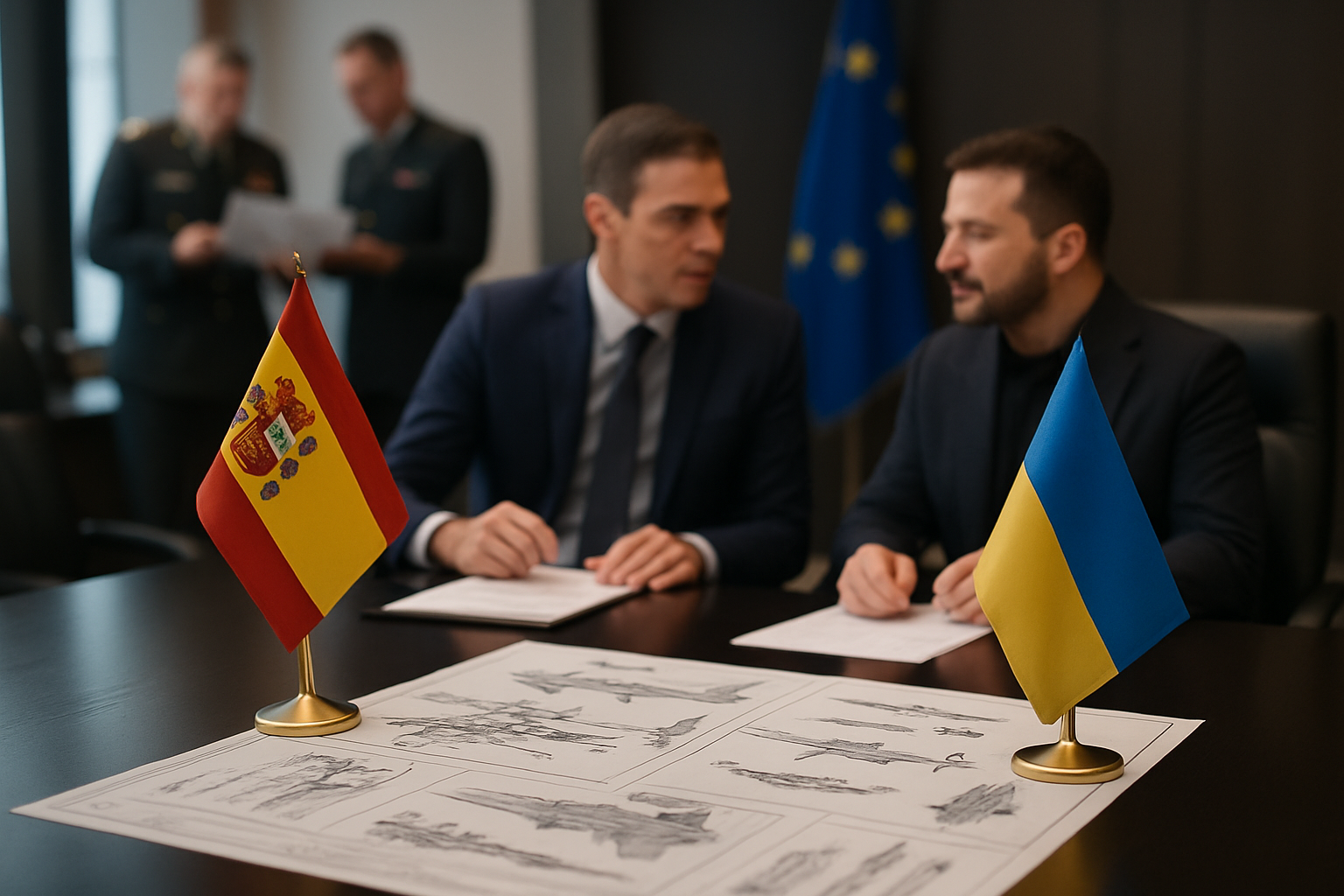
Spain and Ukraine have agreed to establish joint production of military equipment while European leaders grapple with continued support for Kyiv amid mounting concerns that the Middle East crisis is diverting Western attention from the ongoing war.
President Volodymyr Zelensky's visit to Madrid on March 18, 2026, resulted in unprecedented defense cooperation agreements just as trilateral peace talks between Ukraine, Russia, and the United States remain indefinitely suspended due to the Iran crisis. Spanish Prime Minister Pedro Sánchez announced his country would pursue "co-production and co-manufacturing" with Ukrainian defense companies, declaring Spain would remain "a faithful, loyal and reliable ally."
Historic Defense Partnership Emerges
The Spanish-Ukrainian agreement represents a strategic evolution in European defense cooperation. Before meeting Sánchez at La Moncloa Palace, Zelensky visited the headquarters of Spanish defense companies Sener Aerospace & Defence in Tres Cantos, Madrid, where executives signed cooperation agreements with Ukrainian military firms.
Sener and Escribano Mechanical & Engineering (EME) formalized partnerships to develop missiles, drones, and guided munition systems using Spanish technology combined with Ukrainian battlefield experience. This marks Ukraine's transformation from aid recipient to strategic defense partner, leveraging nearly three years of combat expertise against Russian forces.
"We will continue by your side as a faithful, loyal and reliable ally."
— Pedro Sánchez, Spanish Prime Minister
The timing of this announcement is particularly significant as Zelensky simultaneously faces mounting pressure to secure a €90 billion EU loan package that has been blocked by Hungary over the Druzhba oil pipeline dispute. The Spanish commitment demonstrates continued European solidarity despite internal divisions that have exposed deep fractures in EU unity.
Middle East Crisis Derails Peace Momentum
Zelensky's Madrid visit occurs against the backdrop of suspended trilateral negotiations between Ukraine, Russia, and the United States. The Ukrainian president confirmed that talks have been postponed indefinitely due to the Iran crisis, stating there are "no necessary signals for trilateral meeting" until the security situation allows.
This diplomatic setback represents a major blow to peace momentum that had achieved historic breakthroughs in February 2026. The Abu Dhabi talks produced a 314-prisoner exchange—the first in five months—and restored US-Russia military communications after a four-year suspension. Geneva talks in February showed "significant progress" on ceasefire monitoring mechanisms, with European "Big 5" observers participating for the first time.
The suspension threatens to derail the June 2026 deadline established by the Trump administration for comprehensive peace negotiations, potentially to be held at the presidential level in Washington. Intelligence sources suggest the framework for renewed talks remains intact, with prisoner exchange mechanisms and structured negotiation formats preservable for reactivation when conditions permit.
European Unity Under Severe Strain
While Spain demonstrates unwavering support for Ukraine, the European Union faces its deepest internal crisis since the conflict began. Hungarian Prime Minister Viktor Orbán continues to block both the €90 billion aid package and the EU's 20th sanctions package against Russia, using the Druzhba pipeline dispute as leverage.
The crisis has accelerated discussions about enhanced cooperation mechanisms that would allow willing EU member states to proceed without unanimity requirements. Lithuanian Foreign Minister Kestutis Budrys warned that "the EU cannot become Budapest's hostage," reflecting growing frustration with Hungary's blocking tactics.
Finland's contribution to Ukrainian support continues through humanitarian channels, with 12 ambulances departing Helsinki for Ukraine as part of Lions Club charity efforts—one of the largest international humanitarian initiatives undertaken by the organization's Finnish operations.
Nuclear Governance Crisis Adds Urgency
The diplomatic impasse unfolds against an unprecedented nuclear governance crisis. The New START treaty between the United States and Russia expired on February 5, 2026, marking the first time in over 50 years without bilateral nuclear constraints between the superpowers. Both nations control approximately 80% of the world's nuclear weapons, prompting UN Secretary-General António Guterres to warn of a "grave turning point" with nuclear risks at their "highest in decades."
This nuclear governance vacuum adds extraordinary urgency to diplomatic efforts, as the restored US-Russia military communications represent the only remaining formal channel between the nuclear superpowers. The Pentagon confirmed that deconfliction protocols now extend globally, covering operations in Syria, the Arctic, and Africa.
Military Situation Continues to Deteriorate
While diplomatic efforts face setbacks, the military situation on the ground continues to worsen for Ukraine. Russian forces have accelerated territorial gains, capturing 481 square kilometers in January 2026 compared to 260 square kilometers in December 2025—an 85% increase that represents the fastest territorial acquisition in recent months.
Zelensky disclosed that 55,000 Ukrainian soldiers have been officially killed, with a "large number" missing in action. International estimates suggest actual casualties may be two to three times higher. The systematic targeting of civilian infrastructure continues, with over 1,170 Kyiv buildings lacking adequate heating during sub-zero temperatures—a strategy critics describe as "energy terrorism."
Ukrainian forces have maintained their operational capabilities despite defensive pressures, conducting strikes on Russian aircraft manufacturing plants in the Ulyanovsk and Novgorod regions. These attacks demonstrate Ukraine's continued ability to project force deep into Russian territory, maintaining strategic pressure on Moscow's war production capabilities.
International Support Remains Robust
Despite internal EU divisions, international support for Ukraine continues at historic levels. The €90 billion loan package, if approved, would represent the largest single-nation assistance program in European history. Additional commitments include Sweden-Denmark's €246 million air defense package and Germany's delivery of 35 Patriot missiles.
Over 17.8 million Ukrainians are currently accessing winter support programs, reflecting the massive humanitarian challenge posed by systematic infrastructure attacks. The World Bank has provided $40 million for energy restoration efforts, while various European nations continue military aid deliveries.
Ukraine's strategic pivot extends beyond Europe to the Middle East, where Ukrainian military experts are deploying to the UAE, Qatar, Jordan, Bahrain, and Kuwait to share expertise in combating Iranian "Shahed" drone attacks—the same weapons devastating Ukrainian infrastructure. This evolution from aid recipient to security provider demonstrates Ukraine's growing strategic value as a partner rather than merely a beneficiary.
Stakes Extend Far Beyond Ukraine
The current diplomatic crisis carries implications far beyond the immediate conflict. Success in eventually resuming peace talks could provide a template for 21st-century territorial dispute resolution, while failure may intensify military operations globally and undermine diplomatic credibility for resolving territorial sovereignty challenges.
European security architecture faces fundamental redefinition, with stakes including international law enforcement, territorial sovereignty principles, and conflict prevention mechanisms that will shape power competition for decades. The Munich Security Conference's theme of "Era of Disruptive Politics" reflects the broader challenge to post-World War II international order.
France has begun exploring nuclear deterrent expansion beyond national scope for the first time since the Cold War, while Poland and Finland engage in preliminary extended deterrence conversations—reflecting concerns about the reliability of American security guarantees and fundamental reassessment of Western alliance structures.
Coming Phase Uncertain
The timeline for resumed peace negotiations depends entirely on resolution of the Iran crisis, demonstrating how interconnected regional conflicts can derail promising diplomatic initiatives in our multipolar security environment. The international community faces the challenge of managing multiple simultaneous crises while preserving momentum on Europe's most significant security challenge since the Cold War.
The framework achievements from earlier negotiations—prisoner exchange mechanisms, structured negotiation formats, and Pentagon-Moscow deconfliction protocols—can be reactivated when the Iranian crisis permits. However, the delay allows continued military escalation and potentially strengthens Russia's bargaining position through additional territorial gains.
As Spain and Ukraine forge ahead with their defense cooperation agreement, the broader question remains whether diplomatic innovation can overcome military escalation to resolve Europe's deadliest conflict since World War II. The success or failure of eventual resumed talks will carry global implications for territorial sovereignty enforcement, international law credibility, and conflict resolution mechanisms in the 21st century.
The stakes could not be higher: success could end a devastating war and provide a model for resolving territorial disputes through negotiation, while failure may intensify operations globally and undermine confidence in diplomatic solutions to international conflicts. The world watches as European unity faces its greatest test, with Ukraine's survival and the broader international order hanging in the balance.