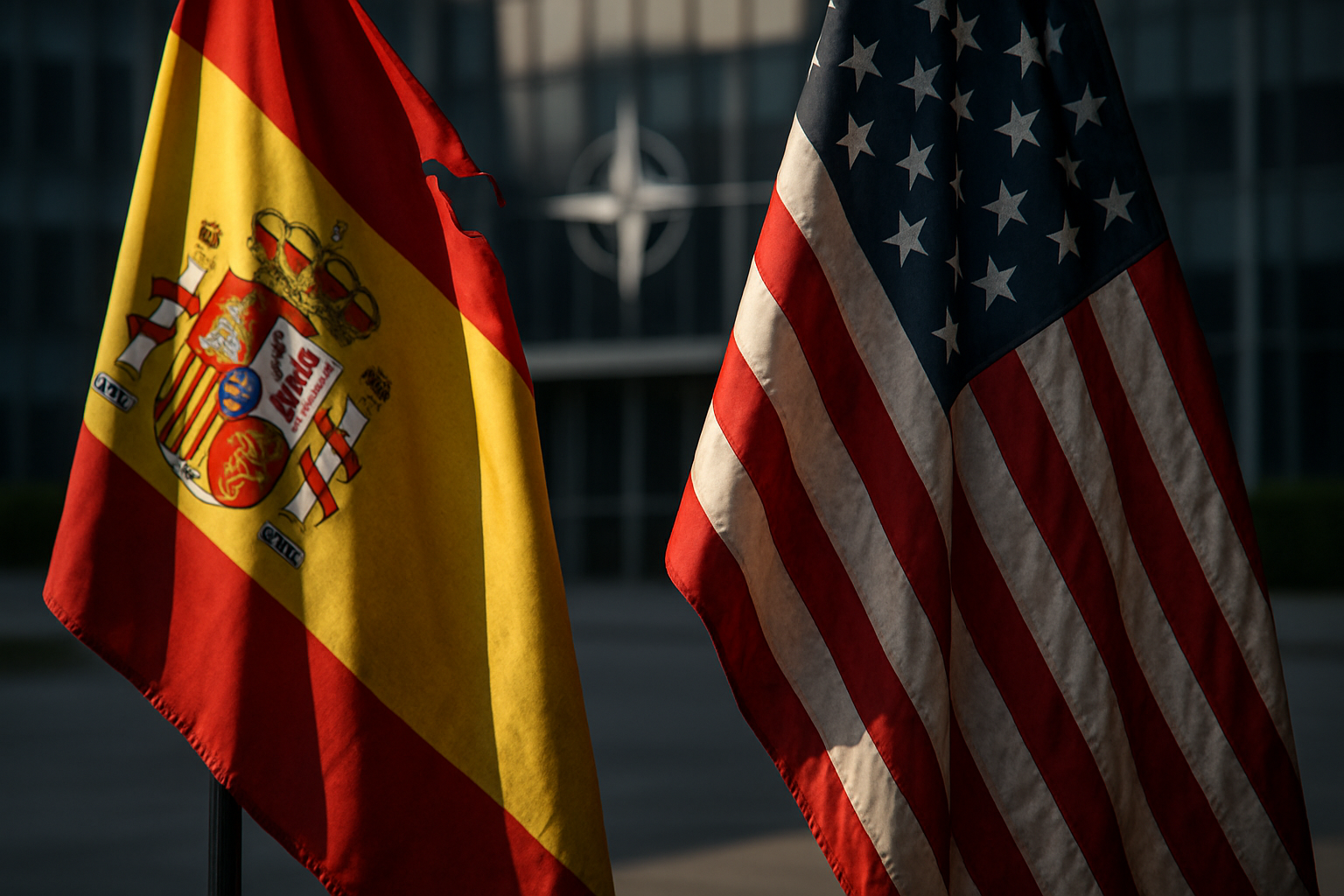
Spain has ignited the most serious diplomatic crisis within NATO in decades by refusing to allow the United States access to Spanish military bases for its ongoing war against Iran, prompting President Donald Trump to threaten cutting "all trade" with Madrid in an unprecedented breach of alliance solidarity.
Prime Minister Pedro Sánchez doubled down on his defiant stance Wednesday, delivering a televised address declaring Spain's position in four stark words: "No to the war." His refusal to support Operation Epic Fury—the largest U.S.-Israeli military campaign since 2003—has shattered traditional alliance unity and exposed deep fractures within the Western security framework.
The Confrontation Escalates
The crisis reached fever pitch on March 3rd when Trump lashed out at Spain during a White House meeting with German Chancellor Friedrich Merz, calling Madrid a "terrible" ally and threatening immediate economic retaliation. "Spain has absolutely nothing that we need—except fantastic people," Trump declared, ordering Treasury Secretary Scott Bessent to "cut off all dealings" with the Spanish government.
Sánchez's response was equally forceful, warning that Trump was "playing Russian roulette with the lives of millions" and urging the world to "learn from history"—a clear reference to the 2003 Iraq invasion that Spain opposed under similar circumstances.
"We are not going to be complicit in something that is bad for the world simply out of fear of reprisals from someone. We are prouder than ever to be Spanish, and we will not be accomplices."
— Pedro Sánchez, Spanish Prime Minister
Military Bases Become Diplomatic Battleground
At the heart of the confrontation lies Spain's refusal to allow U.S. forces to use the strategic Rota Naval Station in Cádiz and Morón Air Base in Seville for Iran operations. These facilities, home to approximately 8,000 U.S. personnel under bilateral agreements dating to the 1950s, represent critical infrastructure for American power projection in the Middle East.
Spanish officials maintain that U.S. forces can only use Spanish bases for activities "consistent with the UN Charter and international law." This marks the first time since the original defense agreements were signed that Spain has explicitly denied base usage for a major U.S. military operation.
The immediate military consequences were severe. The U.S. relocated 15 aircraft, including crucial refueling tankers, from the Spanish bases after Madrid's denial, significantly disrupting decades-old military cooperation that forms a cornerstone of NATO's southern flank defense strategy.
European Solidarity vs. Transatlantic Tension
Spain's defiance has exposed a broader European reluctance to support Trump's military intervention in Iran. European Council President Antonio Costa expressed "full solidarity with Spain," declaring that "the EU will always ensure that the interests of its member states are fully protected."
French President Emmanuel Macron telephoned Sánchez to express support, while the crisis has accelerated European strategic autonomy discussions. Behind-the-scenes talks between Berlin and Paris on nuclear deterrence have gained urgency amid questions about U.S. alliance reliability.
However, the crisis has also revealed divisions within Europe itself. Germany's Chancellor Merz faced harsh criticism from Spanish Foreign Minister José Manuel Albares for failing to defend Madrid during Trump's White House attack, remaining silent when the U.S. president declared America could "just fly in and use" Spanish bases regardless of Madrid's objections.
Iran War Context: When Diplomacy Collapsed
The diplomatic explosion comes against the backdrop of Operation Epic Fury, launched after the complete breakdown of nuclear negotiations despite achieving what Iranian Foreign Minister Abbas Araghchi called "broad agreement on guiding principles"—the most significant diplomatic progress since the 2018 JCPOA collapse.
The war has already claimed over 1,500 lives according to human rights organizations, with Iranian Supreme Leader Ali Khamenei confirmed dead and global energy markets in crisis. Oil prices have surged past $80 per barrel as Iran closed the Strait of Hormuz, threatening 40% of global oil transit.
Spain's position reflects broader European concerns about American military intervention following the collapse of what appeared to be promising diplomatic engagement. The Geneva talks had achieved framework breakthroughs, but fundamental disagreements over scope—Iran excluded ballistic missiles and regional proxies as "red lines" while the U.S. demanded comprehensive agreements—proved insurmountable.
Historical Precedent and Legal Standing
Sánchez explicitly invoked the 2003 Iraq War precedent, when Spain's opposition to American intervention contributed to the Popular Party's electoral defeat in 2004. "This is how humanity's great disasters start," he warned, positioning Spain as defending rules-based international order against what Madrid views as unlawful military intervention.
Legal experts suggest Spain has solid ground for its position. Any unilateral U.S. trade embargo would likely violate World Trade Organization rules and existing EU-U.S. trade agreements. Trump's recent Supreme Court defeat on tariff authority complicates enforcement mechanisms, forcing reliance on alternative legal approaches facing congressional oversight.
Madrid has expressed confidence in having "necessary resources to contain possible impacts, help affected sectors, diversify supply chains," banking on EU collective weight and legal protections through international agreements.
NATO Alliance Under Strain
The crisis represents the most serious rift between major NATO allies in decades, testing whether smaller members can maintain independence on critical security issues when fundamental principles are at stake. The confrontation goes beyond typical alliance disagreements over tactics to fundamental disputes over intervention principles and international law compliance.
Trump's criticism extended beyond Spain to other European allies, calling British Prime Minister Keir Starmer's reluctance to fully support Iran strikes evidence that "this is not Winston Churchill"—the most direct presidential criticism of Britain in modern diplomatic history.
The dispute has particular resonance given Trump's demands that NATO members spend 5% of GDP on defense—well above the standard 2% target—while Spain has refused to meet even Trump's inflated requirements.
Global Implications and Template-Setting
International observers view the crisis as potentially template-setting for 21st-century alliance relationships. Success in managing the dispute through diplomatic channels could strengthen institutional cooperation frameworks. Failure might accelerate Western unity fragmentation at a critical moment for international stability.
The confrontation occurs amid broader challenges to the post-WWII order, including the New START treaty's expiration in February (the first time in 50+ years without U.S.-Russia nuclear constraints), China's nuclear expansion, and questions about multilateral cooperation during global crises.
International media coverage has been stark in its assessment. Politico compared Sánchez's position to that of French President Jacques Chirac's opposition to the Iraq War in 2003, noting that "only one EU leader has dared to directly challenge U.S. President Donald Trump over the Iran war."
Economic Warfare and Diplomatic Resolution
Trump's threat to "cut off all trade" carries significant economic implications, though implementation faces substantial legal hurdles. Spain is confident in its economic resilience, backed by EU collective support and diversified trade relationships that reduce dependence on U.S. markets.
The Treasury Department's Scott Bessent escalated rhetoric Wednesday, calling Spain's position "unacceptable" and accusing "the Spanish of putting American lives at risk" by refusing base access. This dramatic escalation in official rhetoric reflects the depth of Washington's frustration with European pushback against its Iran strategy.
European officials are preparing coordinated responses to potential U.S. economic retaliation, viewing the crisis as a test of European unity in defending member state sovereignty against allied pressure.
Looking Forward: Alliance at a Crossroads
The Spain-U.S. crisis represents more than a bilateral dispute—it embodies fundamental tensions within the Western alliance about sovereignty, international law, and the balance between solidarity and principle. The resolution will influence future conflicts between alliance obligations and legal compliance, setting precedents for NATO unity during major international crises.
As the Iran war continues with no clear end in sight, Spain's defiant stance has emerged as a symbol of European resistance to American military adventurism. Whether this independence can be sustained against escalating U.S. pressure will determine not just the future of Spanish-American relations, but the very nature of transatlantic alliance in the multipolar era.
The crisis has transformed Sánchez from a regional European leader into an international symbol of resistance to great power pressure when core principles are at stake. His declaration that Spain "will not be vassals" resonates beyond European borders, potentially encouraging other middle powers to maintain independence on controversial security issues.
The coming weeks will prove decisive in determining whether this unprecedented NATO crisis can be resolved through diplomatic channels or whether it marks the beginning of a new era of alliance fragmentation, with profound implications for global security architecture and international cooperation mechanisms that have underpinned Western unity for over seven decades.