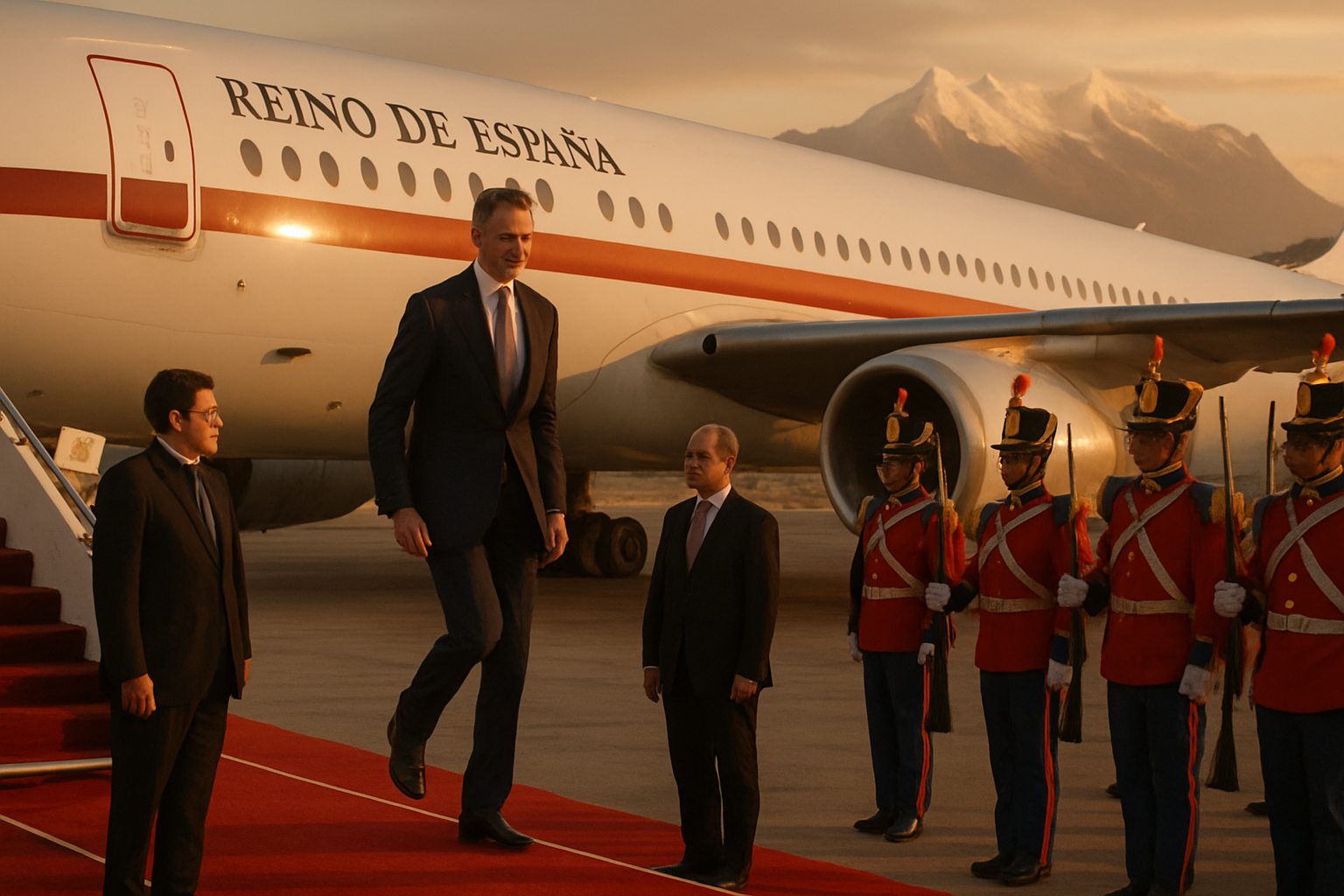
Spanish King Felipe VI arrived in Bolivia Wednesday evening for an official state visit, marking a significant diplomatic engagement between Spain and the South American nation amid unprecedented security arrangements involving 1,400 police officers.
The Spanish monarch's private aircraft touched down at El Alto International Airport at approximately 8:00 PM local time, where he was received by Bolivian Foreign Minister Fernando Aramayo in a formal diplomatic protocol. The Colorado military garrison rendered honors to the visiting head of state, who walked along a red carpet stretched from the aircraft exit to the terminal.
Unprecedented Security Deployment
Bolivian authorities have implemented extraordinary security measures for the royal visit, with Vice Minister of Citizen Security Colonel Rolando Montaño confirming the deployment of 1,400 police officers across the two-day diplomatic mission. The security operation represents one of the largest protective details ever assembled for a foreign dignitary in Bolivia.
"For March 11, we have deployed a total of 650 officers for the king's arrival at the airport; security rings will be established and traffic control agents will be positioned along the route," Montaño explained. "For March 12, 750 uniformed officers will be assigned, bringing the total to 1,400 officers over the two days."
The monarch will be transported from the airport to his accommodation in a security capsule, with temporary road closures planned depending on the contingency routes used during the official convoy's movement. The operation involves the Special Dignitary Security Unit, traffic police, and specialized security personnel working in coordinated fashion.
Diplomatic Agenda and Accommodation
King Felipe VI will stay at a hotel in the southern zone of La Paz during his visit, with Spanish residents and Foreign Ministry officials participating in the welcome ceremony. The visit comes at a crucial time for Spain-Bolivia relations, offering opportunities to strengthen bilateral cooperation across multiple sectors.
According to diplomatic sources, the king's Thursday schedule will commence at 8:00 AM with a working breakfast at the Spanish Embassy, setting the stage for high-level discussions on trade, investment, and cultural exchange. The visit represents Spain's continued commitment to maintaining strong ties with Latin American nations, particularly those with significant indigenous populations and cultural heritage connections.
Regional Diplomatic Context
The royal visit occurs during a period of renewed Spanish engagement with Latin America, as European nations seek to strengthen partnerships with regional allies. Bolivia's strategic position in South America, combined with its significant lithium reserves and cultural heritage, makes it an important partner for Spain's broader regional diplomacy.
The timing of the visit also coincides with Bolivia's efforts to expand international partnerships under President Rodrigo Paz's administration, which has emphasized diplomatic outreach and economic modernization. The Spanish crown's decision to visit Bolivia underscores the country's growing importance in regional geopolitics.
Security Protocols and Public Impact
The extensive security arrangements reflect both the significance of the visit and contemporary security requirements for protecting visiting heads of state. Traffic diversions and temporary road closures are expected to impact daily life in La Paz, with authorities urging citizens to plan alternative routes during the convoy movements.
The security operation extends beyond basic protection to include comprehensive threat assessment, crowd control, and coordination with international security protocols. Spanish security personnel are working alongside their Bolivian counterparts to ensure seamless protection throughout the visit.
Historical Significance
While Spanish royal visits to Bolivia have been infrequent historically, this diplomatic mission represents the ongoing evolution of Spain's relationship with its former colonies. Modern Spanish-Latin American relations have moved beyond colonial history to focus on mutual economic interests, cultural exchange, and shared democratic values.
The visit provides opportunities for both nations to explore enhanced cooperation in areas including renewable energy, mining technology, cultural preservation, and educational exchange. Bolivia's rich indigenous heritage and Spain's experience in heritage conservation offer particular potential for collaboration.
Economic and Cultural Dimensions
Beyond ceremonial aspects, the royal visit carries significant economic implications. Spain remains an important European partner for Latin American nations, offering investment opportunities, technological transfer, and market access. For Bolivia, the visit represents a chance to attract Spanish investment in key sectors including mining, agriculture, and infrastructure development.
Cultural dimensions of the relationship include Spain's support for indigenous rights and cultural preservation, areas where both nations share common interests despite their complex historical legacy. The visit may include discussions on educational exchanges and cultural programs that benefit both Spanish and Bolivian institutions.
Regional Impact
King Felipe VI's visit to Bolivia sends broader signals about European engagement with Latin America at a time of shifting global alliances. As China and the United States compete for influence in the region, European nations like Spain are positioning themselves as alternative partners offering different approaches to cooperation.
The successful completion of this state visit could pave the way for enhanced Spain-Bolivia relations and potentially influence other European nations' diplomatic strategies in the region. The security arrangements and diplomatic protocols established for this visit may serve as models for future high-level diplomatic engagements in Bolivia.
As the visit continues into Thursday with official meetings and ceremonial events, observers will closely monitor outcomes for their potential impact on bilateral relations and broader European-Latin American diplomatic trends. The significant security investment demonstrates both nations' commitment to ensuring the visit's success and establishing foundations for stronger future cooperation.