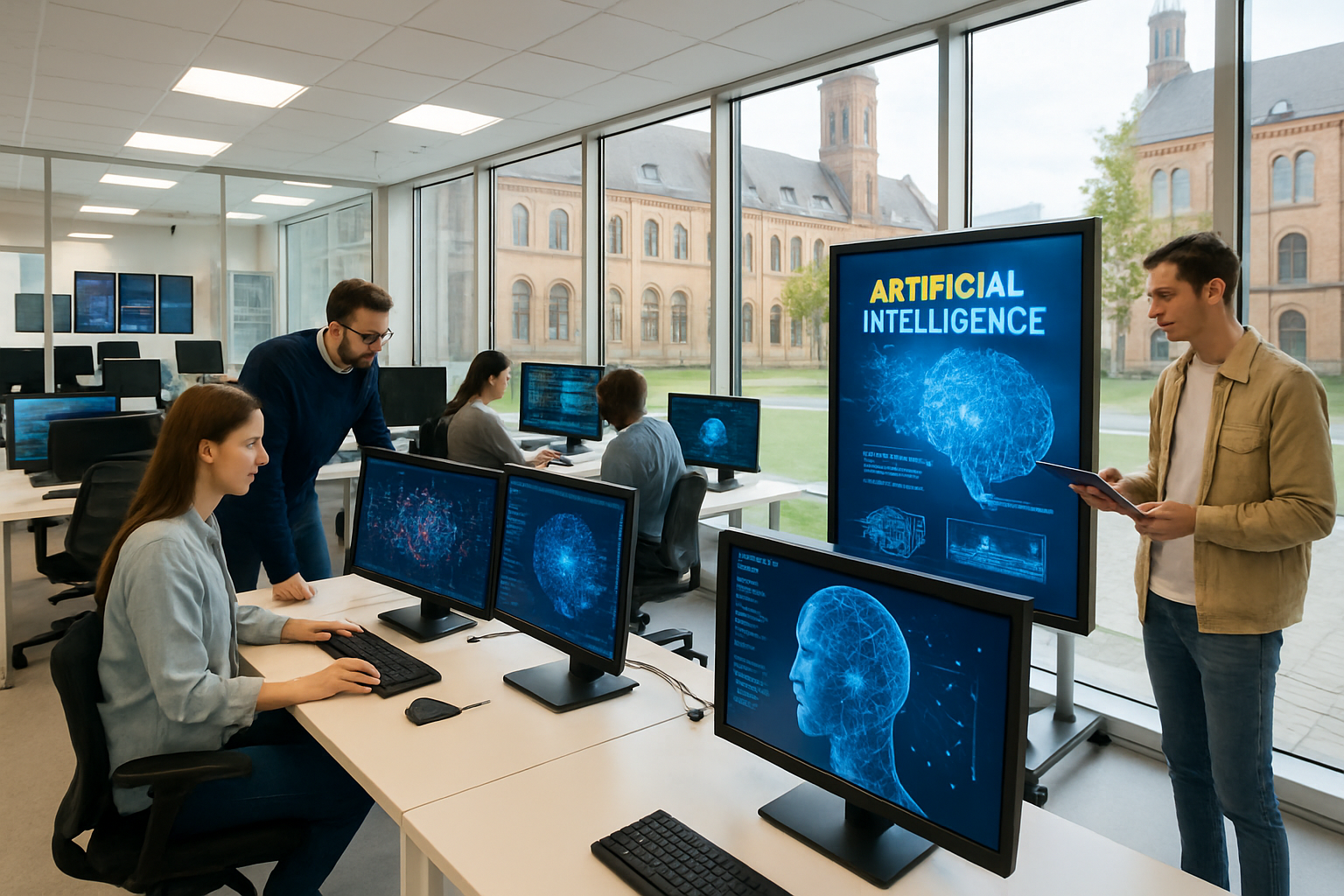
Austria has officially opened a pioneering artificial intelligence real-world laboratory at the University of Applied Sciences St. Pölten, marking a significant milestone in Europe's commitment to educational technology innovation and human-centered AI development.
The announcement, made during the April 10th opening ceremony, comes as Europe positions itself at the forefront of what experts are calling the "2026 Educational Technology Renaissance" – a coordinated global movement toward thoughtful digital tool integration that enhances rather than replaces fundamental human relationships in education.
Strategic Vision: AI Must Serve Humanity
Lieutenant Governor Stephan Pernkopf's keynote address crystallized the laboratory's mission with a powerful declaration: "Artificial intelligence must serve humanity." This human-centered philosophy distinguishes the St. Pölten facility from purely technology-focused initiatives, emphasizing Austria's commitment to ethical AI development that preserves human creativity, critical thinking, and cultural values.
The laboratory represents a sophisticated response to the complex challenges facing educational institutions worldwide as they navigate rapid technological advancement while maintaining educational excellence. Unlike wholesale technology adoption strategies that have shown mixed results globally, Austria's approach emphasizes careful integration of AI tools that amplify rather than replace human capabilities.
Global Context: The Educational Technology Renaissance
The St. Pölten AI laboratory opens amid unprecedented international coordination in educational technology. Recent analyses of global educational initiatives reveal remarkable success stories that share common characteristics: sustained political commitment, comprehensive stakeholder engagement, and innovation-tradition balance.
Malaysia operates the world's first AI-integrated Islamic school, achieving a remarkable 97.82% teacher placement rate while successfully combining artificial intelligence with traditional religious and academic learning. Singapore's WonderBot 2.0 heritage education system demonstrates how advanced technology can preserve cultural knowledge, while Canadian universities implement AI teaching assistants that maintain critical thinking standards while providing personalized student support.
These success models provide crucial templates for the Austrian initiative, demonstrating that effective AI integration requires treating technology as amplification tools serving specific educational goals rather than pursuing technological advancement for its own sake.
Addressing Infrastructure Challenges Through Innovation
The laboratory's launch occurs during a global semiconductor crisis that has driven memory chip prices sixfold higher, affecting Samsung, SK Hynix, and Micron operations through 2027. Rather than delaying innovation, these constraints have paradoxically spurred development of memory-efficient algorithms and sustainable deployment strategies.
Austrian educational technology experts are leveraging these challenges to develop more efficient AI systems that can operate effectively within resource constraints – an approach that could democratize advanced AI access for educational institutions worldwide. This constraint-driven innovation demonstrates how limitations can catalyze breakthrough solutions that might not emerge under unlimited resource scenarios.
European Leadership in AI Governance
Austria's initiative coincides with Europe's emergence as a global leader in responsible AI governance. Spain recently implemented the world's first criminal executive liability framework for technology platforms, while France has conducted AI company cybercrime raids. The European Commission has investigated TikTok for Digital Services Act violations related to "addictive design" features, with potential penalties reaching billions in revenue percentages.
The United Nations has established an Independent Scientific Panel of 40 experts under Secretary-General António Guterres – the first fully independent global AI assessment body. This represents the most sophisticated international technology governance effort since internet commercialization, providing a framework within which educational AI initiatives like St. Pölten's can develop responsibly.
"The convergence of educational innovation, regulatory frameworks, and technological advancement creates unprecedented opportunities for institutions that prioritize human welfare alongside technological progress."
— Educational Technology Policy Expert
Preparing Students for an AI-Integrated Future
The laboratory's curriculum emphasizes developing uniquely human skills that artificial intelligence cannot replicate: creativity, emotional intelligence, cultural understanding, and ethical reasoning. This approach addresses growing concerns about employment displacement by positioning students to work alongside AI systems rather than compete against them.
Research indicates that over 50% of teenagers globally now regularly use AI tools for homework assistance. Rather than viewing this as a threat to traditional education, the St. Pölten laboratory treats it as an opportunity to teach responsible AI usage while maintaining academic integrity and critical thinking development.
The facility will focus on developing "AI literacy" – the ability to understand AI capabilities and limitations, use AI tools effectively for learning enhancement, and maintain authentic intellectual development despite technological assistance. This balanced approach prepares students for a future where AI proficiency becomes essential while human qualities remain irreplaceable.
International Cooperation and Knowledge Sharing
The laboratory is designed to participate in emerging international cooperation networks that share best practices while respecting cultural contexts. Bilateral partnerships and peer-to-peer knowledge sharing have proven more resilient than traditional multilateral approaches, allowing flexible, culturally responsive strategies while maintaining evidence-based standards.
Early partnerships are being established with institutions implementing successful AI integration models, including Canadian universities with AI teaching assistants, Malaysian schools combining technology with traditional learning, and Singapore's heritage education initiatives. This collaborative approach enables the St. Pölten facility to learn from global successes while contributing Austrian innovations to the international knowledge base.
Economic and Social Implications
Educational technology investments are increasingly viewed as strategic 21st-century infrastructure rather than cost centers. Countries implementing comprehensive prevention-first educational approaches demonstrate superior economic outcomes through reduced crisis intervention costs, decreased unemployment rates, and improved workforce productivity.
The laboratory is expected to generate multiple economic benefits: enhanced community resilience, reduced social service demands, improved public health outcomes through comprehensive education, and increased international competitiveness through strategic human capital development. These multiplier effects justify the initial infrastructure investment by creating self-reinforcing cycles where educational excellence supports economic development, enabling further educational investment.
Addressing Digital Age Mental Health
The facility will also address growing concerns about digital age mental health challenges. Recent research confirms that 96% of children aged 10-15 use social media, with 70% experiencing harmful content exposure and over 50% encountering cyberbullying. Early smartphone exposure before age 5 has been linked to persistent sleep disorders, cognitive decline, and weight problems extending into adulthood.
The laboratory's approach emphasizes "digital wellness" alongside technical proficiency, teaching students healthy technology relationships while developing AI skills. This comprehensive strategy addresses both the opportunities and risks of increased technological integration in educational settings.
Future Implications and Scalability
The St. Pölten AI laboratory serves as a prototype for educational institutions worldwide seeking to balance technological advancement with human development priorities. The facility's emphasis on cultural sensitivity, stakeholder engagement, and human-centered design provides a template that can be adapted to diverse educational contexts while maintaining core principles.
Success will be measured not by technological adoption rates but by educational outcomes: improved teacher confidence, enhanced student engagement, and measurable development of critical thinking skills alongside AI proficiency. These metrics reflect the laboratory's commitment to technology serving educational goals rather than pursuing technological sophistication as an end in itself.
A Critical Juncture for Global Education
Educational policy experts identify 2026 as a critical juncture determining educational trajectories for the coming decade. The success or failure of current reform initiatives will significantly affect global capacity to address climate change, technological disruption, and social cohesion through quality educational systems that serve as strategic infrastructure for 21st-century prosperity.
The St. Pölten laboratory represents Austria's commitment to ensuring that educational transformation serves humanity's highest aspirations for learning, growth, and wisdom. By prioritizing human-centered design while embracing technological advancement, the facility offers a model for institutions worldwide seeking to prepare students for an AI-integrated future while preserving the fundamental human relationships that define authentic education.
As artificial intelligence continues its rapid development, educational institutions face unprecedented challenges and opportunities. The University of Applied Sciences St. Pölten's new AI laboratory demonstrates that thoughtful, human-centered approaches can harness AI's transformative potential while maintaining the creativity, critical thinking, and cultural authenticity that make education truly meaningful.