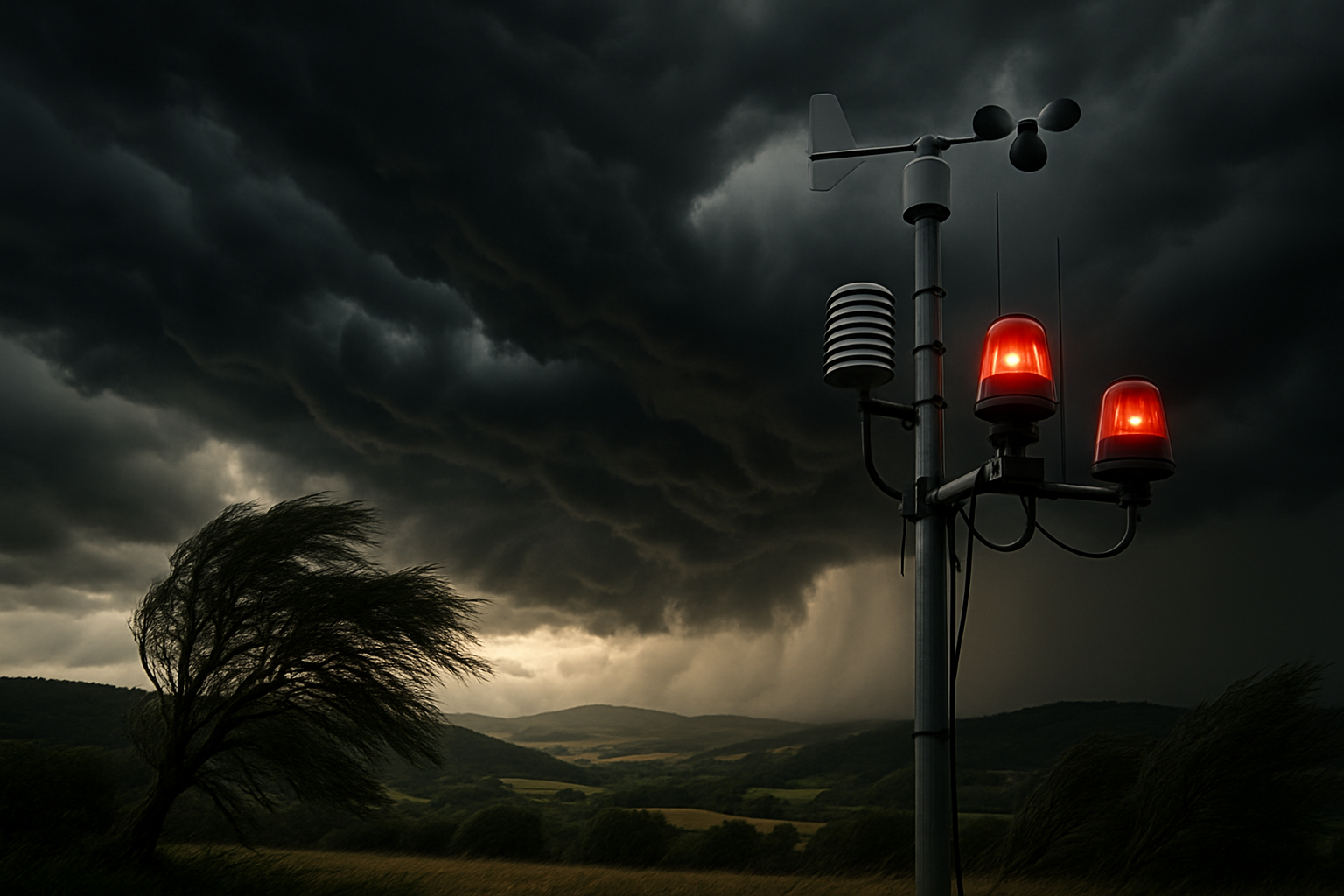
Storm Dave is barreling toward Europe with winds reaching 90 mph as meteorological services across multiple countries issue urgent weather warnings during what experts describe as an increasingly volatile period of extreme weather patterns.
The fourth named storm of 2026 is set to impact Scotland, Northern Ireland, Wales, and northern England with hurricane-force winds, while Ireland's Met Éireann has extended yellow wind warnings to cover all Irish counties for the Easter weekend. The storm represents the latest in a series of dangerous weather systems affecting the continent during the 23rd consecutive month of global temperatures exceeding 1.5°C above pre-industrial levels.
Multi-National Weather Emergency
In Ireland, forecaster Gerry Murphy warned that Donegal and the northwest regions will "bear the brunt of the storm," with dangerous conditions expected from Saturday afternoon through Sunday morning. The Irish weather service has issued a comprehensive yellow wind warning covering the entire country, effective from 1pm Saturday until 2am Sunday.
"Counties Sligo, Donegal, Leitrim, along with Derry and Antrim, are going to get some very strong winds through the evening," Murphy told RTÉ's Morning Ireland. He emphasized that while Storm Dave will bring heavy rainfall, the wind component poses the greatest threat to public safety and infrastructure.
Norwegian meteorological services have issued urgent storm warnings across southern regions, with authorities warning residents to avoid parks and outdoor areas due to falling tree risks. The storm has already left 8,000 households without power, while emergency services report widespread structural damage from powerful wind gusts.
Sweden Faces Unusual Spring Conditions
Sweden's meteorological institute SMHI has issued warnings for what meteorologist Nitzan Cohen describes as "risk for stormbyar" (storm gusts) moving inland. The system is creating unusual conditions for the Easter season, with heavy snowfall forecast for Värmland province.
"We can see now that there is a risk for storm gusts moving in over land," Cohen stated, highlighting the unpredictable nature of current weather patterns. Swedish meteorologist Hilda Westberg noted that "low-pressure systems are lining up," forcing traditional Easter egg hunts indoors due to rain, cold, and snow conditions.
Mediterranean and Eastern European Impacts
Bulgaria faces a complex weather scenario with dangerous meteorological conditions affecting multiple regions. Eastern Bulgaria is experiencing thunderstorms, intense rainfall, and hail conditions caused by an active Mediterranean cyclone system. The Bulgarian meteorological service warns of potential flooding and dangerous driving conditions through the weekend.
Ibrahim Smajlović from the Federal Hydrometeorological Institute of Bosnia and Herzegovina described current conditions as "just the introduction," warning that "the real storm is yet to come." Lithuania's meteorological services are monitoring the system's potential eastern trajectory, though current forecasts suggest the most severe impacts will remain in western and northern Europe.
Historical Context of Extreme Weather
The current weather emergency occurs against the backdrop of Europe's most challenging weather period in recent history. The continent is still recovering from the devastating February 2026 storm succession of Kristin, Leonardo, Marta, Nils, and Pedro, which claimed over 35 lives across Portugal, Spain, and France.
That unprecedented sequence required Portugal's largest peacetime rescue operation, deploying 26,500 emergency personnel including 1,975 military personnel and 30 naval vessels. The EU Civil Protection Mechanism was activated with a €246 million assistance package from Sweden and Denmark - the largest coordinated European weather response on record.
Infrastructure Vulnerabilities Exposed
Current weather patterns are revealing critical vulnerabilities in European infrastructure systems designed for historical rather than current climate conditions. Transportation networks, power grids, and communication systems are operating beyond their design parameters as extreme weather events exceed operational thresholds.
Emergency services across multiple countries are reporting capacity strains as traditional mutual aid mechanisms prove inadequate for simultaneous multi-national disasters. The frequency and intensity of severe weather events are challenging the continent's ability to recover between successive impacts.
Insurance companies are positioning crews in anticipation of widespread damage claims, while authorities urge residents to secure outdoor objects and avoid unnecessary travel during peak storm conditions.
Climate Change Acceleration
Scientists point to the current crisis as evidence of accelerating climate change impacts. January 2026 marked the hottest month on record, extending an unprecedented streak of elevated global temperatures. The World Meteorological Organization forecasts a 50-60% probability of El Niño conditions developing between July and September 2026, which could drive temperatures to unprecedented levels.
Dr. Sarah Chen, a climate researcher at the European Centre for Medium-Range Weather Forecasts, explains that the current weather volatility represents a "paradigm shift" in European climate patterns. "We're seeing sustained global warming enable both temperature records and devastating regional extremes through disrupted atmospheric circulation and polar vortex patterns," she noted.
Economic and Social Implications
The mounting frequency of severe weather events is creating cascading economic impacts across multiple sectors. Agricultural operations face billions in losses during critical growing seasons, while tourism infrastructure suffers repeated damage during peak holiday periods. The Easter weekend timing of Storm Dave threatens additional economic disruption for tourism-dependent regions.
Mental health services report increased demand as communities experience climate anxiety from repeated extreme weather trauma. Families are losing generational properties, while businesses face extinction threats from cumulative weather damage exceeding insurance capabilities.
Adaptation and Preparedness
European authorities emphasize that current conditions may represent a "new normal" requiring fundamental shifts in emergency preparedness and infrastructure design. The concept of "building back better" has evolved from an optional enhancement to an essential survival strategy for communities facing repeated extreme weather.
International cooperation frameworks are being tested as simultaneous disasters across multiple countries challenge traditional bilateral aid assumptions. Environmental challenges increasingly transcend national boundaries, requiring unprecedented coordination for effective response.
Immediate Safety Measures
Authorities across affected regions are implementing comprehensive safety protocols. Transportation operators are prioritizing safety over service continuity, with numerous ferry routes, rail services, and flight operations facing potential disruptions throughout the weekend.
Public safety advisories recommend avoiding parks and wooded areas, securing loose outdoor items, maintaining emergency supply kits, and monitoring official weather warnings for rapidly changing conditions. Emergency services urge residents to report power outages and structural damage promptly to enable efficient resource allocation.
The convergence of Storm Dave with other weather systems across Europe underscores the continent's entry into an era of permanent climate volatility, where extreme weather frequency and intensity challenge traditional emergency response frameworks and require transformative adaptation strategies for long-term resilience.