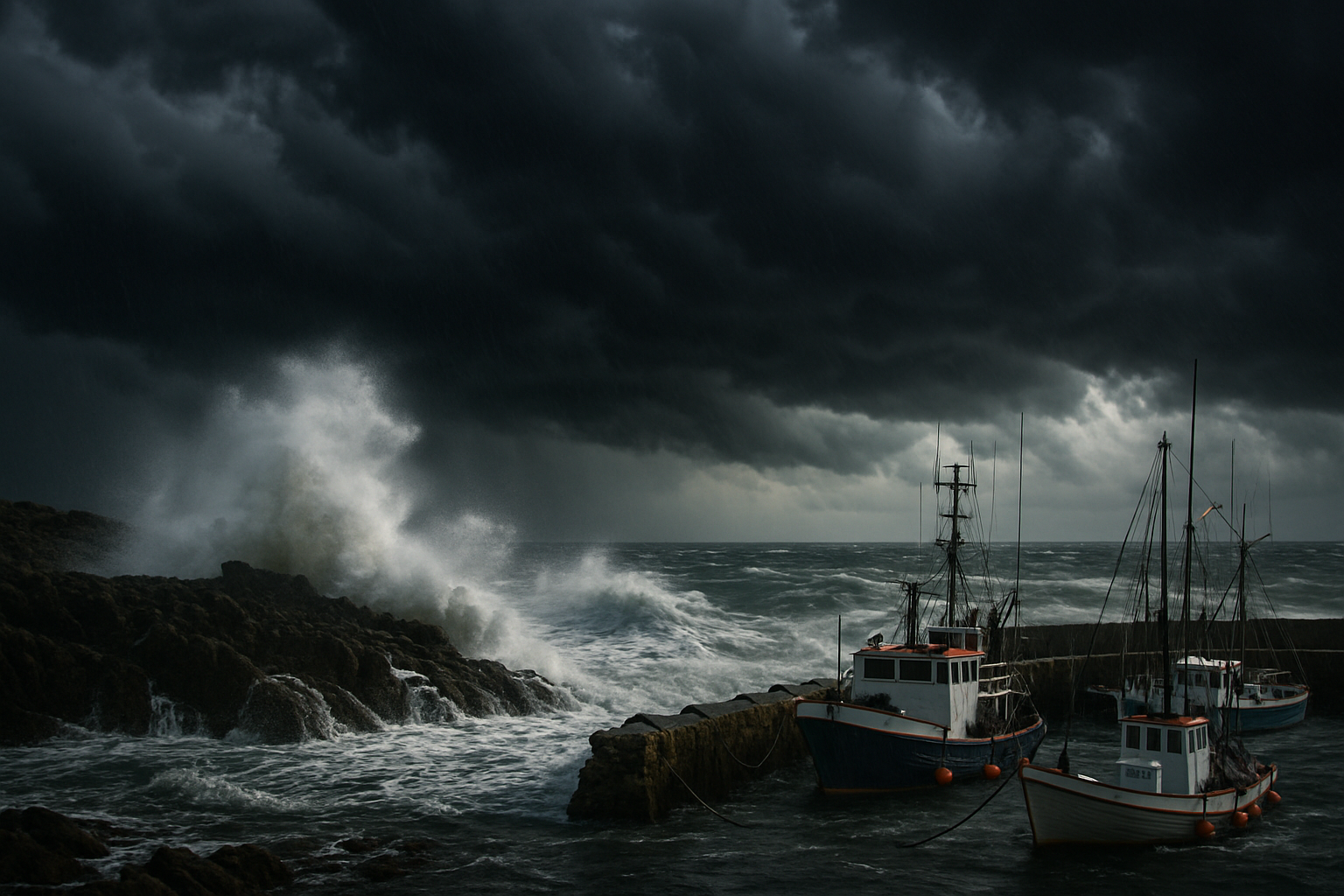
Storm Dave, the fourth named storm system of 2026, is delivering hurricane-force winds up to 90 mph across Northern Europe, forcing widespread ferry cancellations and prompting authorities to issue severe weather warnings during what meteorologists are calling an unprecedented Easter weekend weather crisis.
The powerful Atlantic storm system is affecting multiple countries across Scandinavia and the British Isles, with Denmark reporting waves reaching 11 meters in height and Norwegian authorities warning of dangerous conditions that have already left thousands without power.
Immediate Impact Across Northern Europe
Ireland's Met Éireann has extended yellow wind warnings for all counties from 1pm Saturday until 2am Sunday, with forecaster Gerry Murphy warning that Donegal and the northwest regions will face the worst conditions. "Very strong southerly winds, veering westerly by the evening, will bring severe wind conditions through the evening," Murphy stated during Saturday's briefing.
In Norway, the storm has already caused significant disruption with southern regions reporting 8,000 households without power. Authorities have advised residents to avoid parks and wooded areas due to the risk of falling trees, while emergency services work around the clock to restore essential services.
Sweden's meteorological institute SMHI has issued warnings across the country, with meteorologist Nitzan Cohen describing the "risk for stormbyar" (storm cells) moving inland. The unusual Easter conditions have forced many families to move traditional egg hunts indoors, with heavy snowfall reported in Värmland province.
"Low-pressure systems are lining up in the Atlantic, and we're seeing conditions that are forcing Easter celebrations indoors due to rain, cold, and snow."
— Hilda Westberg, Swedish Meteorologist
Ferry Services Suspended as Maritime Conditions Deteriorate
The storm has prompted widespread cancellations of ferry services across Northern European routes, with Danish authorities specifically citing the prospect of 11-meter waves as making sea crossings too dangerous. Services between Denmark and Norway have been suspended indefinitely, affecting thousands of Easter weekend travelers.
The Storebælt Bridge in Denmark has implemented driving restrictions for certain vehicles due to the extreme wind conditions, demonstrating the storm's impact on critical transport infrastructure.
Historical Context of Atlantic Storm Activity
Storm Dave represents the fourth named storm system to affect Europe in 2026, following an unprecedented pattern of severe weather that has characterized this year's Atlantic storm season. The current crisis builds upon the devastating February 2026 storm succession of Kristin, Leonardo, Marta, Nils, and Pedro, which claimed over 35 lives across Portugal, Spain, and France.
This extraordinary sequence of Atlantic storms required the largest peacetime rescue operation in Portuguese history, involving 26,500 emergency personnel, and prompted the EU Civil Protection Mechanism to provide €246 million in assistance to Sweden and Denmark—the largest coordinated European weather response on record.
Climate Context and Unprecedented Warming
The current storm emergency occurs during what climate scientists confirm as the 23rd consecutive month of global temperatures exceeding 1.5°C above pre-industrial levels—the longest sustained period of extreme warming in recorded human history.
January 2026 was confirmed as the hottest month ever recorded globally, with the World Meteorological Organization predicting a 50-60% probability of El Niño development between July and September 2026, potentially driving temperatures to unprecedented levels through the combination of baseline warming and natural climate cycle amplification.
Dr. Sarah Chen from the European Centre for Medium-Range Weather Forecasts describes the current conditions as representing a "paradigm shift" in European climate patterns, where sustained global warming enables both temperature records and devastating regional extremes through disrupted atmospheric circulation and polar vortex patterns.
Emergency Response and Infrastructure Strain
Emergency services across the affected regions are operating at or beyond capacity limits, with traditional mutual aid mechanisms proving inadequate for managing simultaneous multi-national disasters. Transportation networks, power grids, and communication systems designed for historical climate patterns are repeatedly operating beyond their design parameters.
Insurance companies have positioned emergency crews across the region in anticipation of widespread damage, while authorities recommend that residents secure outdoor items, avoid parks and wooded areas, and monitor rapidly changing weather warnings.
Emergency services urge prompt reporting of power outages and structural damage as response teams work to maintain essential services during the peak storm period.
Broader Regional Impacts
Bulgaria faces dangerous thunderstorm conditions in eastern regions, with the Federal Hydrometeorological Institute warning of intense rainfall and hail from an active Mediterranean cyclone. Ibrahim Smajlović from Bosnia Herzegovina's meteorological service cautioned that current conditions represent "just the introduction - the real storm is yet to come."
Finland's meteorological service is monitoring the storm system's potential eastern trajectory, while Lithuania has activated enhanced monitoring protocols for what could become the most severe Easter weekend weather event in recent memory.
Economic and Social Disruption
The timing of Storm Dave during the Easter weekend threatens significant economic disruption, particularly for the tourism industry already struggling with repeated weather-related cancellations throughout 2026. Agricultural sectors face mounting losses from extreme weather affecting crops during critical growing seasons.
Mental health services across the region report increased demand related to climate anxiety and repeated weather trauma, as families and businesses face the prospect of losing generational properties and livelihoods to recurring severe weather events.
Long-term Adaptation Challenges
The current crisis highlights the critical choice facing European societies between reactive crisis management and transformative infrastructure adaptation. The concept of "building back better" has evolved from an optional enhancement to what experts describe as an essential survival strategy for permanent climate volatility.
Traditional seasonal patterns that have guided infrastructure design, agricultural planning, and emergency preparedness for centuries are proving unreliable under current climate conditions, requiring fundamental reassessment of European resilience frameworks.
Looking Ahead
Meteorological authorities warn that additional Atlantic storm systems are developing, suggesting that the current crisis conditions may persist for weeks, establishing what many experts describe as a "new normal" of extreme weather frequency and intensity that permanently challenges traditional emergency response frameworks.
The window for effective climate action continues to narrow as ecological systems approach critical thresholds that could trigger irreversible changes to global food security, climate stability, and human settlements.
As Storm Dave continues to batter Northern Europe through the weekend, the crisis serves as a stark reminder of the unprecedented environmental challenges facing the continent and the urgent need for enhanced international cooperation and transformative adaptation strategies in an era of permanent climate volatility.