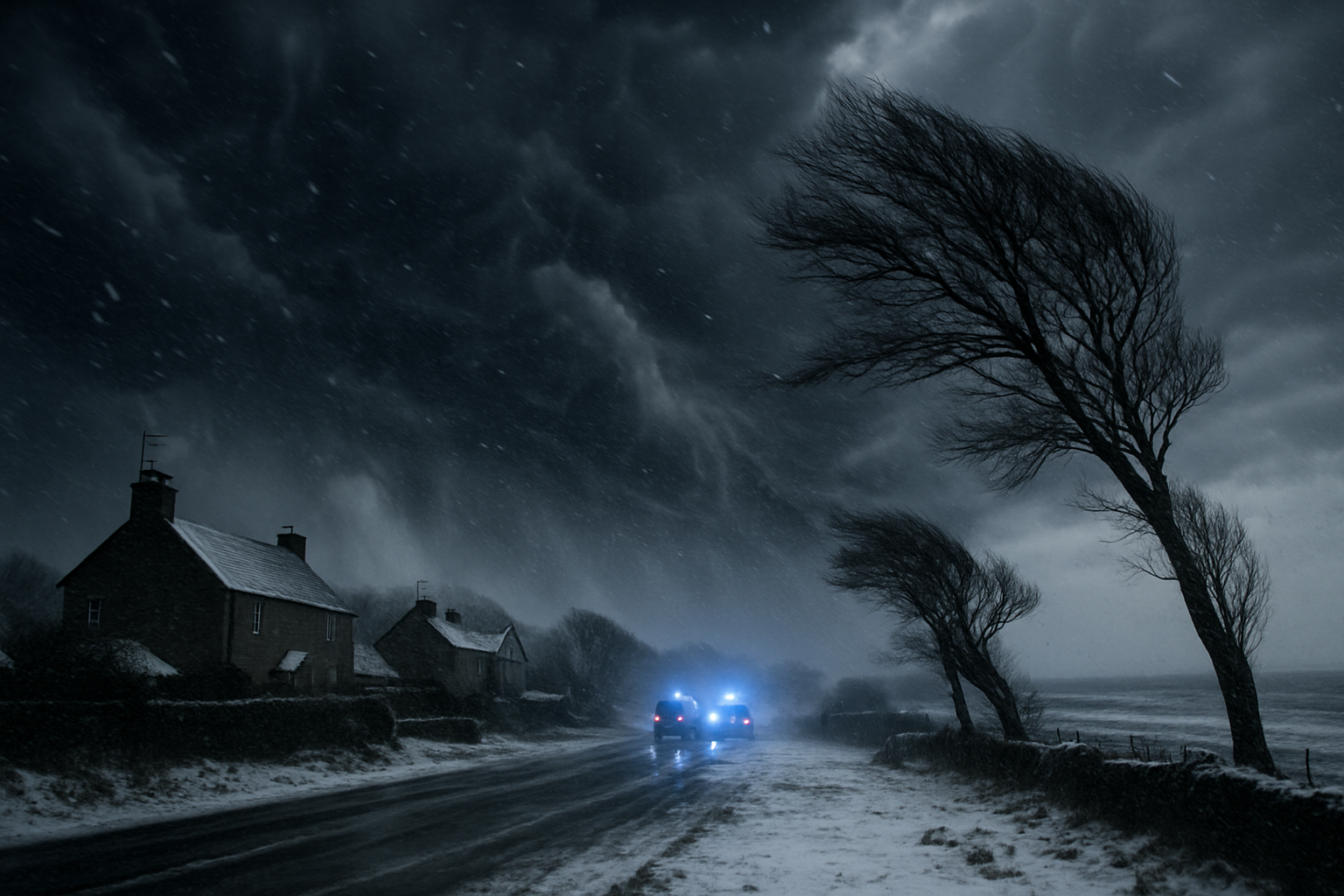
Storm Dave, the fourth named weather system of 2026, is unleashing hurricane-force winds of up to 90 mph and heavy snowfall across the United Kingdom and northern Europe, creating dangerous conditions and widespread travel chaos during the critical Easter weekend period.
The severe weather system is hitting during what scientists confirm as the 23rd consecutive month of global temperatures exceeding 1.5°C above pre-industrial levels – the longest sustained period of extreme warming in recorded human history. This unprecedented streak continues to fuel extreme weather patterns across Europe, with Storm Dave representing the latest in an alarming succession of powerful Atlantic storms.
UK and Ireland Bear the Brunt
Ireland's Met Éireann has issued yellow severe weather warnings for all counties, effective from 1pm Saturday through 2am Sunday. Forecaster Gerry Murphy warns that counties Donegal, Sligo, Donegal, and Leitrim, along with Derry and Antrim, face "very strong southerly winds veering westerly by evening," with the northwest regions expected to experience the worst conditions.
The Met Office has issued amber weather warnings for wind across parts of northern England, Scotland, and Wales for Saturday evening, while Scotland faces yellow warnings for heavy snow and blizzards that could deposit up to 30 centimeters of accumulation. The combination of snow and hurricane-force winds is creating blizzard conditions that pose serious risks to travel and power infrastructure.
Emergency services are positioned across affected regions, with authorities strongly advising against unnecessary travel as conditions deteriorate rapidly across the British Isles.
Scandinavian Countries in Crisis Mode
Sweden's SMHI has issued warnings for what meteorologist Nitzan Cohen describes as "risk for stormbyar" (storm gusts) as the system moves inland. The unusually severe Easter weekend conditions are forcing families across Värmland to move traditional egg hunts indoors due to heavy snowfall and dangerous winds.
Hilda Westberg from SMHI notes that "low-pressure systems are lining up," indicating that Storm Dave may be followed by additional weather systems that could prolong the crisis into next week. Sweden recently recorded its warmest March on record, making the current severe conditions particularly jarring for residents.
Norway is facing its own emergency as southern regions report 8,000 households without power, with authorities warning citizens to avoid parks and wooded areas due to the risk of falling trees. The Norwegian meteorological service has issued urgent warnings for western regions and eastern areas, with some considering red danger levels for coastal areas.
Denmark is experiencing 11-meter waves that have forced the cancellation of ferry services to Norway, while the Storebælt Bridge has implemented vehicle restrictions due to extreme wind conditions threatening safe passage.
Eastern European Impact Spreads
The storm's influence is extending far beyond its primary track. Bulgaria is facing dangerous thunderstorms and hail in the eastern regions, driven by an active Mediterranean cyclone. Ibrahim Smajlović from the Bosnia and Herzegovina Federal Hydrometeorological Institute warns that current conditions are "just an introduction – the real storm is yet to come."
Lithuania is monitoring the system's potential eastern trajectory, while emergency services across the region are coordinating response efforts as the storm's effects ripple across national boundaries.
Historical Context of Extreme Weather
Storm Dave arrives as European emergency services are still recovering from a devastating series of earlier storms this year. The February 2026 Atlantic storm succession of Kristin-Leonardo-Marta-Nils-Pedro claimed over 35 lives across Portugal, Spain, and France, requiring the largest peacetime rescue operation in Portuguese history with 26,500 emergency personnel deployed.
The European Union's Civil Protection Mechanism was repeatedly activated, with Sweden and Denmark providing €246 million in assistance – the largest coordinated European weather response on record. However, the scale and frequency of these events are pushing traditional mutual aid systems beyond their intended capacity.
Climate Science and Infrastructure Concerns
Dr. Sarah Chen from the European Centre for Medium-Range Weather Forecasts describes the current pattern as a "paradigm shift" in European climate, where sustained warming is enabling both temperature records and devastating regional extremes through disrupted atmospheric circulation and polar vortex patterns.
The World Meteorological Organization reports a 50-60% probability of El Niño development from July-September 2026, which could drive unprecedented global temperatures by combining baseline warming with natural climate amplification.
Transportation networks, power grids, and communication systems designed for historical climate patterns are repeatedly operating beyond their intended parameters. The frequency and intensity of storms like Dave are exposing critical vulnerabilities in infrastructure that was never designed to handle such extreme conditions on a regular basis.
Transportation and Economic Disruption
Several train services in western Sweden have already been canceled as a precautionary measure. Aviation authorities across the region are implementing flight restrictions, with major airports including those in Stockholm, Copenhagen, and Oslo monitoring conditions closely.
The timing during Easter weekend compounds the impact, as millions of families have travel plans that may need to be abandoned for safety reasons. Tourism and hospitality sectors, still recovering from previous storms and broader economic challenges, face additional revenue losses during what should be a peak holiday period.
Agricultural sectors across the affected regions are bracing for potential crop damage, particularly concerning given the succession of extreme weather events that have already stressed farming operations throughout 2026.
Emergency Response and Public Safety
Authorities across the affected regions are implementing comprehensive emergency protocols. Insurance companies have positioned crews in anticipation of widespread damage claims, while utility companies are preparing for extensive power restoration operations.
Public safety officials are urging residents to secure outdoor items, avoid unnecessary travel, and monitor weather warnings as conditions can change rapidly. Emergency services report they are prepared for what could be extensive rescue and recovery operations.
The crisis highlights the urgent need for what experts call "building back better" – implementing climate-resilient infrastructure rather than simply rebuilding to previous standards that are proving inadequate for current weather realities.
Looking Ahead
Weather models suggest that additional Atlantic storm systems are developing, raising concerns that the current crisis could persist for weeks rather than days. This would establish what scientists are calling a "new normal" of extreme weather frequency and intensity that permanently challenges traditional emergency response frameworks.
The convergence of Storm Dave with the ongoing climate crisis represents what many experts see as a watershed moment requiring transformative rather than reactive approaches to weather preparedness. As one emergency management official noted, "We're not just dealing with individual storms anymore – we're managing a permanent state of climate volatility."
Citizens across the affected regions are advised to stay informed through official weather services, avoid travel unless absolutely necessary, and ensure they have emergency supplies readily available as Storm Dave continues its path across northern Europe.