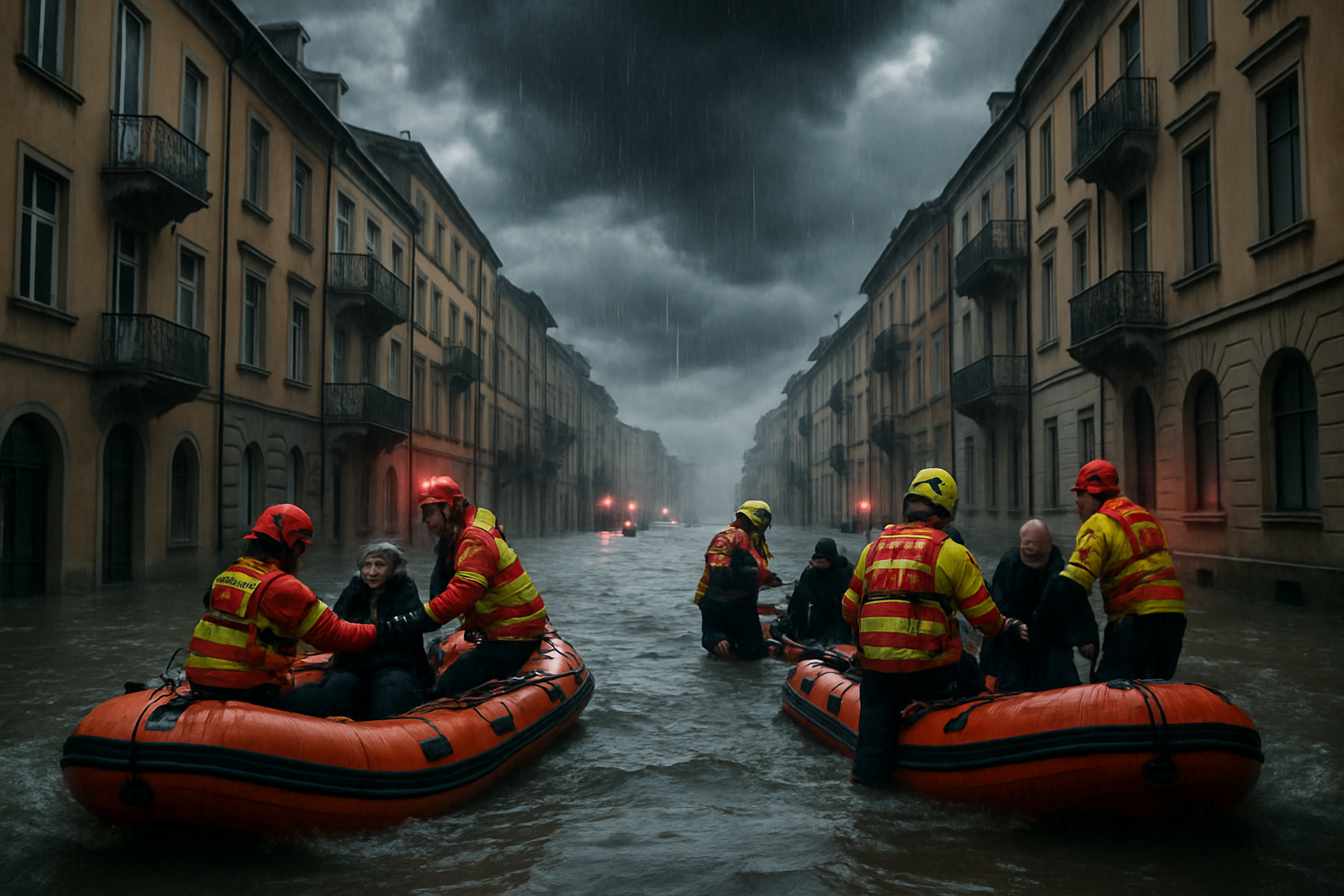
Storm Leonardo has unleashed devastating flooding across the Iberian Peninsula, forcing Portuguese Navy rescues of more than 130 people while Spain evacuates thousands from Andalusia as the deadly weather system disrupts transportation networks, closes schools, and even threatens to postpone Portugal's presidential election.
The powerful Atlantic storm has created what authorities describe as one of the most severe weather emergencies to hit Southern Europe this winter, with Portugal deploying 1,975 military personnel and 30 naval vessels in response to over 1,800 weather-related incidents. The crisis has prompted far-right Portuguese presidential candidate André Ventura to demand postponement of Sunday's election runoff, citing the impossibility of conducting fair elections amid such widespread disruption.
Unprecedented Rescue Operations
The Portuguese Maritime Authority (AMN) confirmed that Navy vessels rescued more than 130 people affected by flooding caused by the passage of Storm Leonardo and its predecessor Storm Kristin. The rescues took place across multiple regions of continental Portugal as flood waters overwhelmed communities and left residents stranded.
In Alcácer do Sal, residents report flooding unlike anything in living memory, with the city completely submerged and surrounding villages isolated. More than 100 people have been evacuated from their homes, while local businesses face devastation. The flooding has exceeded levels recorded in 1963, marking it as potentially the worst natural disaster to hit the region in over six decades.
"We don't remember floods like these that inundated the city and left villages isolated," local residents told Portuguese media, as emergency services worked around the clock to reach those trapped by rising waters.
Spain Under Siege
Spain's Andalusia region has borne the brunt of Storm Leonardo's fury, with authorities maintaining red alerts for "extraordinary danger" and ordering the evacuation of approximately 4,000 people. The small mountain town of Grazalema recorded an astounding 600 liters per square meter of rainfall in just 36 hours – nearly its entire annual average of 523 liters.
The Spanish Meteorological Agency (AEMET) has kept emergency protocols active across Cádiz, Málaga, and Jaén provinces, while schools remain closed in all affected areas except Almería province. The storm has created chaos for educational authorities, who changed school closure lists multiple times during a single evening, leaving parents and students scrambling to adapt.
Transportation infrastructure has suffered severe damage, with Madrid's Barajas Airport experiencing significant disruptions after a burst water pipe flooded the road connecting two terminals and the nearby metro station. Cars became trapped in the airport tunnel as flood waters rose rapidly during the height of the storm.
Regional Infrastructure Crisis
The storm has exposed vulnerabilities in regional infrastructure across both countries. In Portugal's western region, accumulated water has literally lifted, bent, and broken roads in Arruda dos Vinhos, leaving houses on the verge of collapse. In Ponte do Rol, the river overflowed its banks, crossed through private properties, and flooded residential areas.
Railway services have been suspended on key routes between Castanheira do Ribatejo and Alverca, while numerous highways remain closed due to flooding and debris. The Portuguese road network has been particularly hard hit, with authorities warning against non-essential travel as emergency crews work to clear blocked routes.
Political Ramifications
The severity of the crisis has reached the highest levels of government, with Portugal's President Marcelo Rebelo de Sousa reinforcing calls for vigilance and Prime Minister António Costa guaranteeing "all resources" for the emergency response. The deployment of nearly 2,000 military personnel represents one of the largest domestic emergency operations in recent Portuguese history.
"This is an unprecedented situation that requires all our attention and resources,"
— Portuguese Prime Minister António Costa
Far-right presidential candidate André Ventura has seized on the crisis to demand postponement of the election scheduled for Sunday, arguing that severe flooding and infrastructure damage make it impossible to conduct a fair democratic process. His calls highlight the intersection between climate emergencies and democratic procedures, a challenge that European nations may face increasingly in the coming years.
Transportation and Educational Disruption
The storm's impact extends far beyond the Iberian Peninsula. In Ireland, railway services including the DART system have been cancelled due to flooding on tracks and debris on lines, with authorities urging the public to work from home if possible as flood risks continue after a day of widespread disruption.
Educational systems across the region have been severely affected. Andalusia's decision to reopen schools following Storm Leonardo's passage has created confusion, with authorities changing their guidance multiple times and leaving many institutions without clear direction on whether to resume classes.
Climate Context and Future Concerns
Storm Leonardo represents the latest in a series of severe weather events that have battered Europe throughout what meteorologists are calling one of the harshest winters in decades. The storm follows the deadly passage of Storm Kristin just weeks earlier, which claimed five lives in Portugal and demonstrated the region's vulnerability to increasingly volatile weather patterns.
The crisis occurs against the backdrop of January 2026 being recorded as the hottest January in global history, with 18 of the past 19 months exceeding 1.5°C above pre-industrial levels. This apparent contradiction – extreme heat records alongside devastating winter storms – highlights the complexity and volatility of a rapidly changing climate system.
Emergency Services Stretched to Limits
Emergency services across the affected regions report operating at capacity limits, with rescue teams working continuously to respond to calls for assistance. The Portuguese Civil Protection Agency has coordinated with naval forces to conduct maritime rescue operations, while Spanish emergency services have established evacuation centers for displaced residents.
The scope of the emergency has prompted discussions about activating European Union solidarity mechanisms, with Portuguese officials exploring options for additional support as the crisis extends beyond national response capabilities.
Economic and Agricultural Impact
The agricultural sector faces significant losses, particularly in regions known for olive groves and citrus farming. Spanish reservoirs have surged to 67.3% capacity, an increase of 8.1 percentage points in a single week, with 31 reservoirs reaching 100% capacity. While this may alleviate longer-term drought concerns, the immediate flooding has devastated farmland across the region.
The tourism sector, vital to both Spanish and Portuguese economies, has also suffered disruptions as transportation networks remain compromised and coastal areas deal with storm damage. Recovery efforts are expected to take weeks or months, depending on when weather conditions stabilize.
International Response and Coordination
The scale of the crisis has attracted international attention and support. Sweden and Denmark have announced a €246 million assistance package for affected regions, demonstrating European solidarity in the face of climate-related emergencies. The European Union's Civil Protection Mechanism stands ready to provide additional support as needed.
Meteorological agencies across Europe are coordinating to track additional storm systems that may be developing over the Atlantic. Weather forecasters warn that while Storm Leonardo may be passing, the conditions that created it remain present, potentially leading to further severe weather in the coming weeks.
Lessons for Climate Adaptation
The Storm Leonardo crisis provides critical insights into the challenges facing European nations as they adapt to increasingly volatile weather patterns. The event highlights the need for enhanced infrastructure resilience, improved emergency response coordination, and potentially new approaches to maintaining democratic processes during climate emergencies.
As recovery efforts begin, authorities emphasize that the immediate focus remains on ensuring public safety and providing assistance to affected communities. However, the broader implications of this crisis – from election procedures to infrastructure design – will likely influence policy discussions for years to come.
The storm serves as a stark reminder that climate change is not a future threat but a present reality requiring immediate adaptation measures. As European nations grapple with the aftermath of Storm Leonardo, the focus must shift from merely responding to such events to building resilience that can withstand the increasingly extreme weather that climate scientists predict will become the new normal.