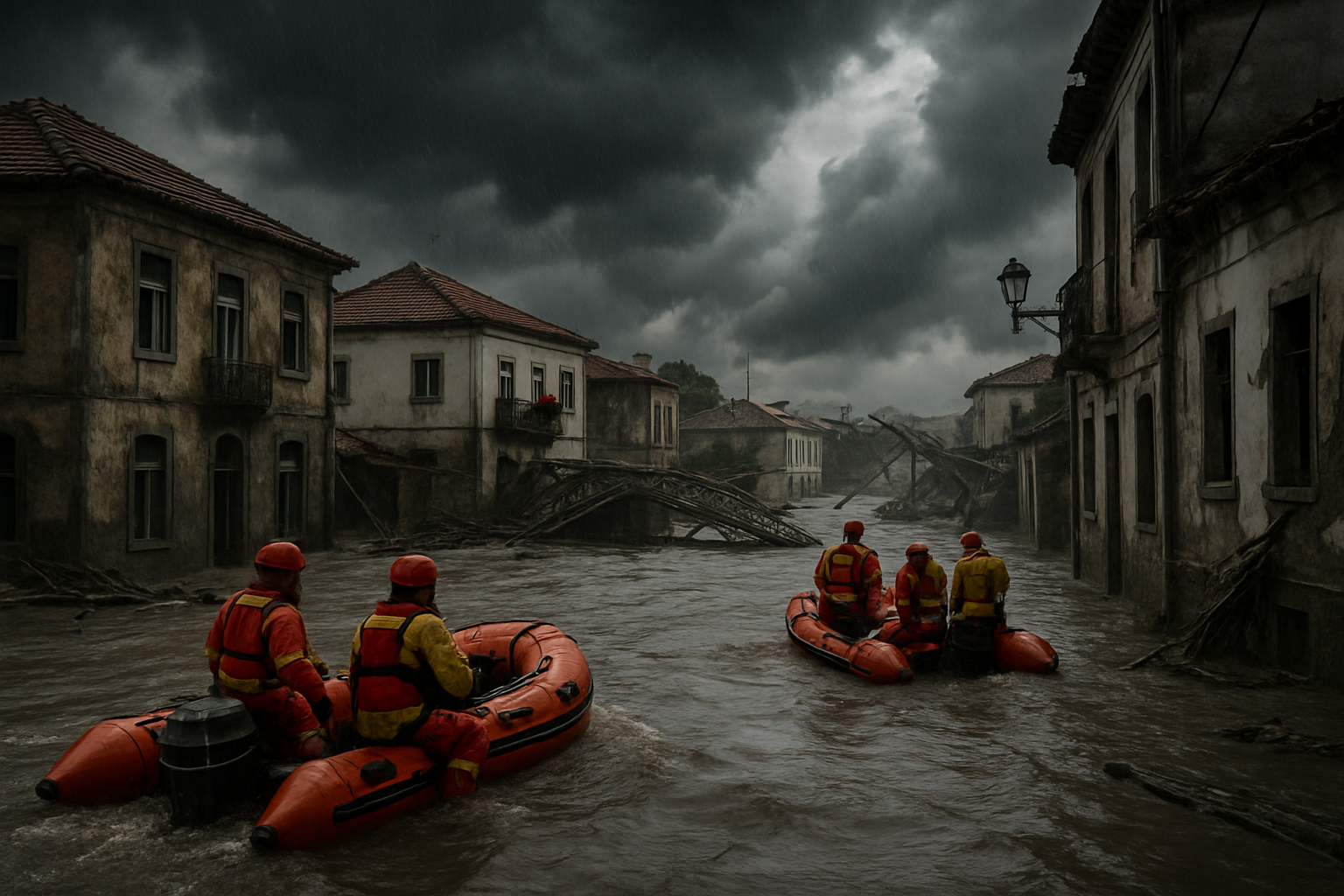
Storm Leonardo continued its devastating sweep across the Iberian Peninsula on February 6, 2026, triggering catastrophic flooding that has killed dozens, displaced thousands, and now threatens to disrupt Portugal's democratic process as the presidential runoff election approaches.
The Portuguese Navy conducted its largest peacetime rescue operation in decades, evacuating 132 people in a single day on Thursday as the storm system brought unprecedented rainfall and flooding across multiple regions. Since February 1, Portugal's Civil Protection agency has registered nearly 6,800 weather-related incidents, with flood rescue requests showing the steepest increase.
Electoral Democracy Under Pressure
Portugal faces an unprecedented constitutional crisis as Storm Leonardo's destruction has prompted calls to postpone the February 8 presidential runoff election. Electoral authorities have insisted the second-round vote will proceed as scheduled despite mounting concerns about voter safety and access in storm-ravaged areas.
The storm's timing has exposed the intersection of climate emergencies and democratic processes, as infrastructure damage and ongoing safety risks raise questions about the fairness and accessibility of the electoral process in affected regions.
Spain Battles Record-Breaking Conditions
Across the border in Spain, Storm Leonardo has shattered meteorological records and forced the evacuation of approximately 7,000 people across Andalusia. The town of Grazalema, historically Spain's wettest location, recorded an extraordinary 1,500 liters per square meter of rainfall in just 36 hours – exceeding the Madrid region's entire annual precipitation.
Spanish authorities have maintained red alerts for "extraordinary danger" across the provinces of Cádiz, Málaga, and Jaén, where rivers have reached critical levels and reservoir systems have been pushed to capacity. Educational authorities suspended classes across most of Andalusia, with closure lists changing multiple times in a single evening as conditions deteriorated rapidly.
"The territories live pending the rises of the rivers and the spillways of reservoirs at maximum capacity that have forced the evacuation of some 7,000 people"
— Spanish Meteorological Agency (AEMET)
Transportation Networks Collapse
The storm's impact has paralyzed transportation infrastructure across both nations. Portugal has suspended railway services between Castanheira do Ribatejo and Alverca, while Spain has shut down all high-speed rail connections between major cities including the Seville-Córdoba and Málaga-Granada lines.
Berlin's Brandenburg Airport has temporarily suspended all flight operations due to black ice conditions, highlighting the storm system's broader impact across Europe. The crisis has created a cascade effect, with Polish railways experiencing complete paralysis in the Lower Silesia region as trains became literally frozen to their tracks.
Military Deployment and Rescue Operations
Portugal has deployed an unprecedented 1,975 military personnel and 30 naval vessels in response to the crisis, representing one of the largest peacetime emergency deployments in the nation's recent history. The operation demonstrates the scale of the emergency response required as traditional civil protection resources have been overwhelmed.
Spanish military units have also been activated for slope stabilization and mining pond security as saturated soils threaten additional infrastructure collapse. The coordinated response between emergency services, military forces, and international partners reflects the severity of the crisis facing the region.
Historical Context and Climate Implications
Storm Leonardo represents the latest in a series of extreme weather events that have battered Europe throughout early 2026. The current crisis follows Storm Kristin, which claimed five lives in Portugal just weeks earlier, highlighting an intensifying pattern of severe Atlantic storm systems.
The timing is particularly significant as January 2026 was recorded as the hottest month in global history, with 18 of the past 19 months exceeding 1.5°C above pre-industrial levels. This juxtaposition of global heat records with regional extreme flooding underscores the complex nature of climate volatility facing European nations.
Cross-Border Cooperation and International Response
The crisis has demonstrated mature trans-boundary disaster response capabilities, with Portuguese emigrants being called upon for damage assessments and technical support being provided between municipalities. Sweden and Denmark have announced a €246 million emergency assistance package, while the EU Civil Protection Mechanism has been activated to coordinate international support.
The response highlights the evolution of European crisis management, with established protocols enabling rapid resource sharing and coordinated emergency operations across national boundaries. However, the scale of the current crisis is testing these systems to their operational limits.
Agricultural and Economic Impact
The storm has devastated agricultural regions across both countries, with extensive damage reported to olive groves and citrus farms. Spanish reservoirs have surged to 67.3% capacity following the unprecedented rainfall, while 31 reservoirs have reached 100% capacity, requiring controlled discharges that have contributed to downstream flooding.
The economic implications extend far beyond agriculture, with tourism infrastructure damaged, supply chains disrupted, and businesses forced to close across affected regions. Recovery costs are expected to reach into the billions of euros, with some areas requiring months of reconstruction work.
Emergency Services at Capacity Limits
Emergency services across both nations report operating at maximum capacity, with warming centers activated and vulnerable population monitoring enhanced. The Portuguese Maritime Authority has been managing complex rescue operations while Spanish meteorological agencies maintain the highest level of alerts for continued "extraordinary danger."
The crisis has revealed infrastructure vulnerabilities that years of climate adaptation planning had sought to address. Roads in Arruda dos Vinhos were literally lifted and broken by water accumulation, while houses near the Ponte do Rol river faced collapse from rising floodwaters.
Looking Forward: Recovery and Adaptation
As Storm Leonardo continues to impact the region, authorities are already planning for a recovery phase expected to last months beyond the immediate weather emergency. The crisis provides critical lessons for global disaster preparedness in an era of increasing climate volatility.
The intersection of extreme weather with democratic processes, demonstrated by Portugal's election timing challenges, highlights new categories of climate adaptation that extend beyond traditional infrastructure concerns to encompass the preservation of democratic institutions during environmental crises.
The comprehensive response to Storm Leonardo – involving military deployment, international cooperation, and advanced emergency coordination – represents both the maturation of European crisis response capabilities and the escalating challenges posed by an increasingly volatile climate system. As recovery efforts begin, the focus will shift to building enhanced resilience for the inevitable extreme weather events that climate scientists predict will become more frequent and severe in the coming years.