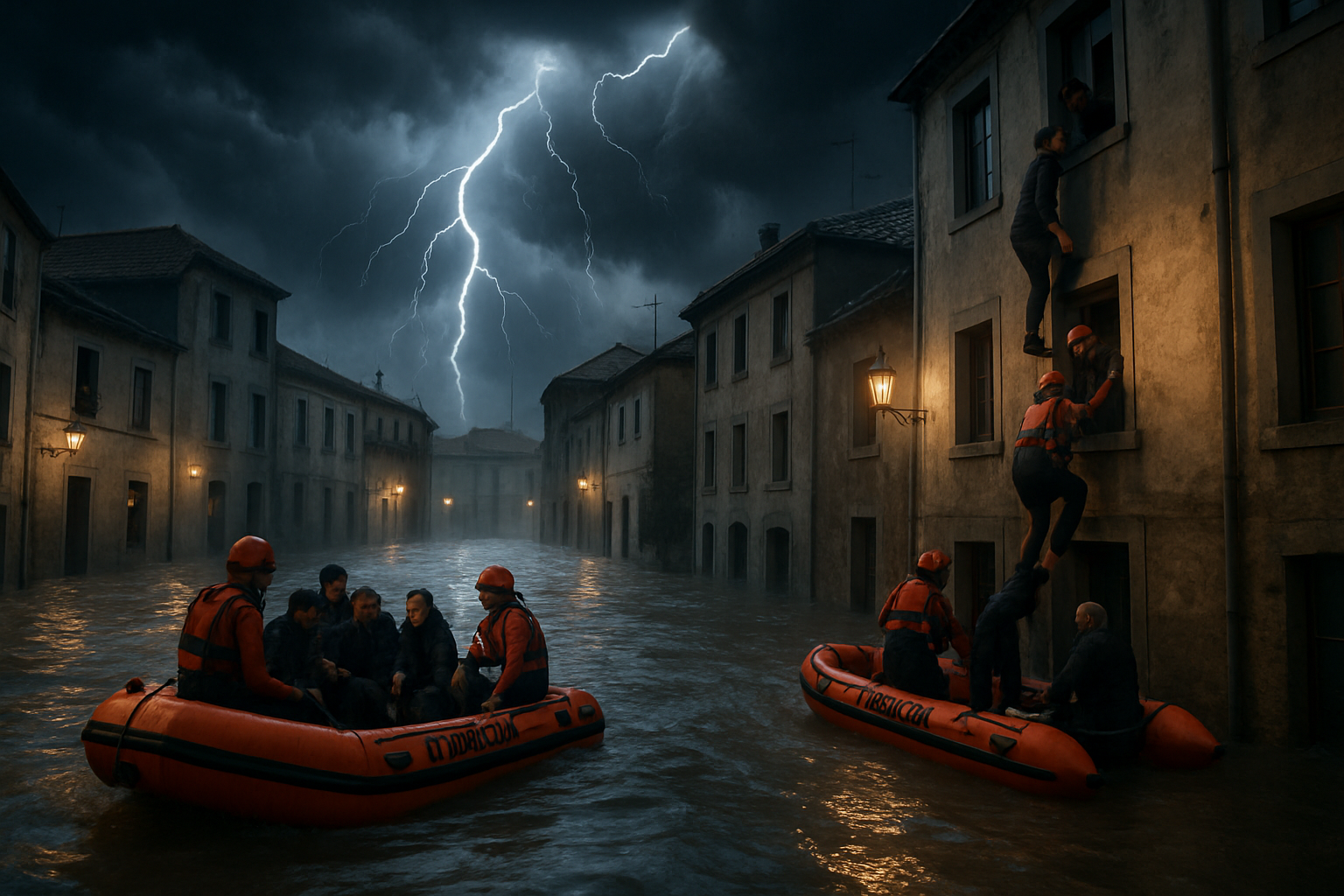
Storm Leonardo has brought catastrophic flooding to Spain and Portugal, forcing thousands of evacuations and causing at least one death, as Europe struggles with its seventh major storm system this year and faces the approaching threat of Storm Marta this weekend.
The devastating weather system has pushed the Guadalquivir River in Spain to more than 5.5 meters - over double its safety limit - while evacuating 8,000 people across Andalusia. In the locality of Grazalema, geologists are investigating whether intense rainfall is producing "hydroseisms" - earthquake-like tremors caused by water saturation affecting soil stability.
Spain Bears Brunt of Storm's Fury
Spanish authorities maintain red alerts for "extraordinary danger" across multiple Andalusian provinces including Cádiz, Málaga, and Jaén. The storm has forced the suspension of high-speed rail services between Sevilla-Córdoba and Málaga-Granada, while classes remain suspended across the region except in Almería province.
The town of Grazalema, already Spain's wettest location, recorded an extraordinary 1,500 liters per square meter of rainfall in just 36 hours - exceeding Madrid's entire annual precipitation total. This deluge has created new streams across completely saturated soils that can no longer absorb additional water.
"We are seeing extraordinarily persistent rainfall patterns that are overwhelming our infrastructure,"
— AEMET Meteorological Service
Portugal Deploys Military Forces
Portugal has mobilized its largest peacetime rescue operation, deploying 1,975 military personnel and 30 naval vessels to respond to the crisis. The Sado River overflow in Alcácer do Sal necessitated boat evacuations, resulting in one confirmed death during what has become the country's seventh major storm this year.
In Porto, Mayor Pedro Duarte issued urgent flood warnings for the Ribeira and Miragaia neighborhoods along the Douro River, with flooding expected to begin at 6 PM local time. The river level continues rising despite ongoing emergency measures.
The town of Alcoutim remains partially flooded, with municipal authorities stating that "no significant immediate changes in river flow are expected today." Meanwhile, the Minho River has overflowed its banks at Monção, with waters advancing more than 100 meters and flooding the ground floor of the historic thermal baths. At 7 AM, the Frieira dam was discharging 3,000 cubic meters of water per second.
Human Cost and Personal Tragedies
In Alcácer do Sal, resident Maria Pisco watched helplessly as 1.5 meters of water destroyed her home and belongings. "I see our life disappearing," she said as cleanup operations began in the town center. Her experience reflects the human toll across the region, where entire communities face months of recovery.
The flooding has reached levels not seen since 1963 in many Portuguese communities, with the Campo Grande tunnels in Lisbon forced to close and over 1,800 weather-related incidents reported across the country since the beginning of February.
Political and Democratic Implications
The crisis has reached Portugal's political sphere, with the severe weather impacting preparations for the presidential runoff election scheduled for February 8. Storm Leonardo has created what political observers call "the depression that depressed the presidential campaign," as infrastructure damage and safety concerns overshadow electoral activities.
President of the Republic has criticized the government's storm response, while municipal authorities struggle to maintain basic services. The weather emergency demonstrates how climate events increasingly intersect with democratic processes and governance challenges.
Infrastructure Under Extreme Stress
Transportation networks across both countries face unprecedented strain. Portuguese railway services between Castanheira do Ribatejo and Alverca remain suspended due to flooding, affecting thousands of daily commuters. Spanish authorities report 76 roads affected by snow and flooding, with 38 secondary roads completely impassable.
Spanish reservoirs have surged to 67.3% capacity - an increase of 8.1 percentage points in a single week - with 31 reservoirs now at 100% capacity. This rapid increase highlights the intensity of the rainfall and the system's struggle to manage the unprecedented water volumes.
International Response and Cooperation
The crisis has triggered international solidarity measures, with Sweden and Denmark announcing a €246 million assistance package for the affected regions. The European Union's Civil Protection Mechanism remains on standby as authorities assess the full scope of damage and ongoing needs.
Cross-border coordination between Spanish and Portuguese authorities has intensified, with shared monitoring of river systems that cross both nations and coordinated evacuation planning for border communities.
Storm Marta Approaches
Weather forecasters warn that Storm Marta will arrive on Saturday, bringing winds up to 120 km/h and waves reaching 13 meters. This eighth named storm of the year threatens to compound the current crisis before communities can fully recover from Leonardo's impact.
The approaching system has prompted authorities to maintain evacuation centers and emergency protocols, while military units remain deployed for rapid response. Meteorological services describe the weather pattern as part of an "extraordinary" Atlantic system affecting the entire Iberian Peninsula.
Climate Context and Future Implications
Storm Leonardo occurs within the broader context of January 2026 being recorded as the hottest month in global history, with 18 of the past 19 months exceeding 1.5°C above pre-industrial levels. This paradox of record heat globally while Europe experiences severe winter storms illustrates the complexity of climate change impacts.
The crisis follows the deadly Storm Kristin that killed five people in Portugal just weeks earlier, highlighting the increasing frequency and intensity of extreme weather events across the region. Climate scientists note that such rapid succession of major storms represents a significant departure from historical patterns.
Agricultural sectors face devastating losses, particularly in olive groves and citrus farms across both countries. Tourism infrastructure, crucial to both economies, has suffered extensive damage that will require months of reconstruction efforts.
Emergency Services at Capacity Limits
Emergency services across both nations report operating at capacity limits, with rescue teams working around the clock to respond to calls for assistance. The scale of simultaneous emergencies has strained resources despite extensive preparation and international support.
Warming centers have been activated across affected regions, while authorities emphasize the importance of carbon monoxide safety as residents rely on alternative heating sources during power outages. The combination of flooding, cold temperatures, and infrastructure damage creates multiple overlapping emergency scenarios.
As Storm Marta approaches this weekend, authorities are working to complete evacuations from the most vulnerable areas while coordinating recovery efforts in communities already devastated by Storm Leonardo. The crisis represents one of the most severe weather emergencies in recent European history, testing the continent's capacity to respond to increasingly frequent and intense climate disasters.