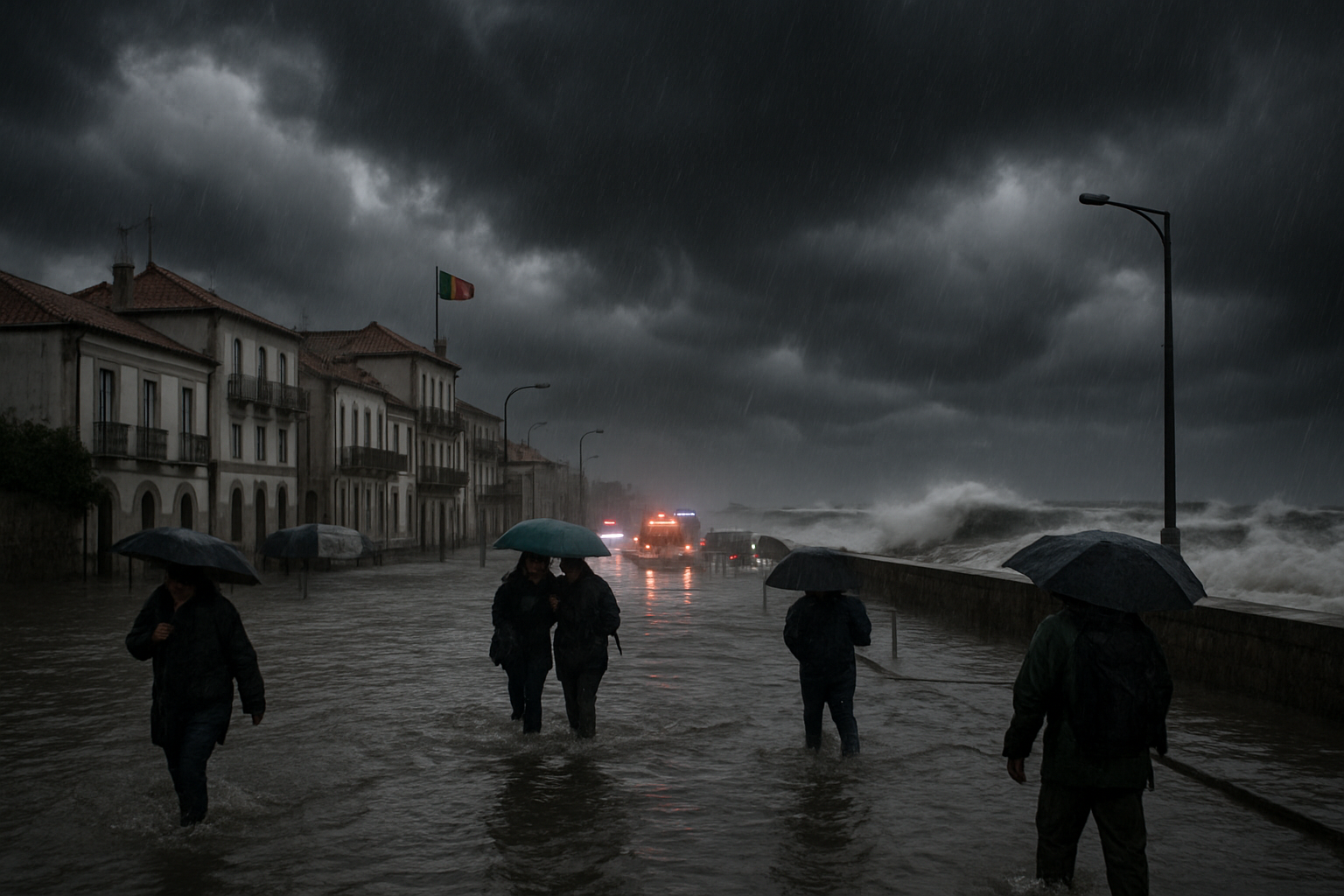
Storm Marta arrived at Portugal's coast Saturday morning as the third devastating Atlantic storm in just two weeks, bringing winds of 120 km/h and triggering orange weather alerts across 13 Portuguese districts while Spanish authorities maintained high alert status for over 11,000 people already evacuated from previous storms.
The Portuguese Institute for Sea and Atmosphere (IPMA) issued orange alerts—the second most severe level—for maritime agitation, precipitation, strong winds, and snow across most of continental Portugal. The storm system struck at 06:00 local time and was expected to affect the country until 15:00, particularly impacting the regions of Leiria, Lisbon, Setúbal, and the Algarve.
Immediate Impact and Emergency Response
In Beja, southern Portugal, authorities evacuated 34 people from two buildings deemed unsafe due to structural damage from recent weather events. The municipal government quickly arranged alternative accommodation for all displaced residents, demonstrating the strain on local emergency services already stretched thin from weeks of extreme weather.
Portuguese Civil Protection services reported they were responding to what authorities described as a "concerning meteorological situation" throughout the weekend. The storm's arrival compounded an already critical situation, with the country still recovering from the devastating impacts of Storms Kristin and Leonardo that have claimed multiple lives and caused widespread infrastructure damage since late January.
"We are facing the third major storm in two weeks, and our emergency services are operating at capacity limits,"
— Portuguese Civil Protection Official
Cross-Border Impact in Spain
Across the border in Spain, the situation remained equally dire. Spanish authorities continued managing the evacuation of over 11,000 people from Andalusia, primarily from areas still reeling from the unprecedented rainfall brought by Storm Leonardo. The town of Grazalema, which recorded 1,500 liters per square meter of rainfall—exceeding Madrid's entire annual precipitation total—remained under close monitoring.
The Spanish Meteorological Service (AEMET) maintained alert levels across southern regions, with particular concern for areas where soils remain completely saturated from previous storms. In the Andalusian province of Cádiz, 169 roads remained closed due to flooding or structural damage, severely hampering recovery efforts and emergency access.
Historical Context of Extreme Weather
Storm Marta represents the culmination of an unprecedented period of extreme weather across the Iberian Peninsula. The current crisis began with Storm Kristin in late January, which killed five people in Portugal, followed by the devastating Storm Leonardo that forced the evacuation of over 8,000 people across Spain and Portugal.
The Portuguese government has deployed 1,975 military personnel and 30 naval vessels in what officials describe as the largest peacetime rescue operation in the country's recent history. Since February 1, authorities have recorded over 1,800 weather-related incidents, highlighting the extraordinary scope of the crisis.
Infrastructure Under Siege
The repeated storms have exposed critical vulnerabilities in Iberian infrastructure. In Portugal, the railway line between Castanheira do Ribatejo and Alverca remains suspended, affecting thousands of Lisbon commuters. The Douro River in Porto has reached critical levels reminiscent of the catastrophic flooding of 1997, while the Minho River has overflowed by more than 100 meters at Monção, flooding the historic thermal baths.
Power outages have affected 69,000 people across Portugal, with some localities in Pombal remaining without electricity for over 10 days. The persistent blackouts prompted 50 people to demonstrate Friday night, underscoring growing public frustration with the emergency response.
Agricultural and Economic Devastation
The agricultural sector across both countries faces unprecedented losses. Spanish reservoirs have surged to 67.3% capacity—an increase of 8.1 percentage points in just one week—while 31 reservoirs have reached 100% capacity. While this addresses previous drought concerns, the sudden influx has overwhelmed drainage systems and contributed to widespread flooding.
Portuguese authorities estimate that recovery will extend well beyond the immediate weather emergency, with some agricultural regions facing months of rehabilitation. The tourism industry, crucial to both economies, has also suffered massive cancellations and infrastructure damage.
Climate Context and Future Implications
The current crisis unfolds against the backdrop of January 2026 being recorded as the hottest month in global history, with 18 of the past 19 months exceeding 1.5°C above pre-industrial levels. This paradox of extreme heat records coinciding with devastating storms exemplifies the increasing volatility of climate systems.
Climate scientists note that the frequency and intensity of Atlantic storm systems affecting the Iberian Peninsula have increased significantly. The rapid succession of three major storms in two weeks is unprecedented in recent meteorological records, suggesting that current infrastructure and emergency response systems may need fundamental reevaluation.
International Support and Cooperation
The European Union has activated its Civil Protection Mechanism to coordinate international assistance. Sweden and Denmark have announced a €246 million emergency assistance package, while other EU member states have offered technical expertise and emergency equipment.
The crisis has also highlighted the importance of cross-border cooperation, with Spanish and Portuguese authorities maintaining constant communication about river flows, dam discharges, and evacuation coordination. This collaboration has proven crucial in managing transboundary water systems and preventing additional casualties.
Looking Ahead: Recovery and Resilience
As Storm Marta moves through the region, attention is already turning to the massive recovery effort required. The Portuguese government has extended its official calamity status through February 15, acknowledging that the emergency phase may continue for weeks.
Emergency services officials emphasize that the immediate priority remains protecting lives and maintaining essential services. However, the scale of infrastructure damage—from lifted roads in Arruda dos Vinhos to flooded historic sites—suggests that full recovery may take months or even years.
The crisis has also forced a reevaluation of climate adaptation strategies across Southern Europe. The rapid succession of extreme weather events has demonstrated that existing infrastructure and emergency protocols may be inadequate for the new climate reality facing the continent.
"This is not just about responding to individual storms anymore—we're dealing with a new pattern of extreme weather that requires fundamental changes to how we prepare and respond,"
— European Climate Adaptation Expert
As authorities continue to monitor conditions throughout the weekend, the focus remains on immediate safety while acknowledging that Storm Marta may represent a defining moment in European climate adaptation policy. The extraordinary mobilization of resources and international cooperation witnessed during this crisis may become the new standard for addressing increasingly frequent extreme weather events across the continent.