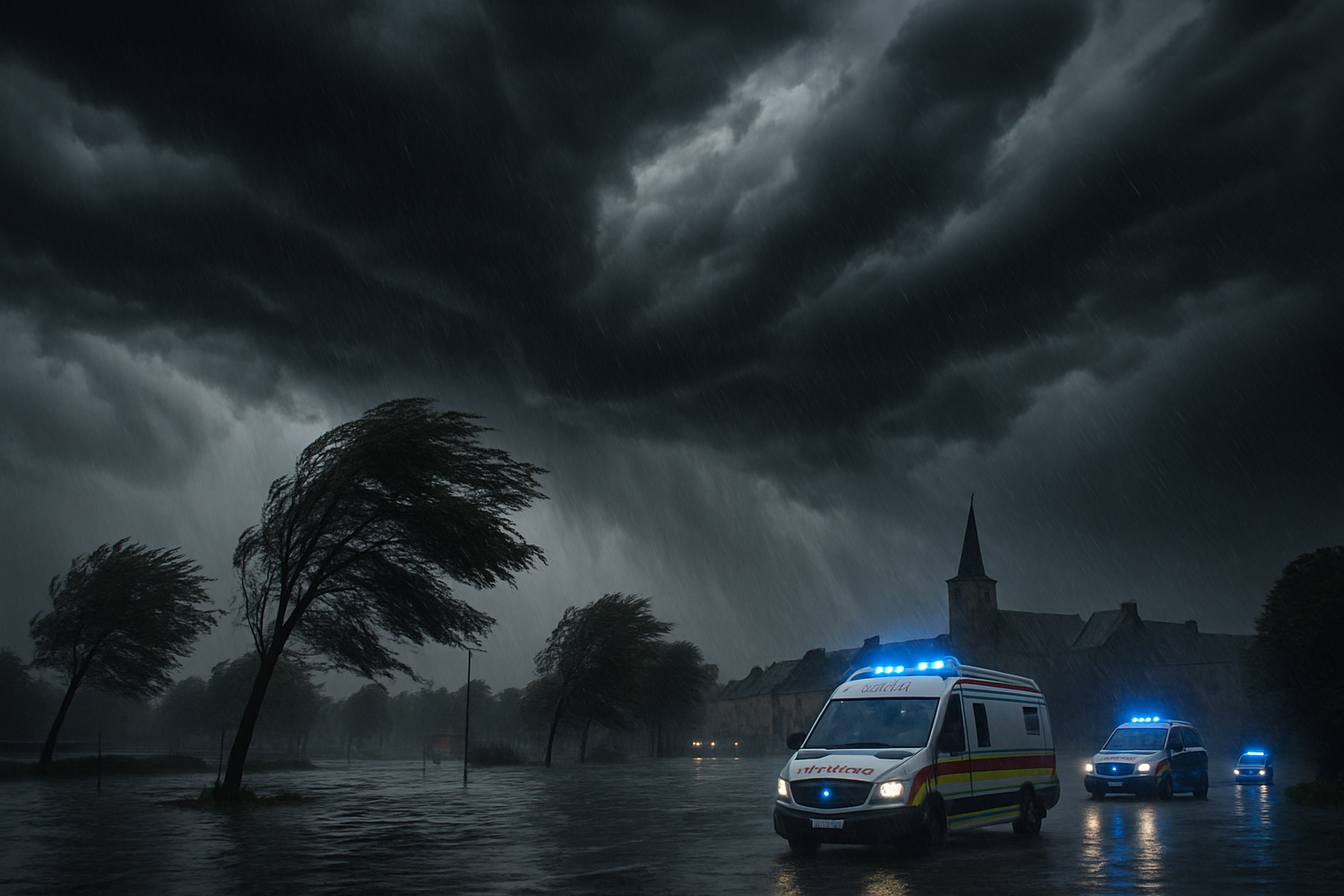
Storm Nils unleashed its fury across southern France on Thursday, leaving at least one person dead in the Landes region and plunging 850,000 homes into darkness, as Europe continues to battle an unprecedented succession of extreme weather emergencies that have overwhelmed emergency services from Portugal to Sweden.
The storm, which began sweeping across the continent Wednesday night, prompted Météo-France to issue red alerts for floods in Gironde and Lot-et-Garonne departments, violent winds in Aude, and avalanche risks in Savoie. Wind gusts exceeding 100 km/h have already been recorded across western France, marking the latest in a devastating sequence of Atlantic storms that have claimed dozens of lives across Europe this winter.
Death Toll Mounts as Storm Nils Intensifies
The fatality in the Landes department represents the first confirmed death from Storm Nils, adding to a winter death toll that has reached tragic proportions across the continent. French emergency services report receiving over 1,600 calls, primarily for fallen trees, branches, and debris threatening public safety.
The massive power outages affecting 850,000 French households have left entire communities without electricity, heating, or communication services. Energy companies are working around the clock to restore power, but officials warn that full restoration may take days given the extent of damage to transmission networks.
Transportation networks across the affected regions have ground to a halt, with rail services suspended and major highways closed due to dangerous conditions. Catalonia, across the border in Spain, has suspended all educational, university, healthcare, and sporting activities as violent winds continue to batter the region.
Continental Weather Emergency Escalates
Storm Nils represents the latest chapter in Europe's most severe weather crisis in living memory, with multiple countries simultaneously battling life-threatening conditions. Sweden's meteorological service SMHI has extended snow warnings across southern regions, with particular concern for Öland island where snow combined with strong winds threatens to create blizzard conditions.
Latvia faces what meteorologists predict could be the strongest blizzard of the winter, with heavy snowfall and dangerous winds forecast for Friday and into Saturday. The Baltic nation's weather services have issued urgent warnings for residents to prepare for potentially life-threatening conditions.
"The situation is evolving rapidly across multiple fronts. We are seeing an unprecedented convergence of extreme weather systems that is testing our emergency response capabilities to their absolute limits."
— Emergency Services Spokesperson, France
Italy has elevated its weather alert system, with orange alerts declared for Calabria and Sicily, and yellow warnings spanning eight additional regions including Abruzzo, Basilicata, Campania, Lazio, Molise, Puglia, Sardegna, and Tuscany. The alerts reflect the critical nature of conditions across the Italian Peninsula.
Greece Battles Severe Flooding
Greece has experienced its own weather emergency, with intense rainfall Wednesday night into Thursday causing significant flooding across Attica and other regions. In Pikermi, a stream overflowed its banks, while ground subsidence was reported in the Polygono area, highlighting the destructive power of the saturated ground conditions.
The Greek meteorological service reports that the heavy precipitation has overwhelmed drainage systems in multiple urban areas, forcing emergency services to conduct rescue operations and evacuations in the worst-affected districts.
Portugal Infrastructure Crisis Deepens
Portugal continues to grapple with the aftermath of infrastructure collapse following the breach of a Mondego River dike in Coimbra. The viaduct collapse on the A1 highway has completely severed one of the country's most vital transportation arteries, with officials warning that restoring traffic flow will take "weeks" of intensive reconstruction work.
The ongoing crisis represents the culmination of three devastating Atlantic storms - Kristin, Leonardo, and Marta - that have battered the Iberian Peninsula since early February. Portuguese authorities maintain their largest peacetime rescue operation, with over 26,500 personnel deployed including military units and naval vessels.
Transport Networks in Crisis
Spain's Catalonia region has experienced complete transportation paralysis, with the violent wind storm forcing suspension of crucial Rodalies train services. The R4 line between Terrassa and Manresa, and the R1 between Blanes and Maçanet have been indefinitely suspended due to fallen trees and debris blocking tracks.
Additional services including the R11 and RG1 lines have been interrupted by large objects falling onto railway infrastructure, creating a cascade of transport disruptions affecting hundreds of thousands of daily commuters. Emergency services have received over 1,600 calls related to fallen trees and wind damage across the region.
The crisis has prompted Spanish authorities to implement unprecedented safety measures, including the closure of schools and universities across most of Catalonia, with only select regions maintaining limited services.
Historical Context and Climate Implications
The current weather emergency occurs against the backdrop of January 2026 being confirmed as the hottest month in recorded global history - the 18th consecutive month of the past 19 to exceed 1.5°C above pre-industrial levels. This paradoxical situation, where record global warmth coincides with extreme regional weather events, demonstrates the complex nature of climate change impacts.
European emergency services, having deployed massive resources throughout the winter crisis, are now operating at absolute capacity limits. The succession of major storms has strained international cooperation mechanisms, with countries like Sweden and Denmark providing €246 million in emergency assistance to affected nations.
The EU Civil Protection Mechanism has been activated multiple times this winter, representing an unprecedented level of continental emergency coordination in response to weather-related disasters.
Economic and Social Impact
The cumulative economic impact of Europe's winter weather crisis is estimated to reach billions of euros, with agricultural sectors, tourism industries, and critical infrastructure bearing the brunt of repeated storm damage. Insurance companies report record-breaking claim volumes, while businesses across affected regions face extended closures and supply chain disruptions.
The social impact extends beyond immediate safety concerns, with vulnerable populations - particularly elderly residents and those in rural areas - facing prolonged isolation and increased health risks. Mental health services report increased demand as communities struggle to cope with the relentless succession of emergency conditions.
Emergency Response and Recovery
Recovery efforts across Europe face the unprecedented challenge of rebuilding infrastructure while simultaneously preparing for additional weather emergencies. The traditional approach of waiting for storms to pass before beginning restoration work has proven inadequate given the frequency and intensity of recent weather events.
Emergency management agencies are implementing new protocols that prioritize "building back better" - reconstructing damaged infrastructure with enhanced climate resilience to withstand future extreme weather events. This approach recognizes that the current crisis represents a new normal rather than an exceptional situation.
International cooperation has become essential, with countries sharing specialized equipment, personnel, and expertise across borders. The European Emergency Response Coordination Centre has established 24-hour monitoring of weather conditions and emergency resource deployment to enable rapid response to developing crises.
As Storm Nils continues its destructive path across Europe, meteorologists warn that additional Atlantic weather systems are developing, suggesting that the continent's weather emergency may persist for weeks to come. The unprecedented nature of the crisis has fundamentally challenged existing emergency response frameworks and highlighted the urgent need for enhanced climate adaptation strategies across all sectors of European society.